Japan National Symbols: Animal, Flower, Bird and Tree

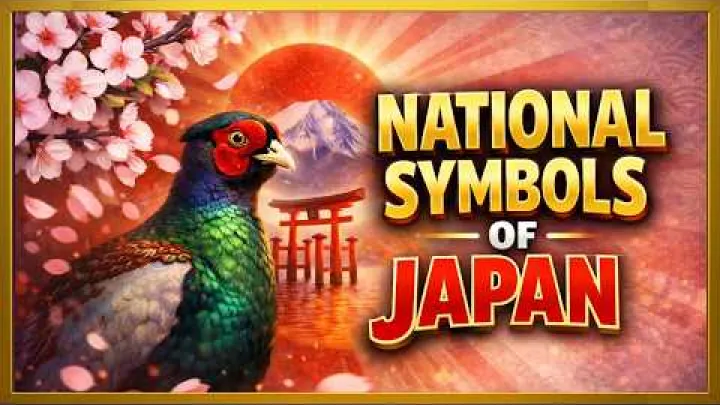
Japan's national symbols are more varied than a single official list. If you are looking for Japan's national animal, flower, bird, or tree, the most important question is whether each item is legally designated, linked to an institution, or widely recognized through culture. This guide separates those categories and explains what the chrysanthemum and paulownia crests represent. It also covers cherry blossoms, the green pheasant, Mount Fuji, sumo, and the uncertain claims surrounding Japan's national tree and fruit.
How National Symbols Are Recognized in Japan
Japan's symbolic system has several layers. Some symbols have a clear legal basis, while others became important through imperial tradition, government use, expert organizations, folklore, art, seasonal customs, or long public recognition. Understanding that difference makes the common answers more accurate.
Official, Institutional, and Cultural Status
The national flag and national anthem are the clearest examples of formally recognized national symbols. The Government of Japan identifies the national flag and anthem and explains that their status was formalized in 1999 through the national flag and anthem law. This article does not repeat their detailed history. Instead, that example provides a useful legal reference point for understanding other symbols.
For the remaining symbols, three categories are helpful:
- Legally designated symbols have a clear basis in a law or another formal state decision. The presence of a symbol in a popular guide does not, by itself, place it in this category.
- Imperial or institutional emblems are connected with the Imperial Family, the government, or another public institution. Their authority comes from that institutional role, not necessarily from a law declaring them a national symbol.
- Widely recognized cultural symbols express Japanese identity through tradition, art, public custom, folklore, or international recognition. They can be deeply meaningful without being statutory symbols.
This distinction is especially important for the phrases national flower, national tree, and national bird. In English-language reference material, national can mean representative or widely associated with a country. It does not always mean that the government has enacted a formal designation. Each symbol below is therefore identified by its status instead of being placed into one assumed legal register.
Why Popular Recognition Does Not Equal Legal Designation
A national symbol can emerge in many ways. An imperial emblem may represent continuity over centuries. A government crest may appear in public-authority contexts. An expert society may promote a species as representative. A flower may become nationally meaningful because millions of people observe it during the same season. Paintings, poetry, folklore, school materials, tourism, and international media can all strengthen a symbol's visibility.
That process explains why a list may call cherry blossoms Japan's national flower or the green pheasant Japan's national bird even when the wording does not identify a statute. It also explains why different lists may disagree about a national tree or fruit. A list can be useful as a guide to cultural associations, but it should not be treated as proof of legal status.
The comparison below uses short labels so that the difference is clear at a glance. The flag and anthem appear only as a benchmark for formal recognition.
| Symbol | Common label | Status | Basis of recognition |
|---|---|---|---|
| National flag and anthem | Formal national symbols | Legally formalized | National flag and anthem law |
| Chrysanthemum crest | Imperial crest | Imperial emblem | Association with the Imperial Family |
| Paulownia crest | Government crest | Institutional emblem | Use connected with government authority |
| Cherry blossoms | National flower | Widely recognized cultural symbol | Seasonal custom, art, and public meaning |
| Green pheasant | National bird | Commonly recognized designation | Cultural and institutional recognition |
| Mount Fuji | National mountain | De facto geographic symbol | Landscape, art, and national identity |
| Sumo | National sport | Widely recognized cultural description | Historical and ceremonial tradition |
Emblems and the Coat-of-Arms Question
People searching for Japan's coat of arms often encounter two crests: the chrysanthemum crest and the paulownia crest. They do not have the same role. One is primarily an imperial emblem, while the other is commonly associated with government authority.

The Chrysanthemum Crest as an Imperial Emblem
The chrysanthemum crest is the emblem most closely associated with the Imperial Family. It is also called the chrysanthemum seal or kikumon. In Japan's symbolic system, it represents the institution of the emperor and the continuity of the Imperial Household. Background on this emblem is summarized in the Imperial crest of Japan reference.
In international descriptions, the chrysanthemum crest is sometimes compared with a coat of arms. That comparison can help readers understand its visual importance, but it should not be confused with a formal designation of a Japanese state coat of arms. The safer and more precise terms are imperial crest and imperial emblem.
The crest's importance comes from its institutional connection. When it appears in imperial insignia or ceremonial material, it signals imperial authority, continuity, and the special status of the Imperial Family. That role is different from the broader cultural role of the chrysanthemum flower. A flower can be familiar in gardens, festivals, and seasonal customs, while the crest is a specific emblem tied to the Imperial Household.
For this reason, the chrysanthemum crest should not be described simply as Japan's official coat of arms. It is an important national emblem in a broad cultural and institutional sense, but its imperial role is more exact than the general label coat of arms.
The Paulownia Crest as a Government Emblem
The five-seven paulownia crest, known in Japanese as go-shichi no kiri, is commonly described in English as the government crest. Its design is associated with paulownia leaves and flowers, and its public meaning comes from its connection with government authority rather than the Imperial Family.
This contrast is useful. The chrysanthemum crest points primarily to the Imperial Household. The paulownia crest is commonly linked with the Japanese government and executive authority. In that sense, both are important emblems, but they answer different questions about who or what they represent.
The phrase government crest should still be used carefully. It describes an institutional role and should not automatically be expanded into Japan's generic national coat of arms. Nor does it mean that every public institution uses the same crest in every context. Present-day use can depend on the office, document, or official setting. For a general explanation, government emblem or government-associated crest is safer than claiming a single universally used state arms.
Floral and Plant Symbols of Japan
Japan's plant symbols show the clearest difference between cultural importance and legal designation. Sakura has the strongest popular association with the national flower question, while the chrysanthemum has the stronger imperial association. Claims about a national tree or fruit require more caution.
Cherry Blossoms as a Widely Recognized National Flower
Cherry blossoms, or sakura, are the answer most people expect when they ask for Japan's national flower. The careful wording is that sakura is Japan's most widely recognized cultural flower symbol, not necessarily a statutory national flower. The National Park Service describes the flowering cherry tree as an important plant in Japan and the beauty of its blossom as a symbol with rich meaning.

Sakura is strongly connected with hanami, the practice of viewing flowers during the spring blooming season. This custom turns the blossom into a shared seasonal reference. People often associate cherry blossoms with the arrival of spring, renewal, the passing of time, and the impermanence of beauty because the display is powerful but brief.
These meanings help explain why sakura functions as a national flower in everyday conversation. It appears in art, public events, education, design, and travel imagery, and it is recognizable to people both inside and outside Japan. Cultural reach, however, is not the same as a legal designation. Cherry blossoms can be Japan's representative flower in a cultural sense without being established by a national flower law.
It is also important to separate the flower from the tree. A cherry blossom is the flower of a cherry tree, but calling sakura Japan's national flower does not automatically prove that the cherry tree is the country's official national tree. Those are separate claims and should be evaluated separately.
The Chrysanthemum as an Imperial Floral Symbol
The chrysanthemum is Japan's other major floral symbol. Its most formal association comes from the chrysanthemum crest, which connects the flower with the Imperial Family, imperial authority, and continuity. This gives the chrysanthemum an institutional meaning that sakura generally does not have.
In broader cultural use, chrysanthemums may also be associated with autumn, longevity, refinement, and endurance. These meanings can vary according to the setting, the color of the flower, and the type of event. They should be understood as cultural associations rather than as the legal definition of a national flower.
The contrast between the two flowers is more useful than trying to force a single winner. Sakura is closely tied to popular seasonal identity and the shared experience of spring. The chrysanthemum carries a strong imperial and institutional association, while also having a broader place in Japanese flower culture. Neither description, by itself, establishes one legally designated national flower.
National Tree and Fruit Claims
Questions about Japan's national tree and national fruit often produce less certain answers than questions about sakura. Broad reference lists commonly present the cherry tree as Japan's national tree, but that label should be described as a commonly repeated or de facto designation unless a formal decision can be identified.
The distinction matters because the cherry tree is already strongly visible through its blossoms. Its cultural importance is clear, but cultural importance alone does not establish a statutory national-tree status. A safe answer is that cherry blossom is the widely recognized national flower, while Japan has no clearly verified statutory national tree in the evidence used for this overview.
Japanese cedar, called sugi, is another tree strongly associated with Japan. It is a native tree commonly identified with the Japanese landscape, but being prominent or native does not automatically make it a national tree. The same caution applies to the Japanese persimmon, or kaki. It may appear in informal lists of national fruits, yet this article does not assign it an official national-fruit status because a clear, current designation is not established here.
The following summary shows how to describe these claims without turning an informal list into a legal statement:
| Plant | Label encountered | Safe status |
|---|---|---|
| Cherry tree and blossoms | National tree or national flower | Widely recognized cultural symbols; statutory status should not be assumed |
| Japanese cedar or sugi | Important Japanese tree | Prominent cultural and natural association, not a verified national designation |
| Japanese persimmon or kaki | National fruit | Informal claim with no clearly verified official status here |
For a short quiz-style answer, cherry blossom is the safest response to Japan's national flower question. For the national tree and fruit questions, the more accurate response is that commonly repeated labels exist, but a clearly verified statutory designation should not be stated without a named formal source.
Animal and Bird Symbols
Animal and bird lists can make Japan's national symbols seem more official than they are. The distinction is especially important because a country may have a widely recognized national bird without having a formally designated national animal.
Does Japan Have an Official National Animal?
Japan does not have a clearly verified, formally designated national animal. That is the most accurate direct answer to the question, even though many animals are strongly associated with Japan.
Wildlife can become nationally recognizable through native habitats, folklore, media, tourism, conservation, or education. None of those forms of recognition automatically creates an official national-animal designation. A popular image or an animal included on a reference website should therefore not be substituted for a formal symbol.
This also explains why the national animal question should be kept separate from the national bird question. A bird may have a commonly cited representative status through cultural or institutional recognition, while the broader category of national animal remains without a clearly verified official designation. The same principle applies to other animal symbols, such as a fish or butterfly: a separate designation does not fill the national-animal category.
If a source gives a definite animal as Japan's national animal, look for the basis of the claim. The useful questions are whether it names a law, identifies a responsible institution, or simply describes public association. Without that information, the claim is best treated as informal.
The Green Pheasant as Japan's Widely Recognized National Bird
The green pheasant, or kiji, is the bird most commonly associated with Japan's national-bird role. Its scientific name is Phasianus versicolor. The Green pheasant reference supports discussion of the bird itself, while its national status should be described as widely recognized or institutionally associated rather than automatically official.
Some reference accounts say that the national-bird label was selected or promoted by the Ornithological Society of Japan. Unless the organization's decision and date are supported by a current institutional record, that account should remain a commonly cited attribution, not evidence of a statutory designation. The distinction is simple: an organization may identify a representative bird, but that action is not the same as a national law.
The green pheasant has cultural resonance because it is associated with native Japanese wildlife and appears in Japanese folklore. It is also connected with the Momotaro story, in which a pheasant is one of the companions who joins the hero. Such folklore helps explain why the bird has a place in national symbolism, but cultural presence does not change its legal status.
For readers who need a concise answer, green pheasant is the safest response to Japan's commonly recognized national bird question. The more precise wording is widely recognized national bird or commonly cited national bird. It should not be called Japan's official national animal, and its representative status should not be confused with a statute unless a formal legal source is provided.
Geographic and Cultural Symbols Widely Associated with Japan
Beyond animals, plants, and crests, several symbols represent Japan through landscape and tradition. Mount Fuji and sumo are two of the most recognizable examples, but both are best described as cultural symbols rather than automatically legal designations.
Mount Fuji as a De Facto National Mountain
Mount Fuji functions as Japan's most recognizable geographic symbol and is commonly described as a de facto national mountain. Its distinctive shape is strongly connected with the visual identity of Japan, even though there is no need to treat the phrase national mountain as a statutory title.
The mountain's meaning comes from more than its appearance. It has been represented in Japanese art, associated with sacred and cultural traditions, and used as a powerful image of the Japanese landscape. Its recognition extends well beyond Japan, so it often serves as a visual shorthand for the country in books, design, education, and international media.
De facto means that a symbol is recognized in practice rather than created by a specific national designation. That wording preserves Mount Fuji's importance without suggesting that the government has issued a formal national-mountain law. It also keeps this section focused on symbolism rather than tourism, climbing, or access information.
Sumo as a Widely Recognized National Sport
Sumo is often described as Japan's national sport because of its long historical continuity, formal presentation, ritual setting, and strong cultural visibility. Its ceremonies, rules, and highly structured matches give it a distinctive place in Japanese public culture.
For many observers, the symbolic meaning of sumo comes from the way sport and ceremony are presented together. Customs around the ring, the formal roles of participants, and the repeated calendar of major tournaments make sumo appear connected with older Japanese traditions. These features explain the common label without requiring a claim that sumo is the only important sport in Japan.
National sport is therefore a cultural description in this context, not a verified statutory designation. Baseball, football, martial arts, and other sports are also important in Japanese society. Sumo's special symbolic role reflects history and visibility, while its status should remain separate from the legal status of the national flag and anthem.
Conclusion
Japan's national symbols form a layered system rather than one complete list with identical legal status. The chrysanthemum crest is an imperial emblem, and the paulownia crest is commonly associated with government authority. Sakura is Japan's most widely recognized cultural flower, while the green pheasant is the commonly recognized national bird. Japan has no clearly verified formal national animal in this overview, and claims about a national tree or fruit should be labeled as commonly repeated or left unconfirmed. Mount Fuji and sumo complete the picture as powerful de facto cultural symbols, showing how national identity can be expressed through landscape and tradition as well as through law.
Select area
Create a post
Posting is free and no registration is required.