China Country Facts: Quick Profile, Geography & Culture
China country facts are easiest to understand when basic identifiers are separated from the country's much broader geographic, demographic, political, and cultural story. China is an East Asian country with a population of about 1.41 billion, a large territory, and a government formally described as a socialist state. This profile explains the difference between Beijing, Shanghai, and Chongqing, then examines China's landscapes, rivers, people, economy, institutions, languages, history, and heritage.
Quick Facts About China
The table below gives a compact China country profile. Numerical observations are dated, while codes and other identifiers are shown as current standard forms.
| Fact | Answer | Reference year or basis |
|---|---|---|
| Official name | People's Republic of China | Constitutional name |
| Common name | China | Common English usage |
| Capital | Beijing | Current national capital |
| Largest urban area | Shanghai | Urban-area comparison; definition and year matter |
| Largest city proper | Chongqing | Administrative city or municipality comparison; definition and year matter |
| Region | Eastern Asia, in Asia | Statistical and continental classification |
| Population | About 1.41 billion | 2023 World Bank series; rounded |
| Area | About 9.6 million square kilometres | 2015 surface-area reference; total area, with definitions varying |
| Currency | Renminbi; yuan is the principal unit | Current monetary system |
| National common language | Putonghua, usually rendered as Standard Chinese | National language-policy terminology |
| International calling code | +86 | International telephone identifier |
| ISO alpha-2 code | CN | ISO country identifier |
| ISO alpha-3 code | CHN | ISO country identifier |
| Country-code top-level domain | .cn | Internet country identifier |
| Time zone | China Standard Time, UTC+8 | One official national standard; no daylight-saving change |
| Form of government | Socialist state led by the Communist Party of China | Constitutional description; unitary administrative structure |
Name, Capital, Largest City, and Region
The official name is the People's Republic of China, while “China” is the normal short name in English. Beijing is the capital and the seat of central state institutions. It is not automatically the country's largest city under every population measure.

Shanghai is commonly identified as China's largest urban area because the comparison focuses on its continuously built-up metropolitan environment. Chongqing is commonly identified as the largest city proper or municipality by administrative population. Chongqing's municipality covers an exceptionally large area and includes extensive rural territory, so its administrative population should not be compared directly with the population of Shanghai's built-up urban area.
For any city ranking, the useful question is whether the source counts a city proper, an administrative municipality, an urban area, or a metropolitan area. China is classified geographically as part of Eastern Asia and, more broadly, the continent of Asia.
Population, Area, Currency, Language, and Government
China's population is about 1.41 billion in the 2023 World Bank series, rounded for a quick profile. The area figure is approximately 9.6 million square kilometres when expressed as a total-area reference. Total area can include inland water, while land-area measurements exclude it, and national statistical profiles do not always use identical methods. Population figures can also differ because a source may use a census count, a mid-year estimate, a projection, or a different geographic coverage.
The currency is the renminbi, often abbreviated RMB. The yuan is its principal unit, so expressions such as “one yuan” and “renminbi” refer to related but slightly different concepts: one names the currency system, while the other names the unit used in everyday prices. Putonghua, or Standard Chinese, is the national common language designation. China also has many regional Sinitic varieties and minority languages, so the national standard does not describe every language spoken in the country.
In formal constitutional terms, China is a socialist state led by the Communist Party of China. Comparative political descriptions may use different terminology, but those labels should not be confused with the wording of China's Constitution. The World Bank Open Data country page is useful for checking the year attached to population and economic indicators rather than treating every displayed number as a current 2026 value.
Communication Codes and Time Zone
China's international calling code is +86. A caller normally adds the relevant local area code and subscriber number after the country code; +86 is not itself a city or regional area code. The ISO alpha-2 code is CN, the ISO alpha-3 code is CHN, and the country-code top-level domain is .cn.
China Standard Time is UTC+8. Mainland China uses one official time standard across the country and does not use a seasonal daylight-saving change. This creates a large difference between official clock time and local solar time in the far west, but national transport, government, education, and business schedules generally use the official standard. These identifiers are operational details, so a person placing a call, configuring software, or registering a domain should use the current rules of the relevant service or registry.
China's Geography, Territory, and Physical Features
China's geography combines a long Pacific-facing coast with a vast continental interior. The country contains lowlands, river plains, basins, plateaus, mountain systems, and desert regions, creating major differences in climate, settlement, agriculture, and transport.

Location, Area, Borders, and Landscapes
China occupies a large part of eastern Eurasia and lies in Eastern Asia. Its eastern and southeastern sides face the western Pacific and adjoining seas, while its northern, western, and southwestern sides connect with the interior of the Asian continent. The country has numerous land borders, but its physical geography is more varied than a simple map description suggests.
A standard country-profile measure places China's total surface area at about 9.6 million square kilometres, with the 2015 reference commonly used in international statistical tables. That is a total-area figure rather than a pure land-area figure. The distinction matters when comparing China with other large countries because some measurements include inland water and some do not. The UNdata China Country Profile provides a useful statistical baseline, but its observations are dated and should be read with the year and definition shown beside each measure.
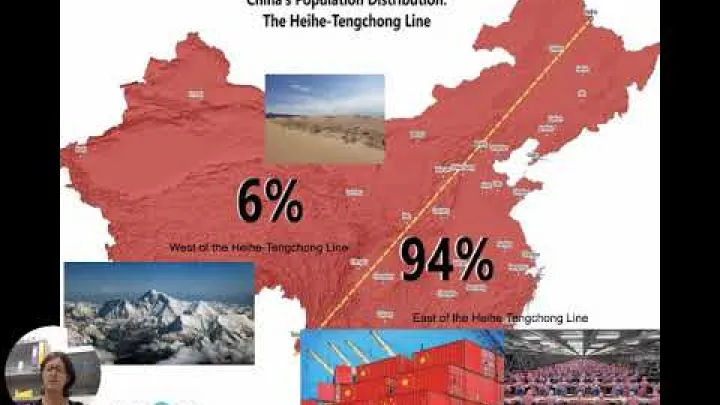
The eastern side contains broad lowlands, coastal plains, and heavily settled river basins. Farther west are high plateaus and major mountain systems, including the Tibetan Plateau and the Himalayas. Northern and western areas include arid and semi-arid landscapes such as the Gobi and Taklamakan regions, while central China includes basins, uplands, and mountain corridors. A broad climatic pattern runs from wetter monsoon-influenced areas in the east and south toward colder, drier, and more continental environments in the north and west.
These contrasts influence where people live and how communities use land. Dense farming and urban networks are associated especially with plains, river valleys, and coastal or delta regions, while high-altitude, arid, and mountainous areas generally present greater challenges for transport, agriculture, and settlement. The result is a country in which physical geography remains closely connected to economic opportunity, environmental pressures, and regional identity.
Area rankings should therefore be treated cautiously. A source may measure total area, land area, or a particular national boundary dataset, and the order of countries can change when measurement methods differ. The Central Intelligence Agency country reference offers broad geographic context, but changing statistics and administrative details are best read alongside newer official or international datasets.
Major Rivers and Well-Known Heritage Sites
The Yangtze River is China's longest river and one of the major rivers of the world. It flows generally eastward from the highlands through central China to the East China Sea. The Yellow River is another foundational river system, especially in the history of northern China, while the Pearl River system supports important cities and economic areas in the south.

River basins have influenced China's physical and human geography for centuries. They provide water for agriculture, support inland transport and industry, connect cities, and shape flood-management challenges. The relationship between rivers and settlement helps explain why major population centers developed around plains, deltas, ports, and navigable corridors.
The Great Wall of China is best understood as a series of walls, passes, watchtowers, and other defensive works built or expanded during different periods. It is not one uniform structure created at one time. The Forbidden City in Beijing is a former imperial palace complex and a major example of China's architectural and political heritage. Both landmarks are useful entry points into the country's history, but they represent only a small part of China's geographic and cultural variety.
Population Distribution and Urbanization
China's population and economic activity are concentrated much more heavily in the east and southeast than in the high plateaus, deserts, and mountain areas of the west. Coastal plains, fertile river basins, historical settlement, ports, transport networks, and later industrial investment all contributed to this uneven pattern.
Beijing is the national capital and a major political, educational, and cultural center. Shanghai is a major coastal metropolis and is often used as the reference point for the country's largest urban area. Chongqing lies in the upper Yangtze region and is a large centrally administered municipality with a much broader administrative territory than the continuously built-up core suggested by the word “city.” These examples show why urbanization statistics need a defined geographic unit.
Urbanization has been shaped by rural-to-urban migration, expanding manufacturing and service economies, infrastructure construction, and the growth of metropolitan regions. For a meaningful city comparison, use figures from the same year and specify whether they count permanent residents in a municipality, residents in urban districts, or people living in a built-up area. Local statistical releases can use different boundaries, so a city ranking should be read as a measurement choice rather than an absolute fact.
Population, Society, and Demographic Change
China's population story has moved from rapid growth to slower growth, population aging, and recent decline in some annual series. The national average also contains major differences between regions, cities, rural areas, and officially recognized ethnic communities.
Population Size, Growth, and Age Structure
The 2020 national census recorded roughly 1.412 billion people within its stated census coverage, while the 2023 World Bank population series gives a rounded figure of about 1.41 billion. These values should not be read as conflicting measurements of exactly the same event. A census is a direct count at a defined date, whereas an international population series is usually an estimate or harmonized annual observation. Timing, geographic coverage, and estimation methods can all affect the result.
China's population growth has slowed sharply from the high-growth decades of the twentieth century. Recent annual statistics show very slow growth or decline as births have fallen, the population has aged, and deaths have increased relative to births. This change affects the size of the working-age population, demand for schools, health-care planning, pensions, household decisions, and the balance between urban and rural communities.
Life expectancy is around 78 years in recent early-2020s observations, although the exact value depends on the year and dataset. Rising life expectancy is an important achievement, but it also means that health systems and social protection programs must respond to a larger older population. Demographic forecasts should be labeled as forecasts rather than presented as observed population counts.
Ethnic Composition and Linguistic Diversity
China officially recognizes 56 ethnic groups. The Han are the majority, accounting for about nine-tenths of the population on a 2020 census basis. The recognized minority groups include the Zhuang, Hui, Uyghur, Tibetan, Mongol, Miao, Yi, Manchu, and many others. Population size and geographic distribution differ significantly among these communities.
Ethnic identity is connected with language, regional history, religion, local traditions, and administrative classification. For example, Zhuang communities are strongly associated with Guangxi, while Tibetan, Uyghur, Mongol, and Hui communities have different historical and geographic distributions. These examples should not be treated as complete boundaries between culture and place. Official ethnic categories are administrative classifications, and ethnicity, nationality, language, and residence are not interchangeable descriptions of a person's identity.
Urban-Rural and Regional Differences
National averages can conceal substantial differences between coastal and inland provinces, major cities and rural counties, and developed metropolitan areas and remote settlements. Access to education, health care, transport, employment, housing, and social insurance is shaped by both local economic conditions and the distance to major urban centers.
Migration has connected rural communities with cities, but the household-registration system, commonly called hukou, can affect how migrants access some local services and public benefits. The practical effect varies by locality and by the type of service. Urbanization should therefore be understood as more than a change in residence: it can involve changes in employment, family arrangements, registration status, housing, and access to public institutions.
Government, Political System, and Administration
China's government can be described accurately only by separating its formal constitutional institutions from broader comparative descriptions of how political power operates.
Constitutional Identity and Central Institutions
Article 1 of the Constitution describes the People's Republic of China as a socialist state governed by a people's democratic dictatorship and led by the working class, based on the alliance of workers and peasants. The Constitution also identifies the leadership of the Communist Party of China as a defining feature of socialism with Chinese characteristics. These are formal constitutional descriptions, not neutral substitutes for every term used in comparative political science.
The National People's Congress is formally the highest organ of state power. The State Council is the central administrative body, while the Central Military Commission leads the armed forces within the state structure. The people's courts and people's procuratorates are also central institutions. The Constitution of the People's Republic of China is the primary reference for these formal roles and for the wording used to define the state.
Terms such as “one-party system” or “authoritarian system” are comparative political classifications used by outside analysts. They should be presented as analytical descriptions rather than quoted as if they were the Constitution's own wording. A clear explanation begins with the formal institutions and then distinguishes them from analysis of party leadership and political practice.
Party-State Structure and Administrative Levels
China is a unitary state rather than a federation. Its provincial-level administrative system includes provinces, autonomous regions, centrally administered municipalities, and special administrative regions. These categories have different histories and arrangements, but they operate within the national constitutional and administrative framework.
Below the provincial level, administrative divisions continue through cities, prefectures, counties, districts, townships, and other local units. Local people's congresses and people's governments perform formal state functions at their respective levels. Communist Party committees also operate throughout the system and provide political leadership within the party-state structure.
Administrative complexity does not mean that each region has the constitutional status of a state in a federation. It also does not make the terms “China,” “the central government,” “the Communist Party,” and “a local government” interchangeable. These refer to different parts of the political and administrative system and should be named precisely when explaining institutions or public services.
Economy, Development, and Human Well-Being
China's economic scale is closely connected with its population, urbanization, manufacturing base, service industries, infrastructure, and regional diversity. Economic indicators need a measurement basis and observation year before they can be compared.
Economic Scale, Income, and Growth
In a 2023 World Bank snapshot, China's GDP at current prices was about 17.8 trillion U.S. dollars, GDP per capita at current prices was about 12,600 U.S. dollars, and annual GDP growth was about 5.2 percent. These are different indicators: total GDP measures the size of the economy, GDP per capita divides that total by population, and growth describes the annual change in real economic output. They should not be treated as interchangeable.
The World Bank Open Data displays indicators by observation year and measurement type. Current-dollar GDP can change because of exchange rates and prices, while purchasing-power measures answer a different question about the domestic buying power of income. China is generally placed in the World Bank's upper-middle-income group, although income-group thresholds and classifications are updated over time.
Since the late 1970s, China has moved from a more centrally planned economic model toward what it describes as a socialist market economy. Market activity, private enterprise, international trade, and competition expanded, while the state has continued to play a major role in regulation, strategic sectors, infrastructure, finance, and long-term development planning. The result is a large and mixed economy rather than a simple example of either complete state ownership or a fully laissez-faire market.
Poverty, Health, and Human Development
A poverty headcount is meaningful only when its threshold, purchasing-power basis, and reference year are stated. A World Bank percentage based on an international extreme-poverty line cannot be compared directly with a percentage based on a national poverty standard, a different purchasing-power conversion, or an older edition of the international lines. Recent measures at the lowest international line show very low extreme poverty, but that does not mean that income differences, regional disadvantage, housing pressure, or all forms of poverty have disappeared.
Life expectancy is around 78 years in a recent early-2020s World Bank observation. Health outcomes have improved over the long term, but national averages can hide differences between provinces, urban and rural communities, income groups, and access to specialized medical care. The same caution applies to education, household income, and social insurance coverage.
The Human Development Index combines health, education, and income, but its score and rank depend on the specific UNDP edition being used. The score and rank should always be read with that edition rather than treated as an undated current figure. The broader point is that China's development includes major national gains alongside continuing differences among regions and population groups.
Culture, Language, History, and Heritage
China's culture is not a single uniform tradition. It includes regional, ethnic, linguistic, religious, and historical differences that have developed across a very large territory.
Official Language, Writing, and Regional Speech
Putonghua, commonly translated as Standard Chinese, is the national common spoken language used in national education, administration, broadcasting, and communication. Its pronunciation is associated with the Beijing standard, but Putonghua is a national standard rather than a description of every person's home speech.
China also contains many regional Sinitic varieties, including Cantonese or Yue, Wu varieties associated with the Shanghai region, Min varieties, Hakka, Gan, Xiang, and others. Minority languages such as Tibetan, Mongolian, Uyghur, and many additional languages are used in different communities. The word “dialect” can be misleading when it suggests that all varieties are easily mutually understandable.
On the mainland, simplified Chinese characters are used widely in official writing, education, media, and public information. Spoken language and writing system are separate questions: different spoken varieties can use a shared written standard, and a common written system does not eliminate linguistic diversity.
History, Traditions, and Contemporary Culture
China has a long historical record shaped by dynastic states, regional societies, migration, trade, agriculture, scholarship, and interaction with neighboring regions. The Qin and Han periods, the Tang and Song eras, and the Ming and Qing dynasties are among the historical frames often used to explain the development of institutions, literature, technology, art, and political culture. No short timeline can represent every community or historical experience.
Ancient China was not a single unchanging civilization. Political centers, economic networks, and cultural practices shifted across successive states and dynasties, while contact with Central Asia, Southeast Asia, Korea, Japan, and other neighboring regions influenced trade, religion, technology, and artistic expression. This long history helps explain why references to “ancient China” cover many different periods rather than one uniform age.
Confucianism and Daoism have influenced ideas about learning, ethics, society, government, and personal conduct, while Buddhism also became an important part of China's religious and artistic history. Calligraphy, classical literature, painting, opera, ceramics, martial traditions, regional cuisines, and craft practices express different parts of this heritage. Their forms vary by region and ethnic community.
Chinese New Year, often called the Spring Festival in mainland China, follows the traditional lunisolar calendar rather than a fixed Gregorian date. It normally falls between late January and February in the Gregorian calendar and is associated with family gatherings, food, visiting, decorations, and public celebrations. Other important festivals include the Lantern Festival, Dragon Boat Festival, and Mid-Autumn Festival. Contemporary Chinese culture combines these traditions with modern literature, film, music, digital media, fashion, business, and global cultural exchange.
Key Takeaways About China
China is an East Asian country whose basic profile combines a population of about 1.41 billion, a total area of roughly 9.6 million square kilometres, the capital Beijing, and the currency renminbi. Shanghai is generally the largest urban area, while Chongqing is the largest city proper or administrative municipality under a different definition. Its geography ranges from eastern river plains and coastal cities to western plateaus, mountains, and deserts. China's society is linguistically and ethnically diverse, its population is aging, and its economy is large and mixed. Understanding the country requires keeping definitions, reference years, administrative boundaries, and formal political terminology clear.
Select area
Create a post
Posting is free and no registration is required.