China Capital: Beijing, History, Role, and Population

Beijing is the capital of the People's Republic of China. Located in northern China, it is the country's principal political and administrative center, although it is not the largest city under every population measure. This guide explains Beijing's legal status, location, government role, history since 1949, and population comparisons with Shanghai and Chongqing. It also clarifies what regional projects such as Xiongan New Area do—and do not—mean for the question of whether China is moving its capital.
Beijing Is the Capital of China
When people search for the China capital or ask what is the capital of China, they usually need more than a name. The answer is straightforward, but population statistics, historical references, and regional planning can make the comparison less clear.
The Direct Answer and Its Legal Status
Beijing is the capital of the People's Republic of China, commonly called China. The Constitution gives Beijing formal national-capital status. This is a legal and governmental designation, not a conclusion based on population, economic output, land area, or the number of visitors.
Capital status describes the city that serves as the national seat of government. It is different from the question of which city is largest. Depending on the measurement, Shanghai may have a larger urban population, while Chongqing may have a larger population within its administrative municipality. Therefore, the answer to the question “What is the capital of China?” is Beijing even when a different city ranks higher under a population or economic measure. Historical references to Beijing as an imperial capital also describe earlier dynastic arrangements, not a continuous modern legal status.
Where Beijing Is and How It Is Governed
Beijing lies in northern China, near the northern part of the North China Plain and the wider Bohai region. It is bordered by Hebei Province and lies close to Tianjin, linking the capital to one of the country's most important population and economic regions. Its position places it between the densely settled plain to the south and mountain areas to the north and west.
Administratively, Beijing is a province-level municipality directly administered by the central government. This means that “Beijing” can refer either to the entire municipality or, in everyday conversation, to its dense central urban area. The municipality includes central districts, outer suburban districts, mountainous areas, and rural settlements. Its administrative boundary is therefore much broader than the continuously built-up city shown in many urban population comparisons.
The capital's political geography is visible in places such as Tiananmen Square, the Great Hall of the People, and Zhongnanhai. Tiananmen Square is a major civic and ceremonial space. The Great Hall of the People is associated with the National People's Congress and important state events, while Zhongnanhai is associated with central government offices and leadership institutions. Together, these landmarks help show why Beijing is understood as a national political center, although national functions are spread across many offices and districts.
Beijing's Capital Role in China
Beijing's capital role is practical as well as legal. It brings together institutions that make national decisions, represents the state in international relations, and supports cultural and scientific functions with national importance.
National Political and Administrative Functions
Beijing hosts the principal national organs of the People's Republic of China. The National People's Congress is the country's highest organ of state power, and its Standing Committee is its permanent body. The State Council is the highest state administrative organ. Their presence in Beijing gives the city its central legislative and executive role.

Other central functions are concentrated in the capital as well. Beijing is the principal location for central executive agencies, national supervisory bodies, central military authorities, top-level courts and procuratorial organs, and the country's main diplomatic institutions. Foreign embassies and many international organizations also operate from the city, reinforcing its practical importance for national and international affairs.
There is an important distinction between law and institutional practice. The Constitution establishes Beijing's status as the capital, while the location of ministries, national bodies, and diplomatic missions shows how that status operates in practice. This does not mean that every government function or every national institution must be located exclusively in Beijing. Agencies can have branches, regional offices, or facilities in other cities without creating a second national capital.
The Four Centers of Beijing
The Beijing Municipal Government describes the city through four official roles: political center, cultural center, center for international exchanges, and scientific and technological innovation center. These roles explain why Beijing matters beyond the presence of government buildings.
- Political center: Beijing hosts the country's principal national institutions and supports central decision-making and administration.
- Cultural center: The city contains major historical sites, cultural institutions, educational resources, and nationally significant heritage.
- Center for international exchanges: Diplomatic missions, international meetings, and exchanges between Chinese and foreign organizations are concentrated in the capital.
- Scientific and technological innovation center: Universities, research organizations, laboratories, and innovation-oriented businesses contribute to Beijing's national science and technology role.
The four centers are a policy and planning framework, not four separate legal capital designations. They should be read as a description of Beijing's responsibilities and development priorities rather than as evidence that China has several different kinds of capital.
Is Beijing China's Largest City?
Beijing is the capital, but the phrase “China capital and largest city” combines two different questions. Political importance, population size, urban scale, and economic importance do not always point to the same city.
Beijing and Shanghai: Capital Versus Largest Urban Area
Shanghai is generally larger than Beijing when the comparison uses urban-population measures. That does not make Shanghai the capital. Shanghai is a major municipality and economic center, while Beijing has the country's formal national-capital role.
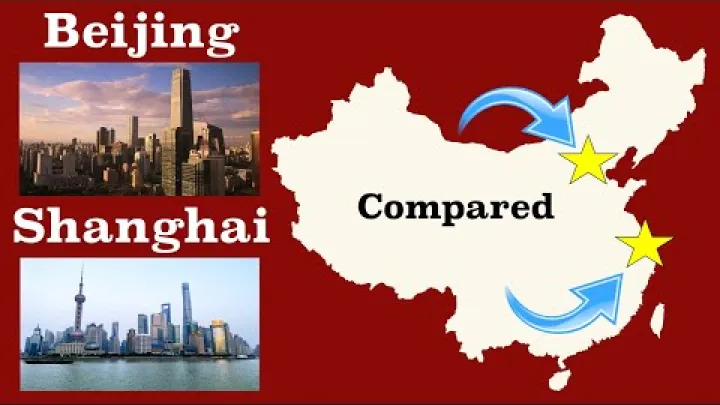
A 2023 comparison in the List of Cities in China by Population gives the following municipality-wide figures. Because the same broad administrative unit is used for all three cities, the figures can be compared with each other, but they should not be treated as counts of each city's continuous built-up area.
| City | Status | Population measure | Approximate 2023 population |
|---|---|---|---|
| Beijing | Capital of China | Municipality-wide | 21.86 million |
| Shanghai | Major municipality | Municipality-wide | 24.87 million |
| Chongqing | Major municipality | Municipality-wide | 31.91 million |
The direct answer is therefore that Beijing is not usually considered China's largest urban area by population. Shanghai is generally larger under that type of comparison. A source using a municipality, urban area, metropolitan region, or economic region may produce a different ranking, so the geographic definition should always be read alongside the number.
Why Chongqing Changes the Population Comparison
Chongqing shows why administrative boundaries matter. Its municipality covers a very large territory that includes extensive rural areas, smaller towns, and a major urban core. A municipality-wide population can therefore be much larger than the number of people living in one continuous built-up city.
Beijing also includes mountain and rural areas beyond its central districts, although its population is more closely associated with a compact metropolitan core. The useful lesson is not to rank Beijing, Shanghai, and Chongqing using incompatible geographic units. Administrative population measures the residents of a legal municipality; urban-area population measures a continuous built-up settlement; metropolitan population usually covers a wider commuting and economic region. Capital status is a legal question, while “largest city” is a statistical question.
How Beijing Became China's Capital
Beijing's modern capital status is connected to a much longer history of shifting political centers. Chinese capitals changed between dynasties and regimes, so the history of Beijing should be separated from the legal status of the modern People's Republic of China.
Earlier Capitals and Beijing's Imperial Rise
Before Beijing became the dominant northern capital, political centers included cities such as Xi'an, Luoyang, and Nanjing. Different dynasties selected capitals for strategic, geographic, military, and administrative reasons. This history means that China has had several important capitals over time rather than one uninterrupted capital in the modern sense.
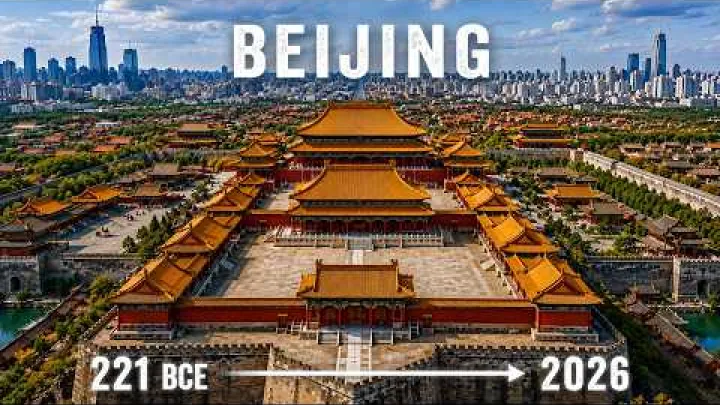
- Earlier dynasties: Xi'an and Luoyang served as major imperial capitals during different periods, while Nanjing also held repeated political importance.
- Yuan dynasty: The Mongol-led Yuan dynasty established Dadu, located in the area of present-day Beijing, as its capital.
- Ming dynasty: The imperial court moved the capital from Nanjing to Beijing, strengthening Beijing's role as the northern political center.
- Qing dynasty: The Qing continued to use Beijing as the imperial capital until the end of dynastic rule.
This chronology explains Beijing's historical importance, but an imperial capital and the capital of the People's Republic of China are not the same legal category. The modern designation belongs to the state founded in 1949.
The 1949 Restoration of Beijing as the PRC Capital
The People's Republic of China was proclaimed in Beijing on October 1, 1949. Since the founding of the PRC in 1949, Beijing has been its capital. The city was known as Beiping during the Republican-era period, and the name Beijing was restored when the new state established its government there.
Nanjing was the principal capital of the Republic of China's national government during the relevant pre-1949 period, although wartime conditions caused the government to operate from other locations, notably Chongqing, after the Japanese invasion. The 1949 change should therefore be understood as the capital designation of a new political regime, not simply as an uninterrupted continuation of an earlier imperial arrangement.
Beijing's Population and Geographic Scale
Population figures for Beijing are useful only when their date and geographic boundary are clear. The number of residents in the Beijing municipality is not the same as the number living in the central urban area or the wider metropolitan region.
Municipality, Urban Area, and Metropolitan Population
For a recent administrative-area snapshot, Statista reports approximately 21.8 million permanent residents in the Beijing municipality in 2025. This is an approximate figure for the administrative area, not a count limited to the historic central districts or the continuously built-up core.
- Municipality population: Counts residents within Beijing's full province-level administrative boundary, including urban, suburban, mountainous, and rural districts.
- Urban-area population: Counts people living in a continuous or mainly continuous built-up settlement. This boundary can exclude less-developed parts of the municipality.
- Metropolitan population: Covers a broader urban and commuting region. Depending on the source, it may include connected areas beyond Beijing's municipal boundary in Hebei or around Tianjin.
The 2025 estimate should not be compared directly with a 2023 figure without noting the different years and definitions. Before comparing any population numbers, record the exact year and whether each figure refers to the municipality, urban area, or metropolitan region. This simple check prevents a large administrative municipality from being mistaken for the largest continuous city.
Beijing's Location in Northern China
Beijing's position in northern China helps explain both its history and its current role. It stands near the northern end of the North China Plain, close to the Bohai region, and is connected administratively and economically with Hebei and Tianjin. The wider Beijing-Tianjin-Hebei region is therefore larger than Beijing municipality alone.
The municipal boundary extends beyond the central districts into outer suburban, mountainous, and rural areas. For a map, a population statistic, or a discussion of work and study, it is useful to specify whether the subject is central Beijing, the full municipality, or the broader northern Chinese region. The city's location also connects its national administrative role with its cultural importance as a historic center between northern routes and the plain.
Is China Moving Its Capital?
Beijing remains the legal capital of China. Confusion about a possible move usually comes from regional planning and proposals to distribute some activities across the capital region, especially references to Xiongan New Area, rather than from a formal change in China's capital.
Current Legal Status Versus Regional Relocation
The current constitutional designation remains Beijing. The Constitution of the People's Republic of China identifies Beijing as the capital, and the existence of a regional project or an office outside Beijing does not by itself change that status.
Xiongan New Area in Hebei is often discussed as part of the wider development and reorganization of the Beijing-Tianjin-Hebei region. If a plan places selected non-core functions, facilities, or activities in Xiongan or another city, that is a functional or regional relocation. It is not automatically the creation of a new national capital. Beijing can remain the legal capital while some activities are distributed to reduce pressure on the central city or support regional development.
For a current report about relocation, separate three questions:
- Current legal status: Does the country's formal constitutional and governmental description still identify Beijing as the capital?
- Functional or regional relocation: Is the report about a particular office, service, institution, or non-core function being located elsewhere?
- Formal capital change: Has an authoritative state announcement clearly named a replacement capital and explained the scope and effective date of the change?
Unless the last point is clearly established, use terms such as functional relocation, regional redistribution, or capital-region planning rather than calling another city China's new capital. This distinction is especially important for students, businesses, and travelers making plans based on fast-changing headlines.
What to Remember About China's Capital
Beijing is the capital of the People's Republic of China and has held that status since the PRC was founded in 1949. It lies in northern China and functions as the country's principal political and administrative center. Its province-level municipality includes far more than the dense central urban area, which is why administrative population figures should not be confused with urban or metropolitan totals.
- Beijing is China's formal national capital.
- Shanghai is generally larger than Beijing by urban-population measures, while Chongqing can be larger by municipality-wide population.
- Beijing's current role follows a long history as an imperial capital, but the modern legal designation dates from the founding of the PRC.
- Plans involving Xiongan New Area or other regional functions do not by themselves mean that China's capital has moved.
The simplest answer is Beijing. The more complete answer is that its capital status, historical role, geographic boundary, and population size are separate facts, and each should be described using the correct date and definition.
Select area
Create a post
Posting is free and no registration is required.