Indonesia Religion Percentage: Latest Breakdown by Faith and Region (2024/2025)
Indonesia’s religious landscape is diverse and regionally varied, and understanding the latest Indonesia religion percentage figures helps make sense of that diversity. Across 2023–2025, the national picture remains stable: Islam is the majority, followed by Christian communities, with Hindu, Buddhist, and Confucian minorities.
Quick answer: Indonesia religion percentages (latest available)
Christians total around 10–11% (Protestant roughly 7–8%, Catholic roughly 3%). Hindu is around 1.7%, Buddhist about 0.7%, and Confucian near 0.05%. Ranges reflect recent administrative registers and surveys; totals may differ slightly due to rounding and reporting practices.
At-a-glance table
The indicative national shares below summarize the latest widely cited figures for 2023–2025. Because different government registers and surveys update on different cycles, presenting ranges is the most accurate way to show the current picture.
- Islam: about 87%
- Protestant: about 7–8%
- Catholic: about 3%
- Hindu: about 1.7%
- Buddhist: about 0.7%
- Confucian: about 0.05%
- Indigenous beliefs: widely practiced; not fully captured in headline totals
These shares are rounded, and the sum may be slightly above or below 100%. They are consistent with the stability observed in 2023 and 2024 updates and remain suitable for high-level comparisons across provinces and years.
Notes on indigenous beliefs and recognition
Indonesia officially recognizes six religions for administrative purposes, but many communities also practice local traditions (adat) and belief systems (kepercayaan). For decades, adherents of indigenous beliefs were often recorded under one of the six official categories, which leads to undercounting in national percentages.

Since a 2017 policy change, citizens can record “Kepercayaan terhadap Tuhan Yang Maha Esa” on national ID cards. This improves visibility, but adoption is gradual and reporting varies by region. As a result, indigenous adherence remains imperfectly measured in most headline statistics for 2023–2025.
Religion-by-religion overview
This section explains the main religious communities behind the national percentages and how they appear in daily life. It highlights key organizations, regional concentrations, and diversity within each tradition to give context beyond a single national average.
Islam in Indonesia: size, organizations, and diversity
Islam accounts for roughly 87% of Indonesia’s population. Most Muslims follow Sunni Islam in the Shafi’i school, with a wide spectrum of local practice and scholarship. Islamic life is visible across Java, Sumatra, Kalimantan, and Sulawesi, while eastern Indonesia shows more mixed patterns.

Two long-standing mass organizations help define the religious landscape. Nahdlatul Ulama (NU) and Muhammadiyah each claim tens of millions of followers and sympathizers, with NU often cited in the high tens of millions and Muhammadiyah widely reported in the tens of millions as well. NU has deep pesantren networks and a strong traditionalist base, while Muhammadiyah is known for schools, universities, and hospitals. Smaller Muslim communities include Shi’a and Ahmadiyya, which are present in select urban areas and regions.
Christians in Indonesia: Protestants and Catholics
Christians comprise about 10–11% nationally, split between Protestants (about 7–8%) and Catholics (about 3%). The share varies widely by province, reflecting historical mission routes and migration patterns, with some eastern provinces and North Sumatra’s Batak heartlands having especially high Christian populations.

Protestant diversity includes large denominational families such as HKBP (Huria Kristen Batak Protestan) in the Batak region, GMIM (Gereja Masehi Injili di Minahasa) in North Sulawesi, and a range of mainline and Pentecostal churches across urban and rural zones. Catholic communities have notable dioceses in eastern Indonesia, including archdioceses and dioceses in Papua and East Nusa Tenggara, where parish life and schools play important roles in social services and education.
Hinduism, Buddhism, Confucianism, and local traditions
Buddhism, around 0.7% nationally, is concentrated in urban areas, with adherents among Chinese Indonesians and other groups. Confucianism, about 0.05%, regained formal recognition after 1998 and is visible through kelenteng temples and observances including Lunar New Year (Imlek). In many places, local traditions coexist with official religions, producing syncretic practices that vary by island and ethnic group.
Regional patterns and notable exceptions
This section highlights regions where the religious composition differs from the national pattern and explains the histories that led to those differences.
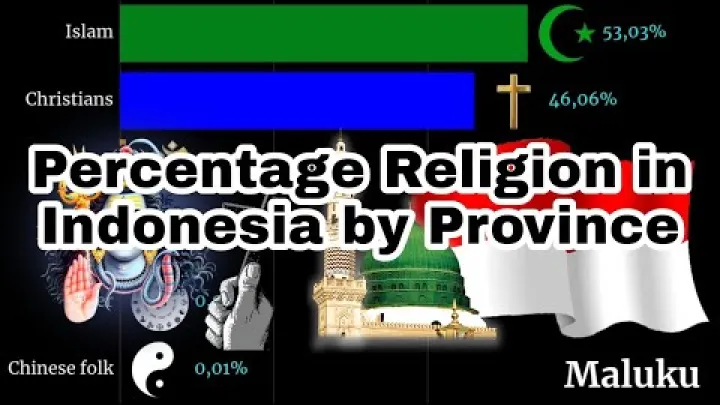
Bali: Hindu-majority province (~86%)
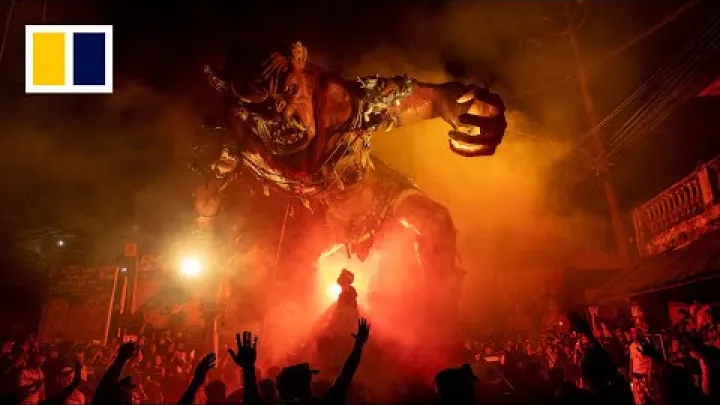
Bali stands out in Indonesia as a Hindu-majority province, with about 86% of residents identifying as Hindu. Ritual life is woven into the public sphere through temple ceremonies, offerings, and island-wide observances like Nyepi, which shapes community rhythms and public holidays.
The island’s subregions, including Nusa Penida within Klungkung Regency, have distinct demographic patterns influenced by geography, livelihoods, and mobility. Muslim and Christian minorities are present across towns and service sectors, contributing to Bali’s plural social fabric.
Papua and North Sulawesi: Protestant majorities
Several provinces in the Papua region have Protestant majorities shaped by 20th‑century missions and the development of local churches. The current administrative map includes Papua, West Papua, Southwest Papua, Central Papua, Highland Papua, and South Papua. Many highland districts show overwhelming Protestant identification, while Catholics are strong in parts of the south and highlands.

North Sulawesi (Minahasa) is also predominantly Protestant, with GMIM’s congregational network central to community life. Coastal towns across these regions host Muslim minorities and other faith communities, often linked to inter-island trade, education, and civil service mobility. Catholic communities are particularly notable in select Papua highlands and coastal districts, illustrating the layered history of missions and migration.
North Sumatra enclaves; Aceh's Sharia autonomy
North Sumatra is religiously mixed. Batak areas such as Tapanuli, Samosir, and nearby districts have large Christian populations anchored by HKBP and other churches.

Aceh, by contrast, is overwhelmingly Muslim and exercises special autonomy that includes Sharia‑inspired bylaws. In practice, Sharia provisions are applied to Muslims, while non‑Muslims generally fall under national legal frameworks. Local implementation can vary by locality, and authorities provide administrative pathways for non‑Muslim residents to handle civil matters through the national system, reflecting Indonesia’s broader legal pluralism.
Trends and historical context (brief)
Today’s percentages are the result of centuries of cultural exchange, royal patronage, and community movement. A concise timeline helps explain why some islands or districts differ so strongly from national averages.
Pre-Islamic roots and Hindu-Buddhist era
Before Islam and Christianity became dominant in many regions, Hindu-Buddhist kingdoms shaped the archipelago’s political and cultural life. Srivijaya, centered in Sumatra from about the 7th to 13th centuries, was a major Buddhist maritime power. On Java, the Hindu Majapahit empire (circa 1293–early 16th century) left a lasting cultural legacy across the islands.

Islamic spread and Christian mission history
Islam spread mainly via trade networks and royal courts between the 13th and 16th centuries, as port cities embraced new connections across the Indian Ocean. On Java, narratives of the Walisongo (Nine Saints) highlight religious learning, local adaptation, and the gradual Islamization of the island during the 15th and 16th centuries.

Christian missions began with Portuguese influence in the 16th century and expanded under Dutch colonial rule. After independence in the mid‑20th century, Protestant and Catholic communities grew through education and health services, especially in eastern Indonesia and the Batak areas. These historical layers help explain present‑day concentrations in places like North Sulawesi, Papua, and East Nusa Tenggara.
Sources, methodology, and data notes (2024/2025)
Figures for 2023–2025 come primarily from administrative registers and large statistical exercises. Because methods and update cycles differ, using ranges offers a realistic snapshot while acknowledging unavoidable uncertainties such as rounding, dual adherence, and changes in registration behavior.

Official recognition of six religions
Indonesia formally recognizes six religions: Islam, Protestantism, Catholicism, Hinduism, Buddhism, and Confucianism. Public services, civil registries, and ID systems commonly reference these categories, which is why headline percentages are reported under these six labels.

Alongside these, indigenous belief systems have a recognized administrative pathway. Since a 2017 change, citizens may record “Kepercayaan terhadap Tuhan Yang Maha Esa” on identity cards through local civil registration offices, with coordination from cultural and religious affairs units. While this improves visibility, not all adherents have updated records, so national reporting still underrepresents indigenous beliefs.
Administrative vs census-based figures and ranges
Two main data streams are used. Administrative totals maintained by the civil registry (Dukcapil, Ministry of Home Affairs) update frequently and reflect current registrations. Survey and census programs from Statistics Indonesia (BPS), such as the 2020 Population Census and routine surveys, provide methodologically consistent snapshots but on longer cycles.

Because year labels vary across sources—some showing late‑2023 snapshots, others updating through 2024 or 2025—this guide presents ranges for each religion. Minor discrepancies also arise from rounding, underreporting, and overlapping practice of indigenous traditions with an official religion. Provincial diversity further means that national averages mask local realities, so readers should check provincial or district data for precise planning needs.
Frequently Asked Questions
What is the current religion percentage in Indonesia?
Islam is about 87% of the population. Christians together are about 10–11% (Protestant roughly 7–8%, Catholic roughly 3%). Hindu is around 1.7%, Buddhist near 0.7%, and Confucian around 0.05%. Indigenous beliefs are widespread but not fully captured in headline percentages due to historic reporting practices.
Which religion is the majority in Indonesia and by what share?
Islam is the majority at roughly 87% of Indonesians. This makes Indonesia the country with the world’s largest Muslim population, distributed across Java, Sumatra, Kalimantan, Sulawesi, and many urban centers in other islands.
What percentage of Bali’s population is Hindu today?
Approximately 86% of Bali’s population is Hindu. The island’s culture, ceremonies, and temple networks reflect this, while Denpasar and tourism hubs show more religious diversity than many rural districts.
What is the Christian population percentage in Indonesia (Protestant and Catholic)?
Christians make up about 10–11% of the population. Protestants account for roughly 7–8% and Catholics about 3%. Higher shares appear in Papua, North Sulawesi, East Nusa Tenggara, and Batak areas of North Sumatra.
How many religions are officially recognized in Indonesia?
Six: Islam, Protestantism, Catholicism, Hinduism, Buddhism, and Confucianism. Citizens may also record indigenous belief affiliation on ID cards, though many still appear under one of the six categories.
Which provinces have Christian majorities in Indonesia?
Several provinces in the Papua region have Protestant majorities, and North Sulawesi is also predominantly Protestant. Parts of North Sumatra, such as Batak districts and Nias, have large Christian populations, though the province overall is mixed.
Are indigenous beliefs counted in Indonesia’s official religion statistics?
Only partially. Since 2017, people can record “Kepercayaan” on ID cards, improving visibility. However, many adherents are still listed under one of the six recognized religions, so national figures understate indigenous adherence.
What is the most recent year of data for Indonesia’s religion percentages?
The latest widely cited figures reflect updates across 2023–2025. Different agencies publish on different schedules, so presenting ranges is the most reliable way to summarize the current situation.
Conclusion and next steps
Indonesia’s religion percentages have been stable across recent updates: Islam around 87%, Christians about 10–11% split between Protestants and Catholics, Hindu around 1.7%, Buddhist near 0.7%, and Confucian around 0.05%. These national averages conceal extensive regional variation. Bali remains predominantly Hindu, several Papua provinces and North Sulawesi are predominantly Protestant, and North Sumatra contains large Christian enclaves alongside diverse urban communities. Aceh stands apart through Sharia‑inspired autonomy applied to Muslims, with administrative provisions for non‑Muslims.
Together, these notes offer a reliable, up‑to‑date overview of the religion landscape in Indonesia for 2024/2025.
Select area
Create a post
Posting is free and no registration is required.