Indonesia GDP per Capita (2024): Latest Figure, PPP vs Nominal, Trend and Outlook

Indonesia GDP per capita is a widely searched indicator for understanding the country’s economic standing and living standards. In 2024, Indonesia’s nominal GDP per capita is about USD 4,900–5,000, while its PPP level is roughly USD 14,000–15,000. These two measures answer different questions: nominal shows market size in dollars, and PPP reflects local purchasing power. This guide explains both numbers, how they are updated, the historical trend, ASEAN comparisons, and what to watch for through 2030 and beyond.
Quick answer and key facts
If you only need the short version: Indonesia’s GDP per capita in 2024 is around USD 4,900–5,000 in nominal terms and about USD 14,000–15,000 in PPP terms. Figures vary across reputable sources due to exchange rates, price deflators, and methodological revisions. When comparing, use the same year and the same unit (for example, “current USD” for nominal or “current international dollars” for PPP).
- Nominal GDP per capita (2024): roughly USD 4,900–5,000.
- PPP GDP per capita (2024): roughly USD 14,000–15,000.
- Nominal is best for market size, trade capacity, and external finance.
- PPP is best for comparing living standards across countries.
- Main data sources: World Bank (WDI), IMF (WEO), and Statistics Indonesia (BPS).
- Updates: IMF typically in April/October; World Bank annually; BPS per national release.
- Exchange-rate swings can move nominal USD figures even if real output is steady.
Latest nominal GDP per capita (USD, 2024)
Indonesia’s nominal GDP per capita in 2024 sits in a narrow range of about USD 4,900–5,000. The small differences you may see across dashboards reflect the specific exchange rate used, the timing of the update, and whether late-year revisions to national accounts have been incorporated. Always pair the number with the reference year (2024) and the unit (current USD) to avoid confusion with constant-price or PPP figures.

As statistical agencies and international institutions revise estimates and adopt updated deflators, these values are refreshed. Using a single, reputable source consistently for a given comparison helps maintain coherence across analyses.
PPP GDP per capita and why it differs
Indonesia’s GDP per capita in 2024 expressed at purchasing power parity is roughly USD 14,000–15,000, which is much higher than the nominal figure. PPP uses a standardized international dollar that adjusts for price level differences across countries. Since the average price of many goods and services in Indonesia is lower than in high-income economies, a dollar buys more locally, so PPP-based income looks larger.

A simple example helps. Suppose a basic daily basket of food and transport costs USD 10 in the United States but the equivalent goods and services cost USD 5 in Indonesia. An Indonesian worker earning USD 5 in local purchasing power can buy the same basket that would require USD 10 in the United States. PPP adjusts for that gap, so it is more appropriate for comparing living standards or consumption possibilities across countries.
Sources and update schedule (World Bank, IMF, national statistics)
For Indonesia, the most used sources are the World Bank’s World Development Indicators (WDI), the IMF’s World Economic Outlook (WEO), and Statistics Indonesia (BPS). The IMF typically updates headline projections in April and October, while the World Bank updates its global databases annually, after digesting national releases. BPS provides the underlying national accounts in rupiah, which feed these international databases.
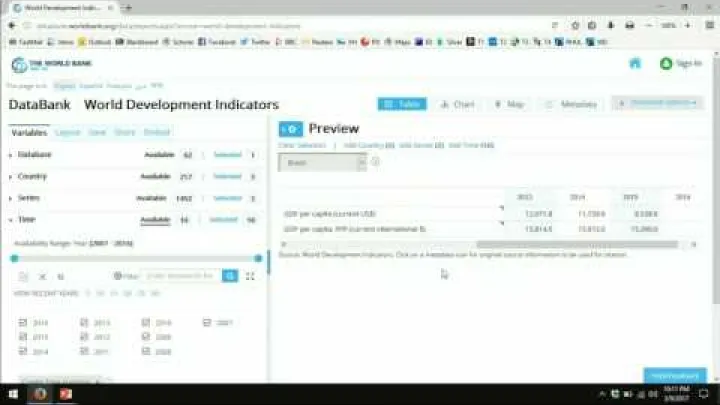
When you consult these sources, check whether the value is nominal GDP per capita in current USD, constant prices (inflation-adjusted), PPP-based GDP per capita, or GNI per capita. Exchange-rate movements can alter nominal USD values from year to year even when real output changes modestly, so a depreciation or appreciation of the rupiah can create a notable divergence between the rupiah-denominated trend and the USD-converted series.
Nominal vs PPP: what each measure tells you
Nominal and PPP are not competing statistics; they serve different purposes. Nominal GDP per capita in current USD shows the economy’s size when converted into dollars and matters for international purchasing power such as imports, foreign debt service, and cross-border investment comparisons. PPP GDP per capita, measured in international dollars, normalizes for price level differences and is better suited for comparing living standards, poverty lines, and real consumption possibilities.
When to use nominal vs PPP
Use nominal GDP per capita when you care about what Indonesia can buy on world markets or how it compares as an investment destination in financial terms. Analysts often use nominal USD to evaluate external debt sustainability, to size potential consumer markets for imported products, or to benchmark corporate revenues across countries in common currency terms.

PPP is the preferred metric for social comparisons because it accounts for lower prices in Indonesia relative to advanced economies. A quick decision checklist:
- Market size, trade, external finance: choose nominal USD.
- Living standards, poverty, real consumption: choose PPP.
- Policy or research: state both, and define the unit up front.
Implications for living standards and comparisons
Because average prices are lower in Indonesia, PPP suggests higher effective consumption than nominal USD implies. This means households may enjoy a standard of living that looks modest in dollar terms but goes further locally. It is why poverty and inequality analyses rely on PPP-adjusted lines and why income ranks can change when you switch between nominal and PPP lenses.
In ASEAN, country rankings can shift by measure. For example, Vietnam’s nominal GDP per capita is close to Indonesia’s but its PPP value can rank differently due to relative price levels. Such shifts remind users to pick the right measure for the question at hand and to clearly label both year and unit.
Historical trend and milestones (1960–2024)
Indonesia’s long-run income profile reflects structural transformation, crises, and resilience. Real GDP per capita growth has averaged around 3–4% over long horizons, with episodic downturns followed by multi-year recoveries. The change in economic structure—from agriculture toward manufacturing and services—has been a central engine for sustained gains in productivity and living standards.
Long-run growth, crises, and recoveries
From the late 1960s through the mid-1990s, Indonesia’s GDP per capita rose steadily, interrupted sharply by the 1997–98 Asian Financial Crisis. In USD terms, per capita income fell markedly in 1998 due to the rupiah’s depreciation, with a drop on the order of tens of percent; in real terms, the contraction was smaller but still meaningful. Recovery took hold in the early 2000s as inflation stabilized and investment returned.

The 2008–09 global financial crisis brought a mild slowdown rather than a deep recession, with real GDP per capita growth decelerating but remaining near positive territory, before rebounding as commodity prices and regional demand improved. The pandemic in 2020 led to a temporary decline in real GDP per capita by a few percent, followed by a multi-year rebound as mobility normalized, vaccines scaled, and infrastructure and digital adoption supported domestic activity.
Average growth rates and structural shifts
Over decades, Indonesia’s real GDP per capita growth has averaged roughly 3–4% per year, reflecting gains from urbanization, human capital improvements, and technology diffusion. The economy has shifted from an agriculture-heavy base toward manufacturing and services, with services now contributing the largest share of value added and manufacturing acting as a key productivity channel in tradables.

While exact shares vary by source and year, services account for about half of value added, manufacturing for about one-fifth, and agriculture for a smaller but still important share. Rising digital adoption, logistics upgrades, and connectivity investments have improved productivity, especially in retail, transport, and finance. These changes underpin the steady increase in GDP per capita and the capacity to weather shocks.
ASEAN comparison: where Indonesia ranks today
Indonesia’s scale makes it the largest economy in ASEAN by total GDP, but GDP per capita differs across neighbors. On a nominal USD basis, Indonesia trails Malaysia and Thailand, sits near Vietnam, and is above the Philippines. On a PPP basis, gaps can narrow due to price level differences, so relative rankings may shift depending on the measure used. Always confirm the unit and reference year when comparing countries.
Comparison with Malaysia, Thailand, Vietnam, Philippines
Indicative 2024 nominal levels place Indonesia around USD 5,000 per person, Thailand near USD 7,800, and Malaysia around USD 13,000. Vietnam’s nominal GDP per capita is somewhat lower than Indonesia’s but has been converging; the Philippines typically sits a bit below Indonesia in nominal terms. In PPP terms, all countries’ values rise relative to their nominal numbers, and the rank order can compress due to differing price levels.

The following compact table presents approximate 2024 ranges, labeled clearly as nominal USD and PPP international dollars. Values are rounded to reflect cross-source variation and currency effects.
| Country | Nominal GDP per capita (USD, 2024 approx.) | PPP GDP per capita (USD, 2024 approx.) |
|---|---|---|
| Indonesia | ~5,000 | ~14,000–15,000 |
| Malaysia | ~13,000 | ~32,000–35,000 |
| Thailand | ~7,800 | ~21,000–23,000 |
| Vietnam | ~4,300–4,500 | ~13,000–15,000 |
| Philippines | ~3,800–4,000 | ~10,000–12,000 |
These are indicative, nominal USD and PPP estimates for 2024. Rankings are sensitive to exchange rates and revisions, so it is best to consult a single database for a given comparison and note the update date alongside the values.
What explains the gaps across countries
Income gaps reflect differences in productivity, capital intensity, technology adoption, and the complexity of exports. Economies with deep manufacturing ecosystems, sophisticated services, and higher research intensity tend to generate more value added per worker. Foreign direct investment depth, supply-chain integration, and stable institutions also support higher GDP per capita.

For Indonesia, policy priorities to close the gap include boosting total factor productivity through competition and skills, expanding logistics and energy infrastructure, and encouraging sectoral upgrading in higher-tech manufacturing and tradable services. Strengthening institutions and regulatory clarity can attract more diverse FDI, while innovation ecosystems and workforce training can help firms climb value chains and narrow the per capita gap with regional peers.
Drivers of income growth
Indonesia’s growth model has long been anchored by domestic consumption, complemented by services expansion and manufacturing upgrades. The interaction between these engines, plus investments in infrastructure, digital networks, and skills, determines the pace at which GDP per capita rises over time. Understanding their relative importance helps interpret both the current level and the trajectory of living standards.
Domestic consumption, services, and manufacturing
Household consumption is a stabilizer, typically accounting for about 50–60% of GDP. This large domestic market provides a buffer when external demand slows. Services contribute the largest share of value added—about half or slightly more—spanning retail, transport, finance, communications, and public services. Services productivity, especially in logistics and finance, influences economy-wide efficiency.

Manufacturing remains a crucial source of tradable productivity, with notable segments including food processing, transport equipment, chemicals, and electronics-related activities. Progress in higher-tech manufacturing and tradable services can raise labor productivity and wages, which feeds directly into higher GDP per capita. Complementary policies—such as improved ports, power reliability, and digital infrastructure—can amplify these gains.
Regional disparities and urbanization effects
Resource-rich provinces beyond Java can experience more volatility due to commodity cycles but also offer diversification potential in mining, energy, and agro-industry. Urbanization supports productivity through density, supply-chain depth, and better labor matching.

Several initiatives aim to reduce disparities, including intergovernmental transfers, village funds, and infrastructure programs such as toll roads, ports, and industrial estates outside Java.
Policy targets and scenarios to 2029, 2034, and 2045
Indonesia’s medium- and long-term targets link per capita income milestones to reforms that lift productivity and investment. Policymakers and analysts often discuss nominal USD goals for 2029 and 2034, and the broader ambition to reach high-income classification around 2045. Achieving these markers depends not only on real growth but also on inflation, exchange rates, and the composition of growth toward higher value-added sectors.
Path to USD 7,000, 9,000, and high-income thresholds
A commonly cited path puts nominal GDP per capita around USD 7,000 by 2029 and about USD 9,000 by 2034, subject to exchange-rate and inflation outcomes. Hitting these waypoints requires sustained growth and manageable currency volatility. Because nominal USD milestones are sensitive to the rupiah-dollar rate, policy credibility and external conditions will influence the exact timing.
High-income status is defined by the World Bank using GNI per capita (Atlas method), not GDP per capita. The GNI measure includes net income from abroad and uses a smoothing methodology for exchange rates, which can yield a different trajectory than GDP. Indonesia’s 2045 ambition centers on lifting productivity, upgrading human capital, and deepening value-added sectors so that both GNI and GDP per capita rise to the required thresholds.
Required growth and productivity improvements
Many scenarios suggest Indonesia needs real GDP growth in the mid-5% range on a sustained basis, paired with faster total factor productivity gains from skills, technology adoption, and competition. Infrastructure and institutional quality—spanning logistics, energy, digital networks, and regulatory predictability—can raise the ceiling on growth and crowd in private investment.

A simple illustration: if real GDP per capita grows near 4% annually and inflation averages about 3%, and the exchange rate is broadly stable, nominal GDP per capita might grow around 7% per year. Over 10 years, 7% compounding roughly doubles the level (factor of about 2). Starting near USD 5,000, that math would imply crossing USD 9,000 within the 2030s, consistent with the indicative milestones if policies maintain momentum.
Downstreaming, EV ecosystem, and sector opportunities
Indonesia’s industrial policy emphasizes downstreaming in natural resources and building an electric vehicle (EV) ecosystem. The goal is to capture more value added domestically, move up supply chains, and translate investment into higher wages and skills. This strategy intersects with the global energy transition and creates opportunities in metals, batteries, renewable power, and supporting services.
Nickel, batteries, and green industry investments
Indonesia is among the world’s leading suppliers of nickel and has promoted domestic processing to upgrade from ore exports to higher-value products such as nickel matte, mixed hydroxide precipitate, and eventually battery materials. EV-related investments, including precursor and cathode facilities, aim to deepen local manufacturing and raise export complexity.

To enhance long-run competitiveness, policies increasingly focus on linking mining to manufacturing and on expanding renewable power to reduce carbon intensity. Avoiding precise market share claims without a defined year is prudent, but the direction is clear: integrating upstream resources with midstream processing and downstream assembly can lift productivity, diversify exports, and support GDP per capita growth.
Risks: jobs, environment, and concentration
Industrial upgrading comes with risks. Environmental management, including emissions, waste, and water quality, requires strong safeguards and effective enforcement. Community engagement, land use planning, and transparent benefit-sharing are essential to maintain social license. Employment quality and skills must keep pace so that local workers benefit from higher-value roles.

Concentration risks can arise if growth depends heavily on a few commodities or a narrow set of investor sources. Practical mitigants include diversifying across metals and manufacturing segments, adopting stronger environmental and labor standards, improving disclosure and monitoring, and building domestic supplier networks so more value stays onshore. Over time, broader participation and higher capabilities can make growth more resilient.
Outlook 2025–2030: baseline and risks
Looking ahead, Indonesia’s baseline outlook envisions steady growth supported by domestic demand, infrastructure pipelines, and human capital improvements. At the same time, external conditions—global growth, commodity prices, and financial market volatility—will shape the path of nominal USD income. Clear communication and policy continuity can help anchor expectations and attract long-term investment.
Macro assumptions, external exposure, and resilience
A reasonable baseline assumes real GDP growth around 5% with moderate inflation and prudent fiscal policy. Public debt remains manageable by international standards, and ongoing infrastructure projects in transport, energy, and digital connectivity support potential growth. Financial sector reforms and inclusion initiatives strengthen domestic resilience.

External exposure includes commodities, demand from major partners such as China and the United States, and global interest rates. Exchange-rate uncertainty is an important caveat: a weaker rupiah can lower nominal USD GDP per capita even if real growth holds, while appreciation would lift the USD-converted figure. Diversifying exports, deepening domestic capital markets, and maintaining credible policies can cushion shocks.
What could lift or slow GDP per capita
Upside scenarios feature faster reforms that raise productivity, higher-quality FDI into advanced manufacturing and tradable services, accelerated digitalization, stronger human capital outcomes, and logistics upgrades that cut business costs. These could lift real GDP per capita growth into the 4–5% range, with nominal USD gains higher if the exchange rate is stable.
Downside risks include slower global growth, commodity price swings, climate and environmental shocks, and domestic regulatory uncertainty that delays investment. A simple scenario range for 2025–2030: real GDP per capita growth could average roughly 3–5% a year, with nominal USD growth varying more widely depending on inflation and the rupiah, potentially ranging from mid-single digits to low double digits.
Frequently Asked Questions
What is Indonesia’s GDP per capita in 2024 in US dollars?
Indonesia’s nominal GDP per capita in 2024 is about USD 4,900–5,000. The exact figure varies by source due to exchange-rate assumptions and late-year revisions. Always cite the year and unit (current USD) for clarity.
What is Indonesia’s GDP per capita in PPP terms and why is it higher than nominal?
It is roughly USD 14,000–15,000 in 2024. PPP is higher because domestic prices are lower than in high-income economies, so each dollar buys more in Indonesia. PPP is better for comparing living standards across countries.
Is Indonesia considered a high-income country by the World Bank?
No. Indonesia is currently classified as an upper-middle-income country. The World Bank’s high-income threshold uses GNI per capita (Atlas method), which differs from GDP per capita and is updated annually.
How does Indonesia’s GDP per capita compare with Malaysia and Thailand?
On a nominal USD basis for 2024, Indonesia is around USD 5,000, Thailand about USD 7,800, and Malaysia near USD 13,000. In PPP terms, the gaps narrow but remain, reflecting differences in productivity and value-added sectors.
Which measure should I use: nominal or PPP?
Use nominal USD for market size, imports, and external finance comparisons. Use PPP for living standards, poverty analysis, and cross-country welfare comparisons. Define the unit and year at the start of any analysis.
What growth rate is needed for Indonesia to reach around USD 9,000 by the mid-2030s?
One feasible path is sustained real growth near 5%, moderate inflation, and a broadly stable exchange rate. Under such conditions, nominal GDP per capita could compound fast enough to approach or exceed USD 9,000 in the 2030s.
What are the main risks to Indonesia’s GDP per capita outlook?
Key risks include global slowdowns, commodity price swings, climate and environmental shocks, and domestic regulatory uncertainty. Exchange-rate volatility also affects the nominal USD series even when real output is steady.
Where can I find the latest official GDP per capita data for Indonesia?
Check the World Bank (WDI), IMF (WEO), and Statistics Indonesia (BPS). Confirm whether figures are nominal USD, constant prices, PPP, or GNI per capita before comparing across sources.
Conclusion and next steps
Indonesia’s GDP per capita in 2024 stands near USD 5,000 in nominal terms and around USD 14,000–15,000 in PPP terms, reflecting different lenses on size and living standards. Long-run gains have been steady despite shocks, with services, manufacturing, and urbanization underpinning progress. Policy priorities—productivity, skills, infrastructure, and industrial upgrading—will shape whether Indonesia reaches its 2029, 2034, and 2045 ambitions. Exchange-rate dynamics will continue to influence the USD-converted path, so using consistent definitions and sources remains essential for clear comparisons.
Select area
Create a post
Posting is free and no registration is required.