Thailand Visa for Indians (2025): Visa‑Free Rules, Costs, and e‑Visa Steps
It also explains how to apply for the Thailand e‑Visa, extend your stay, and avoid overstay penalties. Read on for practical steps, verified links, and tips tailored for Indian passport holders.
Quick answer: Thailand visa for Indians—do you need one in 2025?
Most Indian passport holders can enter Thailand visa‑free for tourism under the current policy, subject to a fixed stay limit and standard entry conditions. For longer stays, business purposes, or multiple trips, you may prefer the Thailand e‑Visa (tourist SETV/METV) or other non‑immigrant categories.
Rules can change during the year, so verify the permitted stay, fees, and pre‑arrival requirements with official Thai government sources before you travel. Airlines may apply their own boarding checks as well, including passport validity and onward ticket proof.
Current visa-free policy for Indian passport holders
Update stamp: October 2025. Indian citizens may enter Thailand visa‑free for tourism with an indicated stay allowance commonly up to 60 days per entry. Many travelers can apply for a one‑time, in‑country extension of 30 days at a local immigration office for a government fee that is typically 1,900 THB. However, some reports note possible reversion to a 30‑day visa‑free stay for certain periods or checkpoints. Because policies evolve, confirm the exact duration near your travel date.
Visa‑free entry still has conditions. You should carry a passport valid for at least six months, an onward or return ticket within your permitted stay, proof of accommodation, and evidence of sufficient funds. Entry remains at the discretion of immigration officers. Keep printed copies of key documents and confirmations to support a smooth arrival.
What to verify before you travel (policy changes and official links)
Before departure, confirm the current rules with official portals. Check the permitted visa‑free stay, any extension options, and whether your entry point is eligible. Also review airline requirements for boarding: passport validity (six months or more), blank pages for stamps, and proof of onward travel within the allowed stay.

Official resources to bookmark and carry as printouts or offline files include: Thailand e‑Visa portal (https://www.thaievisa.go.th), TDAC pre‑arrival form (https://tdac.immigration.go.th), Royal Thai Embassy in New Delhi visa page (https://newdelhi.thaiembassy.org/en/page/visa), and the Embassy of India in Bangkok (https://embassyofindiabangkok.gov.in/eoibk_pages/MTM0). Cross‑check dates, fees, and eligibility just before you fly.
All entry options for Indian travelers
Thailand offers multiple ways for Indian travelers to enter: visa‑exempt (visa‑free) entry for tourism, Visa on Arrival (VoA) for short trips, and pre‑approved tourist visas via the official e‑Visa portal. For work, business, or long‑stay plans, specific non‑immigrant categories and membership programs exist. Choosing the right option depends on your trip length, number of entries, and purpose of travel.

Below is a clear breakdown of the common paths, including conditions, expected stays, and when each option makes sense. Always check for updates close to your travel date, because stay durations, fees, and eligible checkpoints can be revised during the year.
Visa-exempt (visa-free) entry: stay length, conditions, extension
Visa‑free entry is the simplest path if you meet the current policy. The typical allowance is up to 60 days per entry for tourism, with a possible 30‑day in‑country extension at a local immigration office for a fee that is usually 1,900 THB. You must hold a valid passport, an onward or return ticket dated within your permitted stay, accommodation proof, and sufficient funds to cover your visit.
When planning logistics, note that rules at airports and land borders can differ. Thailand has historically limited the number of visa‑exempt land entries per calendar year for some nationalities, and processing practices can vary by checkpoint. If you expect multiple land crossings, verify the latest conditions for Indian passport holders with the Thai Immigration Bureau or an embassy/consulate.
- Extension basics: apply before your current stay expires, bring your passport, completed application, a passport photo, and pay the fee.
- Last day tip: your arrival day counts as Day 1. For example, arrive on 05 Oct and a 60‑day stay typically ends on 03 Dec. Confirm the stamp date in your passport to avoid overstay.
Tourist visas: Single-Entry (SETV) and Multiple-Entry (METV)
If you want confirmed approval before you travel, or you need multiple entries, consider a tourist visa via the official e‑Visa portal. A Single‑Entry Tourist Visa (SETV) generally permits one tourist stay with an indicative visa fee around USD 40. A Multiple‑Entry Tourist Visa (METV) has an indicative government fee around USD 200 and is valid for several entries within its validity period.
For METV, the permitted stay per entry is commonly up to 60 days, and many travelers can apply for a 30‑day in‑country extension on each entry if eligible. Apply online through https://www.thaievisa.go.th with standard documents: recent photo, passport, funds, onward/return ticket, and accommodation proof. Final conditions, validity windows, and extension outcomes remain subject to officer discretion and current rules.
Visa on Arrival (VoA): who should use it, where, and limits
Visa on Arrival suits short, spontaneous trips when visa‑free entry is not used or does not apply to your specific situation. The VoA fee is typically 2,000 THB in cash, and the usual stay limit is up to 15 days. Expect queues at peak arrival times, and allow extra time if you have a tight onward connection.
Bring your passport, a completed VoA form, a passport‑sized photo, proof of funds, and an onward ticket departing within 15 days. For eligible travelers, visa‑free entry typically offers a longer stay and less time at the counter.
Special cases: Destination Thailand Visa (DTV), Non-Immigrant B (Business), Thailand Elite
Thailand has additional pathways for specific purposes. The Destination Thailand Visa (DTV) targets longer‑stay visitors such as remote workers, digital nomads, and participants in cultural or wellness programs; details and eligibility criteria may evolve as policy progresses. The Non‑Immigrant B (Business) category supports employment or business activities and commonly requires employer or organizational documentation.

For premium long‑term options, Thailand Elite (membership program) offers extended stay privileges and bundled services for higher fees. To verify DTV eligibility and the most current application pathway, rely on official sites such as the Ministry of Foreign Affairs and the Immigration Bureau, starting with https://www.thaievisa.go.th and embassy pages like https://newdelhi.thaiembassy.org/en/page/visa for announcements and links.
Thailand e‑Visa: how to apply online step by step
The official Thailand e‑Visa system enables Indian citizens to submit tourist and other visa applications fully online. This is the recommended route if you need a pre‑approved visa, plan multiple entries, or expect to stay beyond the current visa‑free limit. Preparing clear, correctly formatted documents is key to smooth processing.

Documents checklist (photos, passport, tickets, funds, accommodation)
Have these items ready before you start your e‑Visa application: a passport with at least six months of validity beyond your intended arrival date, a recent passport‑style photo, confirmed accommodation (hotel bookings or host invitation with address), and a confirmed onward or return ticket that fits your intended stay. Proof of funds is often checked at entry; carry recent bank statements or equivalent evidence. A common reference threshold is 10,000 THB per person or 20,000 THB per family, though officers may assess overall trip readiness.
When uploading, follow the portal’s file rules displayed on the upload step. Typical formats include JPG/JPEG/PNG and PDF, with per‑file size limits often around 3–5 MB. Ensure scans are clear, color where required, and that names, dates, and passport numbers are legible. Mismatched or unreadable uploads are a frequent cause of delays or rejections.
Processing times, validity, and typical fees
Processing usually takes about 14 calendar days from successful submission, though timelines can vary by season and case complexity. A practical plan is to prepare documents one to two months in advance, submit the application four to five weeks before travel, and track your email for queries. Print your approval and keep it with your passport to show the airline and immigration if requested.
Indicative fees for tourist visas are around USD 40 for a Single‑Entry Tourist Visa (SETV) and around USD 200 for a Multiple‑Entry Tourist Visa (METV). Visa approval validity, entry windows, and the permitted stay depend on the visa class and current policy. Always verify the exact amount and accepted payment methods on https://www.thaievisa.go.th while applying.
Thailand visa for Indians: costs and fees at a glance
Understanding Thailand visa costs helps you budget your trip and choose the most suitable entry path. Visa‑free entry has no visa fee, but you should factor in possible in‑country extension costs. Visa on Arrival involves a cash fee at the airport. For pre‑approved tourist visas, fees are paid online through the official e‑Visa portal. All fees are subject to change, so verify the latest amounts and payment modes before you apply or fly.
Below is a quick comparison of common options, their typical stay limits, and indicative government fees for Indian travelers. Use this as a reference and confirm the current figures on official portals.
| Option | Typical stay | Govt. fee | Where to get it | Notes |
|---|---|---|---|---|
| Visa‑free (exempt) | Up to 60 days (verify if 30 days applies) | No visa fee | At the border | One‑time 30‑day extension often possible (1,900 THB) |
| Visa on Arrival (VoA) | Up to 15 days | 2,000 THB (cash) | Designated checkpoints | Bring photo, funds, onward ticket |
| SETV (tourist) | Usually up to 60 days | ~USD 40 | https://www.thaievisa.go.th | Extension may be available in Thailand |
| METV (tourist) | Multiple entries, up to 60 days per entry | ~USD 200 | https://www.thaievisa.go.th | Exit and re‑enter within visa validity |
| DTV | Policy‑dependent | Varies | Official MFA/Immigration portals | For longer‑stay profiles; check current rules |
| In‑country extension | +30 days (typical tourist) | 1,900 THB | Local immigration office | Apply before your stay expires |
2025 updates you must know
Thailand has introduced new digital arrival procedures and has signaled possible adjustments to visa‑free durations. Indian travelers should plan around these updates, especially if traveling close to policy transition dates or during busy seasons.

TDAC (Thailand Digital Arrival Card): how and when to file
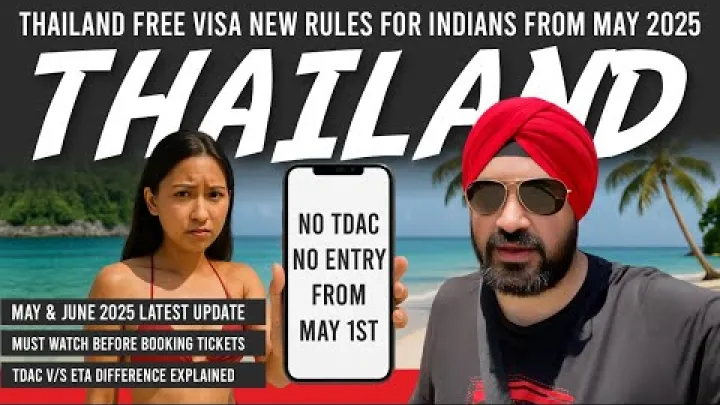
TDAC is mandatory from May 1, 2025. Each traveler, including minors, should submit the TDAC within 72 hours before arrival using the official portal: https://tdac.immigration.go.th. After submitting, keep your confirmation or QR code easily accessible for airline and immigration checks.
TDAC does not replace visa requirements or entry conditions; it is a pre‑arrival data process. A simple pre‑arrival checklist: confirm your stay length and entry path; file TDAC within 72 hours of landing; print or save the TDAC confirmation; carry your e‑Visa approval if applicable; keep accommodation and onward ticket proof handy.
Possible visa-free duration adjustments in 2025
Recent practice has allowed many Indian travelers up to 60 days visa‑free per entry for tourism, alongside a 30‑day extension option in Thailand. However, authorities may adjust the visa‑free stay to 30 days for certain periods or checkpoints. Such changes affect itinerary planning, accommodation bookings, and the need for a tourist visa instead of relying on visa‑free entry.
Verification steps you can follow before you fly: check the Royal Thai Embassy (New Delhi) visa page at https://newdelhi.thaiembassy.org/en/page/visa for current notices; review the e‑Visa site at https://www.thaievisa.go.th for tourist visa alternatives; confirm airline boarding requirements; and recheck https://tdac.immigration.go.th for the TDAC window and any entry notices. Print or save the relevant pages so you can show officers if needed.
Extensions, overstays, and penalties
Many tourists can extend their stay once by 30 days at local immigration offices, but you must apply before your current permission ends. Overstays carry daily fines, capped at a maximum, and serious or prolonged overstays can trigger entry bans. Understanding these rules helps you plan with confidence and avoid unexpected costs.
Keep a clear record of your stamped last day in Thailand, set calendar reminders, and allow buffer days in your itinerary. If you need more time, proceed with an extension rather than risking an overstay.
How to extend a tourist stay
Apply for an extension at a local immigration office before your current permission expires. The standard fee is typically 1,900 THB. Bring your passport, a completed application form, a passport photo, and supporting documents such as accommodation proof and evidence of funds. In Bangkok, for example, extensions are processed at the Immigration Bureau office in Chaeng Watthana.
The standard application form is commonly referred to as TM7. Officers may ask questions about your trip or request additional documents. Extensions are not guaranteed; decisions remain at the discretion of immigration. Start the process early to allow time for any follow‑up requests or a second visit if needed.
Overstay fines and bans
Overstays incur a fine of 500 THB per day, capped at 20,000 THB. Long overstays can lead to entry bans, especially if you accumulated many days or were found during enforcement. Voluntary surrender after a long overstay can still result in bans ranging from one to ten years, depending on the length and circumstances.

Examples: a two‑day overstay at departure typically results in a 1,000 THB fine if there are no aggravating factors. A 45‑day overstay may trigger the 20,000 THB cap and can complicate future entry. Very long overstays (for example, many months) can result in multi‑year bans. Avoid “border runs” aimed solely at resetting stay periods; officers can refuse entry if they suspect non‑compliance.
Travel preparation and contacts
Good preparation ensures a smoother trip. Besides visas and TDAC, think about funds, travel insurance, and basic safety. Having the right contacts and hotlines saved on your phone helps you respond quickly to unexpected events.

Keep copies of your passport data page, visa approval, insurance policy, and bookings in both digital and printed forms. Share your itinerary with a trusted contact and have a plan for emergencies.
Money, insurance, and safety basics
Carry some cash for fees like Visa on Arrival. Use ATMs in well‑lit locations and reputable exchange counters. Travel insurance is strongly recommended for medical expenses, evacuation, theft, and trip disruption; keep your policy and insurer hotline accessible.

Stay aware of common scams such as unsolicited “gem deals,” unofficial tour operators, and unmetered taxis. Use registered taxis or rideshare apps, and confirm prices before service. If you need assistance, the Tourist Police offer English support nationwide at 1155. Save emergency contacts on your phone and keep a backup offline.
Useful hotlines and embassy links
Key numbers: Tourist Police 1155, Emergency medical 1669, and General police 191. For visas and entry guidance, consult official sites. Thailand e‑Visa portal: https://www.thaievisa.go.th. TDAC pre‑arrival filing: https://tdac.immigration.go.th. These links provide current rules, accepted documents, and application steps.
Embassy contacts to bookmark: Royal Thai Embassy, New Delhi visa page: https://newdelhi.thaiembassy.org/en/page/visa. Embassy of India, Bangkok: https://embassyofindiabangkok.gov.in/eoibk_pages/MTM0. Validate hotline numbers and URLs shortly before your trip to ensure accuracy.
Frequently Asked Questions
Do Indians need a visa for Thailand in 2025?
Under the current policy, Indian citizens can enter Thailand visa‑free for tourism, subject to a fixed stay limit and standard entry conditions. For longer stays or multiple trips, consider a tourist visa (SETV/METV) or another suitable category. Always verify rules on official Thai government sites before booking.
How long can Indian citizens stay visa‑free in Thailand?
Most guidance states up to 60 days per entry, with a possible 30‑day extension in Thailand. Some reports suggest the stay could be adjusted to 30 days during certain periods in 2025. Confirm the latest duration before departure and check your passport stamp on arrival.
What is the Visa on Arrival fee and stay limit for Indians?
Visa on Arrival usually costs 2,000 THB in cash and permits up to 15 days. It is available only at designated checkpoints. If you qualify for visa‑free entry, that path generally allows a longer stay with fewer steps.
How do I apply for a Thailand e‑Visa from India?
Apply at https://www.thaievisa.go.th. Create an account, fill out the form, upload documents, pay online, and wait for approval. Processing typically takes about 14 calendar days. Print your approval email and bring it when you travel.
What documents and funds should Indians show at entry?
Carry a passport valid for at least six months, a return or onward ticket within your allowed stay, and accommodation proof. Be ready to show funds, commonly referenced as 10,000 THB per person or 20,000 THB per family. Officers may check your readiness to travel.
Can I extend my Thailand stay as a tourist and what is the fee?
Yes. Many tourist stays can be extended once by 30 days at a local immigration office for a government fee that is typically 1,900 THB. Apply before your current permission expires and bring your passport, photo, and supporting documents.
Is travel insurance mandatory for Indian tourists in Thailand?
Travel insurance is not mandatory for most tourist entries, but it is strongly recommended. Choose a policy with adequate medical cover and keep the policy details accessible in case of emergencies.
What happens if I overstay my permitted stay in Thailand?
Overstays incur fines of 500 THB per day, up to a maximum of 20,000 THB. Serious or prolonged overstays can lead to entry bans. Track your last day carefully and apply for an extension if you need more time.
Conclusion and next steps
For Indian travelers in 2025, Thailand offers flexible entry choices: visa‑free stays for tourism, Visa on Arrival for short visits, and e‑Visa routes for single or multiple entries. Check the latest stay duration, file TDAC within 72 hours before arrival, and keep funds, tickets, and accommodation proofs ready. With timely verification on official portals and careful date tracking, your trip planning will be accurate and stress‑free.
Select area
Create a post
Posting is free and no registration is required.