Hong Kong Official Languages: Chinese, English & Cantonese

Hong Kong has two official languages: Chinese and English. However, the answer to what language is spoken in Hong Kong is different: Cantonese dominates everyday conversation, while Putonghua and English are widely used in particular social, educational, commercial, and institutional settings. This distinction explains why Hong Kong can be legally bilingual while sounding mainly Cantonese in daily life. The sections below cover official status, speaker measures, government and court use, education, writing systems, and cultural identity.
What Are the Official Languages of Hong Kong?
The formal language profile of the Hong Kong Special Administrative Region is easiest to understand when legal status is separated from everyday speech. The law identifies Chinese and English for official use, while population data show how often residents speak Cantonese, English, Putonghua, and other languages in ordinary life.
Chinese and English Are the Two Official Languages
The direct answer is that Hong Kong has two official languages in its legal framework: Chinese and English. This does not mean that Cantonese and English are the two legally named languages. Cantonese is the main local spoken language, but the legal designation is the broader term Chinese.
Basic Law Article 9 states that, in addition to Chinese, English may also be used as an official language by the executive authorities, the legislature, and the judiciary of Hong Kong. This constitutional wording is complemented by the Official Languages Ordinance, which declares English and Chinese to be the official languages of Hong Kong for official communication and proceedings.
The ordinance also provides the statutory framework for using the two languages in communication between the government and the public, in government institutions, and in legal materials. In practical terms, a resident may encounter official information, forms, legislative texts, and court documents in Chinese, English, or both. The existence of two official languages does not imply that they have the same frequency in homes, shops, local media, or informal conversation.
The word Chinese in this legal framework does not specify a spoken variety. It does not state that all official spoken communication must be in Cantonese, nor does it identify Putonghua as a separate official language. It is therefore useful to keep three ideas apart: Chinese and English are the official languages; Cantonese is the dominant local spoken language; and Putonghua is a widely understood spoken variety that has important cross-border and educational roles.
When a decision depends on formal status, such as drafting an official submission or interpreting a legal text, rely on the current wording of the Basic Law and the Official Languages Ordinance rather than on a simplified description. The precise rule can depend on the institution, document, and legal context.
Official, National, and Working Language Are Different Terms
An official language is a language recognized by law for specified public functions. It can be used in communication with public authorities, in legislative work, and in judicial or administrative proceedings under the applicable rules. Official status is therefore about institutional access, legal recognition, and public administration, not about which language most residents use at home.
A working language is a functional term. It describes the language used by an organization or workplace for internal work, meetings, records, or service delivery. A department may use a combination of Chinese, English, Cantonese, Putonghua, and other languages depending on its staff, audience, and task. Working-language practice does not automatically create a new official language.
If someone asks for Hong Kong's national language, the safest legal clarification is that this is not the operative label in the framework above. The relevant official-language answer is Chinese and English. Cantonese can be described as Hong Kong's dominant everyday spoken language and an important cultural language, but it should not automatically be relabeled as a legally designated national or regional official language.
What Languages Are Spoken in Hong Kong?
Hong Kong's spoken-language profile has several layers. Cantonese is the main language of ordinary local interaction, English has a strong official and international role, and Putonghua is widely understood even though it is less often reported as the usual spoken language. Heritage, migrant, community, and signed languages add to this diversity.
The most useful population snapshot comes from the Census and Statistics Department Thematic Household Survey on use of language in Hong Kong. The survey was conducted from September to December 2021 and provides measures for both language ability and usual spoken language.
Cantonese Is the Main Everyday Spoken Language
Cantonese is the main language heard in everyday social interaction across much of Hong Kong. It is commonly classified as a variety of Yue Chinese. Residents use it extensively in family and social conversation, local entertainment, popular culture, and many routine public interactions. Hearing Cantonese in a neighborhood, market, restaurant, or local media setting is therefore normal even though the legal framework uses the broader term Chinese.

The 2021 C&SD language survey needs to be read carefully. Its population base for these measures is people aged 5 and above. Ability to speak means that respondents reported being able to speak the language; it is not a standardized test of equal fluency. Usual spoken language means the language respondents reported normally speaking, not a claim that they use that language in every setting. The results are:
| Language | Reported ability to speak | Reported usual spoken language |
|---|---|---|
| Cantonese | 93.7% | 88.2% |
| English | 58.7% | 4.6% |
| Mandarin or Putonghua | 54.2% | 2.3% |
These figures answer two different questions. The 93.7% figure indicates how many people aged 5 and above reported that they could speak Cantonese, while the 88.2% figure indicates how many named it as their usual spoken language. The gap between the measures is expected in a multilingual society. Some people can speak Cantonese but normally use another language at home or work, and some use different languages with different groups.
The data show why Cantonese is the main everyday spoken language, but they do not turn Cantonese into a separately named official language. Legal status and spoken frequency describe different parts of Hong Kong's language system.
English Is Official but Not the Main Home Language
English has official status in Hong Kong, but it is not the main usual spoken language for most residents. In the same 2021 C&SD measures for people aged 5 and above, 58.7% reported the ability to speak English, while 4.6% reported English as their usual spoken language.

The difference between these percentages is important. English can be used for schoolwork, professional communication, legal materials, international business, higher education, and international-facing administration without being the language a person normally speaks with family or close friends. A reported ability to speak English also covers a range of ability and does not establish that every respondent has the same level of fluency.
For an international visitor, student, or professional, English may be highly useful in formal and cross-border settings. That usefulness should not be confused with population-wide dominance in daily conversation. Many ordinary local interactions are more likely to take place in Cantonese, although the exact choice depends on the people, setting, and purpose.
Putonghua Is Widespread but Usually Not the Main Local Language
Putonghua is the term commonly used in Hong Kong for the Mandarin standard associated with mainland China. It is widely encountered in cross-border communication, interactions with mainland institutions or speakers, some educational settings, and situations involving people from different Chinese-speaking backgrounds.
The 2021 survey reported that 54.2% of people aged 5 and above could speak Mandarin, while 2.3% reported Mandarin as their usual spoken language. These figures show widespread ability alongside a much smaller share using it as their normal spoken language. Widespread ability does not mean that Putonghua is the dominant language of local daily conversation.
Putonghua is also not separately named as a third official language in Basic Law Article 9. The article uses the broader legal term Chinese. This allows the legal framework to recognize Chinese without resolving every question about which spoken variety is used in a particular conversation, classroom, workplace, or courtroom.
Other Chinese Varieties and Minority or Indigenous Languages
The linguistic landscape is broader than Cantonese, English, and Putonghua. Other Chinese varieties and heritage languages discussed in relation to Hong Kong include Hakka, Shanghainese, and Teochew. People may use these languages or varieties within families, social networks, cultural groups, or particular communities. The examples are illustrative rather than an exhaustive list, and no unsupported current speaker totals should be attached to them.
Hong Kong also includes a range of community languages, such as Urdu, Hindi, Nepali, Punjabi, Tagalog, and Indonesian. Hong Kong Sign Language is a signed language and should not be treated as simply another spoken-language variety. These distinctions matter because spoken languages, signed languages, heritage languages, and Chinese varieties describe different kinds of linguistic experience.
References to local, Indigenous, migrant, heritage, or community languages describe social and linguistic presence. They do not confer official status under Hong Kong's Chinese-and-English legal framework. Smaller languages can be important to the people who use them even when they are not used for general government legislation or official proceedings.
How Chinese and English Function in Government and Law
Hong Kong's legal bilingualism has practical effects in administration, legislation, and the courts. It provides official channels in Chinese and English, but it does not require every conversation, document, or department to use the two languages in exactly the same way.
Government Communication and Public Administration
Residents can communicate with the Hong Kong Government in Chinese or English under the official-language framework. Public-facing administration commonly uses bilingual forms, notices, consultation documents, announcements, and information materials, especially when a department needs to reach both local and international audiences.
Bilingual administration is audience-oriented rather than mechanically identical. A department may choose the most useful language arrangement for a particular subject, service, or group of users. Some documents may be issued in both languages, while other communications may lead with one language and provide the other where appropriate. The choice can depend on the department, the audience, and whether the communication is written, spoken, technical, or public-facing.
Written administrative language should also be separated from spoken interaction. A government form may be available in Chinese and English even when a routine service conversation with a local resident takes place in Cantonese. Conversely, an international-facing meeting or professional exchange may use English even though Cantonese remains the usual language in the surrounding community. This is why official bilingualism does not mean that routine public life operates equally in English.
The same principle applies to the legislature and other public bodies. The availability of Chinese and English supports access to official work, while the language heard in a meeting or service interaction can vary with the participants and setting.
Legislation, Courts, and the Judiciary
Chinese and English both have an established role in Hong Kong's legal system. Legislation, explanatory materials, court documents, judgments, forms, and professional legal communication may involve both languages. The important point is that bilingual legal materials are part of the institutional system, not merely informal translations prepared for convenience.
Where legislation has Chinese and English versions recognized as authentic under the applicable statutory rules, the two versions can carry equal legal authority. That does not mean that legal interpretation is a word-for-word comparison or that one version can be ignored. The meaning of a provision must be considered within the relevant ordinance, definitions, context, and rules of interpretation.
Court proceedings may be conducted in either official language where the applicable rules and circumstances allow. The language used in a particular case can depend on the judge, legal representatives, witnesses, parties, documents, and subject matter. A courtroom may therefore include spoken Cantonese while operating within a formal framework that identifies Chinese and English as the official languages.
This distinction is useful for students and professionals who encounter Hong Kong legal material. Cantonese is a common spoken language in the community and may be heard in court, while the statutory label Chinese covers the official language framework for written and institutional purposes. Neither fact makes Cantonese a separately named official language.
A Biliterate and Trilingual Civil Service
The Hong Kong Government describes its policy goal as maintaining a civil service that is biliterate in written Chinese and English and trilingual in spoken Cantonese, Putonghua, and English. This policy connects the legal bilingual framework with the practical needs of public service delivery.
In this context, biliteracy concerns the ability to work with written Chinese and English. Trilingualism concerns spoken-language capability in Cantonese, Putonghua, and English. Training, writing guidance, translation support, and language development help departments serve local residents, mainland-linked audiences, and international users.
The policy is an administrative objective for staffing and service quality. It is not a claim that every civil servant has identical proficiency in all five skills, and it does not create Putonghua as a third official language. It also does not mean that each internal meeting or public interaction uses all three spoken languages. Language choice remains related to the department, task, audience, and staff involved.
The policy helps explain an apparent contrast in Hong Kong. The government can expand the use of Chinese in official work while retaining English for international and professional functions, and employees can be expected to support Cantonese, Putonghua, and English without those spoken languages having identical legal status.
Education and the Role of Language Learning
Education adds another layer to Hong Kong's language profile. A language may be taught as a subject, used for literacy, or selected as the medium of instruction. These are related but different choices, so school language policy should not be read as a direct measure of the language spoken in every student's home.
Biliteracy and Trilingualism in Schools
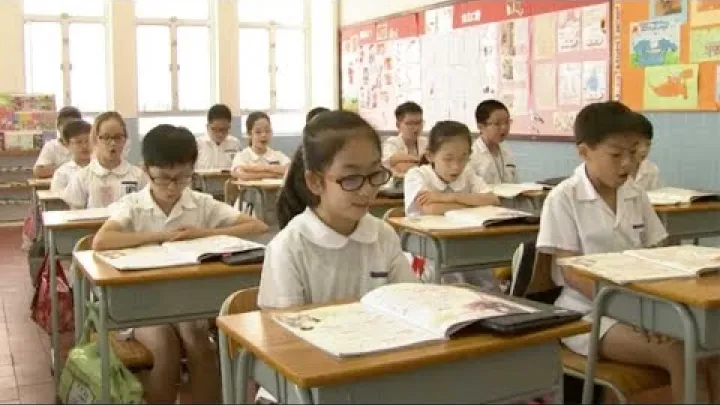
Hong Kong's education goal is often summarized as biliteracy and trilingualism. In practical terms, this means developing the ability to read and write Chinese and English while learning to speak Cantonese, Putonghua, and English. The goal reflects the needs of local communication, public administration, higher education, professional work, and international contact.
The three spoken languages are complementary skills in this education framework. Their inclusion does not mean that Cantonese, Putonghua, and English are three legally equal official languages. Chinese and English remain the official-language categories, while Cantonese, Putonghua, and English describe the spoken-language abilities that education seeks to develop.
A language being taught is not the same as a language being used as the medium of instruction. A school can teach English or Putonghua as a subject while using Chinese or English to teach other subjects. Exposure also varies by school, class, subject, student background, and educational stage. It is therefore unsafe to assume that every school provides the same amount of practice in each language.
The Education Bureau provides guidance that helps explain the relationship between language learning and medium of instruction. Its published material should be read as education policy guidance, not as a population statistic or a legal declaration of official-language status.
Chinese- and English-Medium Instruction
Hong Kong's medium-of-instruction policy has changed over time. Earlier policy efforts encouraged secondary schools to use Chinese as the medium of instruction and discouraged mixed code, meaning a mixture of Chinese and English in teaching and learning. Later arrangements developed more flexibility at the school, class, or subject level.
This history helps explain why English remains important even though Cantonese is the main home and community language for much of the population. English can be central in some secondary and tertiary study, professional training, and international academic or business contexts. At the same time, not every institution is English-medium, and not every subject or school follows the same language combination.
The linked Education Bureau material is marked as archived guidance, so it is most useful for understanding policy development rather than describing one universal current arrangement. Current choices can differ between schools and subjects. Medium of instruction also does not determine a student's complete spoken repertoire: a student may study through one language, learn another as a subject, and use Cantonese or a community language at home.
Writing Systems and Written Language in Hong Kong
Hong Kong's written language choices add an important distinction to the question of what language is spoken. A script records language in writing, but it does not by itself reveal how a person pronounces the words or which spoken variety they use.
Traditional Chinese Characters and English Orthography
Traditional Chinese characters are the established written form of Chinese used across major public, educational, and cultural contexts in Hong Kong. English is written with the standard Latin-based English orthography. These two written systems reflect the official-language framework, but the presence of Chinese characters does not identify a single spoken language.
The same or related Chinese characters may be read with Cantonese pronunciation or Putonghua pronunciation. Written Chinese can therefore connect readers who speak different varieties while leaving pronunciation and some everyday expression different. Traditional characters also do not prove that the writer speaks Cantonese, just as English writing does not prove that English is the writer's usual home language.
Readers may also encounter simplified characters in particular mainland-facing, visitor-facing, or digital contexts. Usage is not uniform across every sign, website, publication, or private message. It is more accurate to describe Traditional Chinese as the established local written convention than to infer a separate legal status for a script unless a specific official rule says so.
Standard Written Chinese, Written Cantonese, and Romanization
Formal written Chinese and spoken Cantonese are related but not identical. Standard written Chinese is commonly used for formal administration, education, and other situations that require a shared written standard. Informal communication, messaging, entertainment, and popular culture may use written Cantonese expressions that more closely represent everyday speech.
Spoken Cantonese and spoken Putonghua can use many related Chinese characters while differing in pronunciation, grammar, word choice, and everyday sentence patterns. A person who can read Chinese characters may still have a different level of ability in spoken Cantonese or Putonghua. Writing ability and spoken ability should therefore be measured separately.
Romanization adds another layer. Cantonese-based romanization appears in some established personal names and place names, while Putonghua Pinyin is associated with the Mandarin standard. Hong Kong does not use one romanization system universally in every name, map, publication, or digital service. Romanization is a method of representing pronunciation, not an additional official language.
Language and Cultural Identity in Hong Kong
Language in Hong Kong communicates more than institutional function. It can signal audience, familiarity, family background, cultural context, or the purpose of an interaction. These social meanings exist alongside the legal categories of Chinese and English.
Cantonese as a Local Cultural Language
Cantonese plays a major role in Hong Kong's local cultural life. It is widely used in social interaction, local media, popular music, entertainment, humor, and ordinary conversation. Its sound, vocabulary, and expressive patterns help shape cultural works made for local audiences.
This cultural role explains why a visitor may hear Cantonese almost everywhere in daily community life even when official documents are bilingual. It also explains why the legal term Chinese can feel less specific than the language people hear around them. The law identifies the language category used by public institutions; social life reveals the spoken variety that is most familiar in many local settings.
Not every resident has the same language background or identity. English, Putonghua, other Chinese varieties, signed language, and community languages all have meaningful roles for different groups. Cantonese's local importance should therefore be described as a strong sociolinguistic and cultural fact, not as a claim that every person uses it or identifies with it in the same way.
The central distinction remains simple: Hong Kong is legally bilingual in Chinese and English, while everyday life is multilingual and is dominated in ordinary local conversation by Cantonese. Putonghua and English can be highly useful without replacing Cantonese as the main local spoken language.
Conclusion: Hong Kong Is Legally Bilingual and Everyday Life Is Multilingual
Hong Kong's two official languages are Chinese and English. For the everyday question, Cantonese is the main spoken language, while Putonghua is widely understood and English has an important official, professional, educational, and international role. The 2021 C&SD measures show the difference between being able to speak a language and naming it as one's usual spoken language.
Government, courts, education, and cultural life add further detail. Written Chinese and English support official work, the civil service aims for written biliteracy and spoken trilingualism, and Traditional Chinese characters are a major part of the local written environment. The clearest summary is therefore: officially Chinese and English; in everyday local speech, mainly Cantonese; in wider public and international life, also Putonghua and English.
Select area
Create a post
Posting is free and no registration is required.