Hong Kong Flag: Design, Meaning, History & Display Rules

The Hong Kong flag is the red-and-white regional flag that represents the Hong Kong Special Administrative Region. Its centered white bauhinia and five red stars make it easy to distinguish from both the Chinese national flag and older colonial designs. The flag also carries an official explanation about Hong Kong’s relationship with the motherland and the principle of one country, two systems. This guide explains the Hong Kong flag’s design, colors, meaning, history, legal status, display protocol, and differences from similar flags.
What the Hong Kong Flag Looks Like
The current Hong Kong flag is officially the Regional Flag of the Hong Kong Special Administrative Region. Hong Kong flag and flag of Hong Kong are common terms, but regional flag is the precise official description. It represents Hong Kong within the constitutional framework of the People’s Republic of China rather than serving as the national flag of a separate country.
The Red Field and White Bauhinia
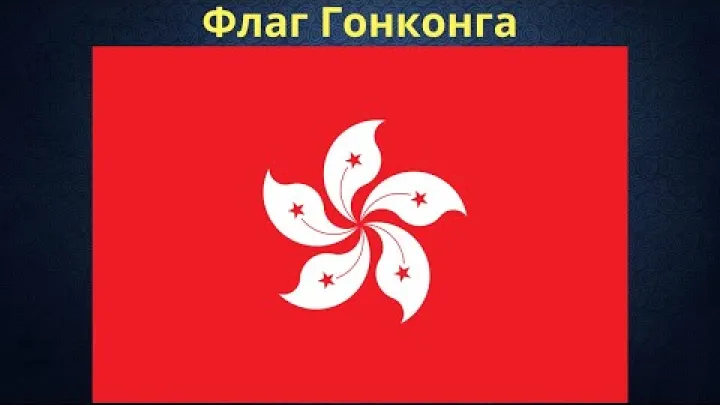
The quickest way to identify the current Hong Kong flag is to look for a red rectangular field with a centered, stylized white bauhinia flower. The flower has five evenly arranged petals. Each petal contains a small red five-pointed star and a red line or trace that follows part of the flower’s inner structure.
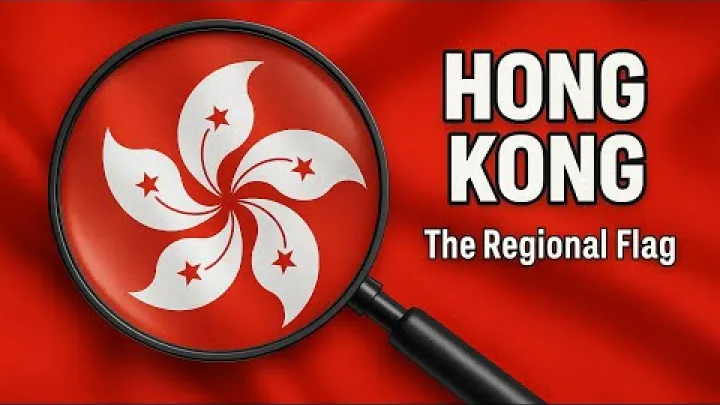
The large white flower is the dominant visual feature. It is not placed inside a white disk, and it does not sit in the corner of the flag. Instead, the bauhinia spreads across the central area of the red field. The red stars and traces create a strong color contrast against the white petals, allowing the design to remain recognizable even when the flag is seen from a distance.
The flag should not be confused with the regional emblem. The emblem is a separate official symbol with a circular design, while the regional flag is the simple red rectangle with the white five-petal flower. Historical images, souvenirs, and online searches may use Hong Kong flag as a broad label, so the date and design should be checked when an image shows a different symbol.
Colors, Ratio, and Official Construction
The main Hong Kong flag colors are red and white. The flag has an official length-to-height ratio of 3:2. Some references write the same proportion as 2:3 because they list height before length. These are not different designs: a flag that is three units long and two units high has a height-to-length ratio of 2:3.
The red field is specified to match the chrominance of the red used on the national flag of the People’s Republic of China. This creates a deliberate visual relationship between the two flags. The central bauhinia is white, with five red stars and red traces within the petals. The flower is arranged symmetrically around the center rather than aligned with the hoist, which is the side attached to the flagpole.
For most readers, the visible features matter more than technical color codes. A correct flag should have a strong red background, a clearly recognizable white five-petaled flower, and five red stars placed within the petals. Hexadecimal, Pantone, and printing values should not be guessed from a screen image because display settings and fabric can change how colors appear.
Hong Kong Flag Meaning and Symbolism
The Hong Kong flag meaning is explained officially through its colors and central flower. Those explanations should be distinguished from broader personal, cultural, or political interpretations. The official symbolism connects Hong Kong to the motherland while also giving the region a distinct visual identity.
The Official Meaning of Red, White, and the Five Stars
The official explanation states that the red background represents the motherland, in a way that parallels the red background of the Chinese national flag. The white bauhinia denotes Hong Kong as part of China. The two colors together are associated with the principle of one country, two systems: Hong Kong is represented as a distinct region while remaining within the country’s national framework.
The five red stars in the petals are officially linked to love for the motherland. They also echo the five-star motif on the Chinese national flag. Their placement inside the white flower is significant to the visual structure of the regional flag: the national connection is shown through the stars and red field, while the bauhinia identifies Hong Kong.
This explanation is presented by the Hong Kong Information Services Department. It is best described as the official interpretation rather than as a universal meaning that every observer must share. For example, people may attach additional ideas to red, white, flowers, or stars, but those broader associations should not be presented as official flag symbolism unless an authoritative source states them.
The Bauhinia as Hong Kong's Regional Symbol
The bauhinia gives the flag its strongest regional character. A flower associated with Hong Kong is placed at the center of a field that visually connects the region to the national flag. This allows the design to communicate two ideas at once: Hong Kong has its own recognized regional symbol, and that symbol appears within a wider national color scheme.
The stylized flower is also practical. Its five broad petals are easy to identify, and the red stars provide a repeated pattern that is distinct from the large yellow stars of the Chinese national flag. The result is a design that can function on government buildings, official documents, ceremonies, and ordinary public displays without needing a detailed coat of arms.
The bauhinia should therefore be understood primarily as a regional symbol in the flag. Public and cultural interpretations may differ, and the flag can carry different personal meanings for different communities. There is no need to add unsupported botanical claims about the flower’s history or biological characteristics in order to understand the flag’s official symbolism.
History of the Hong Kong Flag
The history of the Hong Kong flag is closely connected to the change from British colonial administration to the Hong Kong Special Administrative Region. A useful timeline separates the older colonial design, the approval of the current design, and the first official hoisting of the present flag.
The Colonial Hong Kong Flag Before 1997
Before the current regional flag, the late-colonial flag of Hong Kong was a Blue Ensign. It had a dark blue field, the Union Jack in the upper hoist corner, and Hong Kong’s coat of arms displayed on a white disk. This design is commonly associated with the period from 1959 to 1997.

The colonial flag looked very different from the current red-and-white bauhinia flag. Its Blue Ensign construction and British symbols reflected Hong Kong’s constitutional position under British administration. The coat of arms also gave it a heraldic appearance, whereas the current flag uses a large stylized flower and a repeated star pattern.
Searches for the British Hong Kong flag may therefore produce historical images, reproduction flags, or modern references to the colonial period. Those images can be useful when studying Hong Kong’s history, but the colonial design is not the current legally recognized regional flag. A label showing the historical period is important when displaying or discussing it.
Design Selection and Adoption Before the Handover
The current flag was selected during preparations for the post-1997 Hong Kong Special Administrative Region. A new regional design was needed because the colonial Blue Ensign no longer represented the constitutional arrangement that would begin after the handover. The bauhinia provided a way to express a Hong Kong identity without copying the former colonial design.
The adoption date commonly cited for the current design is 4 April 1990. That date belongs to the formal design-approval or adoption stage, not to the later ceremony at which the flag was first raised in Hong Kong. Keeping those events separate prevents a common historical mistake: treating the date on which the design was approved as the date on which it began everyday official use.
A short timeline is useful:
- Before 1997: The late-colonial Hong Kong flag was a Blue Ensign with the Union Jack and Hong Kong’s coat of arms.
- 4 April 1990: The current red-and-white regional design is commonly dated to its formal adoption.
- 1 July 1997: The current regional flag was first officially hoisted during the handover.
When comparing historical sources, a design illustration dated 1990 and a photograph from 1997 can refer to the same flag while documenting different stages of its official history.
First Hoisting and the Current Regional Status
The current Hong Kong flag was first officially hoisted on 1 July 1997, during the handover that established the Hong Kong Special Administrative Region. At that point, the colonial flag was replaced by the red regional flag with the white bauhinia. The date is therefore both a major historical milestone and the beginning of the flag’s continuing official use.
Today, the flag’s formal role is the regional flag of the HKSAR. It is not the national flag of an independent state. This distinction explains why it appears in Hong Kong government ceremonies and public institutions alongside the Chinese national flag, rather than replacing the national flag in settings where national symbols are required.
The flag’s continuing use reflects Hong Kong’s regional status and its recognized local identity. That constitutional description does not prevent people from attaching personal or cultural meanings to the design, but it does determine the flag’s official name, legal role, and position in formal ceremonies.
Constitutional and Legal Status
The Hong Kong flag has both a constitutional basis and specific local rules for its use. Understanding those two layers helps explain why the flag is officially called regional and why display practices can involve more than simple visual etiquette.
The Regional Flag Under the Basic Law
The Basic Law recognizes the national flag and national emblem of the People’s Republic of China while also allowing Hong Kong to use its own regional flag and regional emblem. In practical terms, Hong Kong has a distinct regional symbol, but that symbol exists alongside the national symbols rather than replacing them.
This two-symbol arrangement is the legal basis for displaying the Chinese national flag and the HKSAR regional flag together. It also explains why the phrase Hong Kong national flag can be misleading. People may use it as a search term, but the formal classification is Regional Flag of the Hong Kong Special Administrative Region.
Relevant national laws on national symbols are identified within the framework set out in Annex III of the Basic Law. The regional flag has its own local legal framework as well. The constitutional arrangement should be kept separate from broader claims about political identity or autonomy, which are not necessary to identify the flag or explain its formal status.
Rules on Misuse, Desecration, and Respectful Display
The Regional Flag and Regional Emblem Ordinance sets rules for the regional flag and emblem. At a high level, it provides that a regional flag or regional emblem must not be displayed upside down and must not be displayed or used in a way that undermines its dignity. These are legal restrictions, not merely suggestions about good manners.
The rules for the regional flag should also be distinguished from protections that apply to the Chinese national flag. The two flags are displayed together in many official situations, but they are not the same symbol and do not derive their legal status from exactly the same instrument. A general statement that a use is respectful or disrespectful is not a substitute for reading the provision that applies to the specific conduct.
This is general information, not legal advice. Before altering, displaying upside down, or using the Hong Kong flag in a public or official setting, check the current wording of the Hong Kong e-Legislation entry for the Regional Flag and Regional Emblem Ordinance. The current ordinance is the appropriate reference for questions about misuse, dignity, and possible legal consequences.
How the Hong Kong Flag Is Displayed
Formal flag display reflects both respect for the symbols and the relationship between national and regional status. The exact arrangement can depend on the setting, so official protocol is more reliable than assumptions based on an informal photograph.
Relationship with the Chinese National Flag
The Chinese national flag has precedence when it is displayed with the Hong Kong regional flag. In a common side-by-side outdoor arrangement, the viewer-facing order is normally the Chinese national flag on the viewer’s left and the HKSAR regional flag on the viewer’s right. This description is from the perspective of a person looking at the flags from the front.
Protocol wording can create confusion because left and right may be described from the flags’ own perspective. In that convention, the national flag is on its right and the regional flag is on its left, which produces the viewer-facing order just described. An instruction that simply says to place one flag to the right is therefore incomplete unless it identifies the perspective.
A simple example is a pair of flagpoles outside an official venue: a person approaching the display sees the Chinese national flag first on the left and the red bauhinia regional flag on the right. The arrangement does not suggest that the regional flag is unimportant. It shows that the national flag has precedence while the HKSAR retains a distinct regional symbol. For formal installations, the current guidance of the Hong Kong Protocol Division should control the placement.
Official Ceremonies and Everyday Public Use
The regional flag appears in Hong Kong government ceremonies and other official settings, often alongside the Chinese national flag. It helps viewers identify the HKSAR within the wider national framework. For international visitors, students, and business professionals, recognizing the bauhinia flag is a useful way to understand why Hong Kong may display a local symbol without using it as a national flag.
When a flag is used in a formal setting, the practical baseline is straightforward: it should be accurately made, correctly oriented, clean, intact, and displayed respectfully. A damaged or heavily altered flag may be unsuitable for an official ceremony even when the same fabric could be treated as a casual souvenir in a private context.
It is also helpful to separate formal requirements from everyday courtesy. A ceremony may follow detailed protocol, while a person seeing the flag in a cultural or educational setting may simply need to identify it correctly and avoid treating it as a decorative object that can be modified without care. When a display is connected to a government or official event, the applicable protocol and law take priority.
How the Hong Kong Flag Differs from Similar Flags
The flag of Hong Kong is sometimes confused with the Chinese national flag or with the British Hong Kong flag. Comparing the field, central or corner symbols, colors, and legal status makes the differences clear even when no image is available.
Hong Kong Flag Compared with the Chinese National Flag
The two flags share a red field and a visible connection through the use of stars. That shared red color is intentional and helps express the official relationship between Hong Kong and the motherland. However, the central layouts are completely different.

The Hong Kong flag has one large white five-petal bauhinia in the center. Each petal includes a red five-pointed star. The Chinese national flag has one large yellow five-pointed star and four smaller yellow five-pointed stars in the upper hoist area. It does not have a white flower.
The status difference is equally important. The Chinese flag is the national flag of the People’s Republic of China. The red-and-white bauhinia design is the regional flag of the HKSAR. A useful verbal test is therefore: centered white flower with red stars means Hong Kong regional flag; yellow stars grouped in the upper hoist corner means Chinese national flag.
Hong Kong Flag Compared with the British Hong Kong Flag
The current flag and the late-colonial flag have almost opposite visual structures. The current design is a red field with a centered white bauhinia. The British Hong Kong flag was a blue field with the Union Jack in the upper hoist corner and Hong Kong’s coat of arms on a white disk.
The colonial design is associated with Hong Kong from 1959 until the 1997 handover. It is relevant to museums, historical research, archival images, and discussions of the colonial period, but it should be labelled as historical. Calling it simply the Hong Kong flag without a date can cause readers to mistake it for the current regional flag.
The comparison also shows how the flag’s symbolism changed. The older design used British colonial heraldry, while the current flag uses the bauhinia, red field, and five red stars to represent Hong Kong’s regional identity within the People’s Republic of China.
Hong Kong Flag: Key Takeaways
The most important facts about the Hong Kong flag can be summarized in a few points:
- Its formal name is the Regional Flag of the Hong Kong Special Administrative Region.
- It has a red rectangular field with a centered, stylized white five-petal bauhinia.
- Each petal contains a small red five-pointed star and a red structural trace.
- The official explanation links the red field to the motherland, the white flower to Hong Kong as part of China, and the red-and-white combination to one country, two systems.
- The five red stars are associated officially with love for the motherland and echo the five-star design of the Chinese national flag.
- The current design is commonly dated to formal adoption on 4 April 1990 and was first officially hoisted on 1 July 1997.
- It is a regional flag, not a national flag of an independent state.
- It differs from the Chinese national flag through its centered white flower and red stars, and from the colonial flag through its red-and-white design rather than a Blue Ensign with British symbols.
For quick identification, look for the white bauhinia at the center of a red field. For historical or official use, also check the date, the flag’s regional status, and the applicable display rules. Together, those details explain both what the Hong Kong flag looks like and why it occupies a distinct place among Hong Kong’s public symbols.
Select area
Create a post
Posting is free and no registration is required.