Hong Kong Neighboring Countries: Which Country Borders Hong Kong?

If you are searching for Hong Kong neighboring countries, the direct answer is simple: China is the only country that shares a land border with Hong Kong. That boundary lies along the northern New Territories beside Guangdong province and Shenzhen, mainland China. Hong Kong also has close maritime and regional connections with Macau and countries around the South China Sea, but those places should not be added to the direct land-border list. The sections below explain how Hong Kong's border is classified, where it is located, and how it functions.
The Direct Answer: Hong Kong Borders China
For the question of what countries border Hong Kong, the answer is one: China. More precisely, Hong Kong's land boundary meets mainland China in Guangdong province. The classification is straightforward geographically, even though the border has unusual administrative and operational features.
China Is Hong Kong's Only Land-Bordering Country
China is Hong Kong's only land-bordering country. The boundary connects Hong Kong with mainland China, not with Guangdong as a separate country and not with Shenzhen as a separate country. Guangdong is the province, and Shenzhen is the large mainland city directly north of much of the urbanized frontier.
Hong Kong is a Special Administrative Region of the People's Republic of China. Therefore, this is a real geographic land boundary between Hong Kong and the mainland, with controlled movement across it, but it is not an international border between two sovereign states. When a geographic database lists Hong Kong's country border, China is the country entry. A CIA World Factbook field listing also identifies China as Hong Kong's regional border.
Why Hong Kong's Border Is Administratively Unusual
The border is unusual because it combines a geographic boundary with a strong administrative and operational divide. Hong Kong and mainland China are within one sovereign country, but Hong Kong operates its own immigration and customs arrangements. A person or vehicle crossing from Hong Kong into Shenzhen is therefore passing through a controlled checkpoint, even though the crossing is not an international border in the standard country-to-country sense.
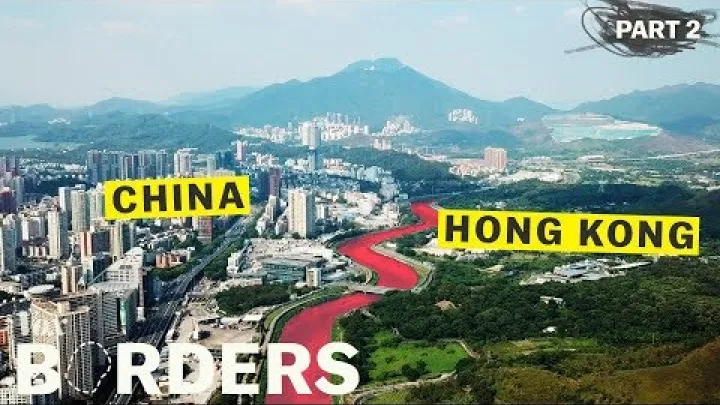
It helps to separate three terms. A country border is the boundary between sovereign states. A land border is a boundary that can be crossed over land, regardless of whether it is international. An administrative boundary separates jurisdictions within a wider political system. Hong Kong's northern frontier is commonly described using the last two ideas: it is a land boundary with mainland China and a controlled administrative frontier, while China remains the only neighboring country in the geographic answer.
Hong Kong's Land Border with Mainland China
Hong Kong's land border is concentrated in the north. Its position makes the relationship with Guangdong and Shenzhen easy to see on a map, while the southern and eastern sides open toward coastal waters rather than additional land frontiers.
Where the Border Meets Guangdong and Shenzhen
The boundary runs along the northern New Territories, the part of Hong Kong closest to mainland China. On the mainland side is Guangdong province. Shenzhen, a city within Guangdong, lies directly across much of the built-up border area and is the mainland urban center most often associated with Hong Kong's land crossings.
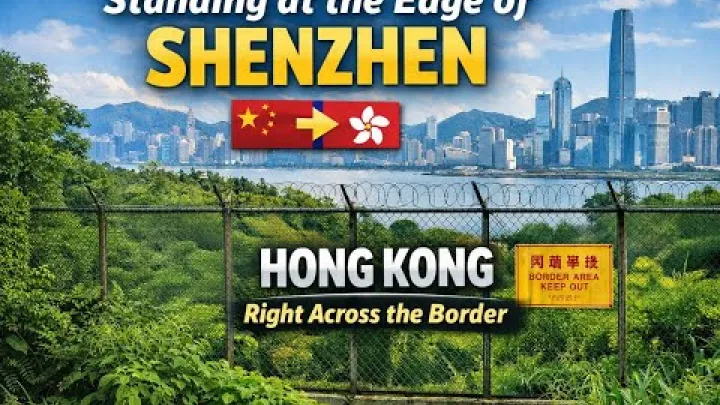
This wording matters when reading maps or lists of Hong Kong borders. Guangdong is a province and Shenzhen is a city; neither should be counted as another neighboring country. Hong Kong has no second land-bordering state elsewhere in its territory. The rest of its perimeter consists of islands, coastline, the Pearl River estuary, and other coastal waters, so a map may show nearby places without showing additional land borders.
How Long Is Hong Kong's Land Border?
Common geographic references give Hong Kong's land boundary with China as approximately 30 kilometres, or about 19 miles. The figure is best understood as a rounded geographic estimate for the total land boundary, not as evidence of several separate country borders. It should not be read as a precise measurement of every fence, river segment, or mapped boundary point.
For ordinary geography questions, the approximate figure is sufficient. For mapping, surveying, property, infrastructure, or legal analysis, use an authoritative boundary dataset and a stated measurement method. The CIA World Factbook field listing is the source for the commonly reported 30-kilometre figure used here.
Border Crossings and Their Practical Role
Hong Kong's land boundary is not only a line on a map. It is a controlled immigration and customs interface used by people, freight, road traffic, and rail services. Crossings connect the northern New Territories with the mainland, and their practical role helps explain why Hong Kong borders can feel more significant than an ordinary internal administrative line.
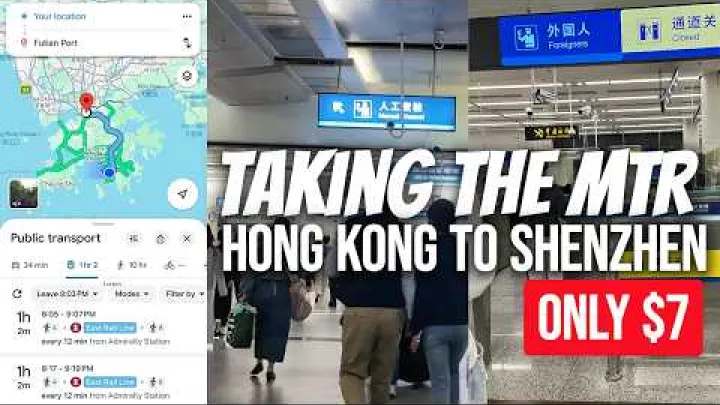
The Hong Kong Transport Department identifies nine land crossings, including road-based and rail-based crossings. The exact status or operation of an individual crossing can change, so anyone planning a journey should consult the Hong Kong Transport Department for the current list and operating information. These crossings are access points along the single land boundary with China, not separate country borders.
Maritime Neighbors: China, Macau, and the South China Sea
Hong Kong's geography is mainly coastal. That creates important nearby places across water, but a maritime neighbor is not automatically a country that shares Hong Kong's land border. Keeping these categories separate avoids one of the most common errors in answers about countries bordering Hong Kong.
Maritime Boundaries Are Different from Land Borders
Hong Kong sits beside the Pearl River estuary and the South China Sea. Water surrounds much of the territory, and the waters immediately around Hong Kong form part of its local maritime setting within China. The wider South China Sea, however, contains maritime relationships involving multiple coastal states. These relationships should not be treated as additional land borders.
![Preview image for the video "SOUTH CHINA SEA DISPUTE MAPPED EXPLAINED [2024] #shorts #shortsfeed #shortsviral #shortsusa".](/sites/default/files/styles/media_720x405/public/oembed_thumbnails/2026-08/Lp3z7hPRWFOchEMDk-ISG6THJdIYFcFfXuN_z5ahfvA.jpg.webp?itok=eEMUqu1V "Preview image for the video \"SOUTH CHINA SEA DISPUTE MAPPED EXPLAINED [2024] #shorts #shortsfeed #shortsviral #shortsusa\".")
For this reason, a useful classification is: China is the direct country neighbor by land; Macau is a nearby administrative territory; and countries such as Vietnam, the Philippines, and Malaysia are wider regional maritime neighbors. Do not add a foreign country to the direct list simply because it is located across the sea or appears on a map of the South China Sea. Background descriptions of Hong Kong's boundaries, such as Boundaries of Hong Kong, also distinguish the land boundary from the broader maritime setting. Exact maritime lines and measurements can depend on the boundary definition and should not be inferred from a simple regional map.
Macau Is a Nearby SAR, Not a Neighboring Country
Macau is the closest major administrative neighbor commonly discussed with Hong Kong. It is another Special Administrative Region of China, located across the Pearl River estuary. Hong Kong and Macau therefore belong to the same sovereign country while retaining separate administrative systems.
Hong Kong and Macau do not share a land border. Their separation is by water, so Macau is better described as a nearby neighboring administrative territory or maritime neighbor, not a neighboring country. It appears in discussions of Hong Kong's neighbors because both SARs are close to one another, have distinct immigration and customs controls, and occupy the same Pearl River Delta region. Those facts explain the proximity without changing the answer to the land-border question.
South China Sea Countries Are Regional Neighbors, Not Direct Borders
The South China Sea provides a wider regional frame. It is bordered by or associated with several coastal states, including Vietnam, the Philippines, and Malaysia, as well as China and other jurisdictions. Those countries may be described as regional maritime neighbors of Hong Kong in a broad geographic discussion, but they do not share a direct land border with Hong Kong.
Sharing the same sea, shipping area, or broad regional map is not the same as bordering Hong Kong directly. The EBSCO South China Sea overview identifies the sea's wider coastal setting, which helps explain why these countries appear in regional lists. Unless a source is using a specific and authoritative maritime-boundary definition, it is better not to rank the nearest foreign countries: nearest can mean straight-line distance, maritime boundary, or location around the wider sea.
The direct answer remains unchanged: China is the only country with a land border with Hong Kong. Macau is nearby but not a country, while Vietnam, the Philippines, Malaysia, and other South China Sea states are regional maritime neighbors rather than direct land neighbors.
Bottom Line on Hong Kong's Neighboring Countries
Hong Kong has one country on its land-border list: China, along the northern New Territories next to Guangdong and Shenzhen. Its other important geographic relationships are across water, including Macau across the Pearl River estuary and the wider South China Sea region. Distinguishing the single land boundary from nearby administrative and maritime neighbors gives the clearest answer to questions about Hong Kong borders and neighboring countries.
Select area
Create a post
Posting is free and no registration is required.