Timor-Leste Population: 2025 Estimate, 2022 Census & Growth
The population of Timor-Leste is estimated at 1,418,517 people in 2025, or about 1.42 million. This latest figure from the World Bank is an annual estimate, not a live headcount. The latest national census recorded 1,341,737 people in 2022, so the two figures answer slightly different questions. This guide explains the population of Timor-Leste by year, its recent growth, population density, and urban share while keeping census counts separate from estimates and projections.
What Is the Population of Timor-Leste?
There are two important population figures for Timor-Leste: the latest annual estimate and the latest national census count. Both are useful, but they should not be presented as though they were collected in the same way.
Latest reliable population estimate
The latest figure used in this article is 1,418,517 people in 2025. Rounded for general use, that means about 1.42 million people live in Timor-Leste.
The 2025 number is a model-based annual estimate. It is produced for a specific reference year using demographic information and statistical methods. It is not a real-time count of every person in the country, and the final digits should not be interpreted as proof of live, day-by-day precision.
For most readers, the best wording is “Timor-Leste had an estimated population of about 1.42 million in 2025.” Including both the year and the word “estimated” makes the figure easier to compare with other population data.
The number is most useful as a standardized reference point for comparing Timor-Leste with other countries or for following a consistent international series over time. It is less suitable for answering how many people were physically present in a particular municipality on a particular day. For that purpose, readers should use a census or local administrative source whose reference date and geographic coverage are clearly stated.
The latest census count and what it means
The latest comprehensive national count supplied by the National Institute of Statistics Timor-Leste is 1,341,737 people in 2022. The INETL population summary identifies this as the 2022 population size. The associated census publication is presented as preliminary results in the supplied INETL material, so that status should remain visible when the figure is quoted.
A census records people according to a defined census operation, reference date, geographic coverage, and population definition. An annual estimate, by contrast, fills the years between major counts through demographic modeling. The 2022 figure is therefore the best benchmark for the 2022 census, while the 2025 figure is the more recent annual estimate.
- 2022: 1,341,737 people, a national census count reported by INETL.
- 2025: 1,418,517 people, an annual estimate reported through World Bank data.
The census count should not be substituted for the 2025 estimate simply because it comes from a direct enumeration. Likewise, the estimate should not be described as a new census count.
Timor-Leste Population by Year
A population-by-year timeline is useful only when every value has a clear label. Timor-Leste's historical record includes census snapshots and annual modeled estimates, and those categories should remain separate.
Official census benchmarks
The 2015 and 2022 census years provide the most useful recent national benchmarks. A GHDx census record reports 1,167,242 people in 2015, with the census conducted in July of that year. INETL reports 1,341,737 people in 2022.
| Year | Population | Data type | How to read it |
|---|---|---|---|
| 2015 | 1,167,242 | Census count | Record for the July 2015 census |
| 2022 | 1,341,737 | Census count | INETL national census figure |
These are snapshots rather than annual observations. They show the population recorded during two census operations, but they do not show exactly how the population changed in every intervening year.
There is also an important source difference. INETL's 2022 summary reports a population change of 158,094 people and a 13.4 percent increase for the relevant census comparison, with an average annual increase of 22,399 people. That result does not reconcile arithmetically with subtracting the GHDx 2015 figure from the 2022 figure. The difference may reflect a revised or preliminary value, a different comparison base, or a different population definition or reference point. The figures should therefore be retained under their original source labels rather than silently combined into a new calculation.
For a historical comparison, the safest approach is to quote each census with its own source and status. A census value can be useful even when a later publication revises or clarifies it, because the original observation remains part of the country's demographic record. It should simply not be presented as interchangeable with a modeled estimate for the same nominal year.
Annual estimates between census years
Annual estimates are designed to describe population change between census benchmarks. For a consistent population-by-year series, use one annual series, such as the World Bank total-population data, rather than switching between census counts, health estimates, and unrelated summaries.
![Preview image for the video "[🇹🇱Timor-Leste] Population Pyramid & Ranking (1950-2100) #wpp2024".](/sites/default/files/styles/media_720x405/public/oembed_thumbnails/2026-08/cwrkkR4aLGQZzz9YNCtu9eegudgf_D_j8IMk3UOl5ao.jpg.webp?itok=lgkeJMop "Preview image for the video \"[🇹🇱Timor-Leste] Population Pyramid & Ranking (1950-2100) #wpp2024\".")
The clearly stated recent annual point used here is the 2025 World Bank estimate:
| Year | Population | Data type | Use |
|---|---|---|---|
| 2025 | 1,418,517 | Annual estimate | Latest stated value used in this article |
The 2023 and 2024 values are not reproduced here because the data summary used for this article does not state those exact observations. They should not be created by averaging the 2022 census and 2025 estimate or by drawing a straight line between them. If a complete annual timeline is needed, retrieve all years from the same World Bank series and preserve each year's estimate label.
Annual estimates can also be revised when the underlying United Nations or national data, methods, or historical assumptions change. A revised estimate is not automatically evidence that an earlier census count was incorrect; it may reflect a different statistical process.
Readers comparing a year such as 2021, 2022, or 2024 should first decide whether they need a recorded census result or a harmonized annual estimate. The answer affects which source is most appropriate. For a census-year event, the national census provides the direct benchmark; for a multi-year chart, a single annual series avoids switching methods midway through the comparison. If two sources show different values, retain both labels and compare their reference year, population definition, and revision status before drawing a conclusion.
How Fast Is Timor-Leste's Population Growing?
Timor-Leste's population is increasing, but the growth rate depends on the period and the type of data being used. A census-period average and a single-year modeled growth rate are not interchangeable.
The recent population growth trend
INETL's census summary reports a 13.4 percent population increase from 2015 to 2022. It also reports an average annual increase of about 1.8 percent, or approximately 22,399 additional people per year across the comparison period.
This is an average across a census interval, not a claim that the population grew by exactly 1.8 percent in every year. It summarizes the change between the relevant census benchmarks.
The World Bank country data also present a separate population-growth indicator expressed as an annual percentage. That indicator is a modeled annual observation and has a different time basis from INETL's census-period average. The supplied data summary does not state a precise latest annual growth rate, so no unsupported rate is assigned here.
Read together, the available figures support a direction of continued population growth rather than decline. The broader annual modeled pattern can be described as growth with a gradually moderating pace, but that qualitative description should not be turned into a precise recent rate by comparing the 2022 census count directly with the 2025 estimate.
Growth rates also need a denominator and a time interval. A percentage calculated across the full period from one census to the next answers a different question from the change reported for a single calendar year. Small differences can also arise from rounding, revised historical estimates, or whether the series is based on enumerated residents or a modeled total. For practical comparisons, report the period first, then the rate, and identify whether it came from a census summary or an annual statistical series.
Main demographic factors behind growth
Population growth is determined by the balance between births, deaths, and migration. In simple terms, natural increase is the number of births minus the number of deaths. Net migration then adds or removes people depending on the balance between arrivals and departures.
- Fertility and births: More births increase the population when they exceed deaths and outward migration. A fertility figure must always be tied to a particular year and source.
- Mortality and life expectancy: Fewer deaths or longer survival can raise the total population, while mortality changes can reduce the pace of growth.
- Migration: Net migration can accelerate or slow population growth, but gross movement into and out of the country is not the same as net migration.
The headline population figures do not provide enough evidence to assign a percentage of Timor-Leste's growth to each factor. They also do not by themselves prove that fertility, mortality, or migration was the dominant influence during a particular period. A responsible demographic explanation therefore identifies these factors without presenting undocumented relative weights or exact assumptions as facts.
These factors can matter differently over time. Births and deaths affect natural increase within the country, while migration can change the total even when the number of births and deaths remains stable. The effect may also vary between Dili, other municipalities, and more remote communities. Without a matching local series for each factor, however, it is safer to describe the mechanisms than to rank their contribution or apply a national rate to every municipality.
Population Density and Urbanization in Timor-Leste
Population density and urbanization add geographic context to the national total. They are useful for understanding where people are concentrated, but neither measure should be treated as a direct measure of living conditions in every community.
National population density
Population density is calculated by dividing the population by the country's land area. It is normally expressed as people per square kilometer and must always be read with its reference year and method.
A year-specific density series reports Timor-Leste's national population density at 93.09 people per square kilometer in 2023, compared with 92.08 people per square kilometer in 2022. The Macrotrends population density series reports these values as part of its historical data.
| Year | Density | Meaning |
|---|---|---|
| 2022 | 92.08 people per km² | Year-specific national average |
| 2023 | 93.09 people per km² | Year-specific national average |
A national average can hide major local differences. Population is more concentrated in Dili and other settled areas, while remote or mountainous parts of Timor-Leste can have much lower settlement density. The national figure should therefore not be used as a direct estimate of crowding, housing demand, or infrastructure pressure in every municipality.
Density is also sensitive to the land-area denominator. A national calculation and a calculation for a municipality or built-up settlement may use different boundaries, so two valid density figures can differ without either being wrong. Density does not show how evenly homes are distributed, how accessible services are, or how much land is actually developed. Those questions require local geographic and infrastructure information in addition to the national average.
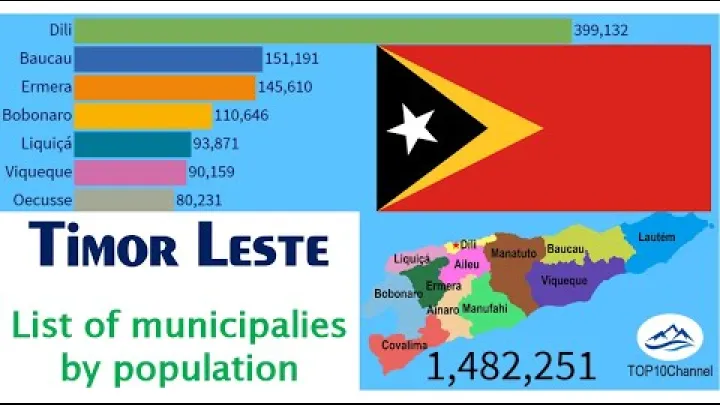
When using density for a local decision, first check the year and methodology of the national series, then consult municipality-level data from INETL or another clearly identified census source. Municipal density, city density, and built-up-area density describe different geographic units.
Urban population and Dili's role
The World Bank urban population indicator uses the World Urbanization Prospects basis. Its recent series places Timor-Leste's national urban share at roughly 30 percent. Because a rounded chart summary does not provide a single precise latest year-value pair here, the exact percentage and reference year should be read together from the live World Bank urban population series when making a formal comparison.

The national urban percentage is a statistical classification, not the population of Dili. It may include urban places outside Dili and depends on the definition used by the underlying World Urbanization Prospects series. It should not be combined with a Dili estimate from another year or with a built-up-area estimate that uses different boundaries.
Dili is an important local anchor because the capital and its surrounding settled areas are central to discussions of population concentration, services, housing, and employment. However, Dili municipality, the wider built-up capital area, and the other municipalities of Timor-Leste are not interchangeable geographic units.
Before comparing urban shares, confirm whether the figure refers to the national urban population, Dili municipality, a particular municipality, or a defined built-up area. Also record the year and classification. This prevents a national percentage from being mistaken for a city-specific population measure.
Understanding Differences in Timor-Leste Population Sources
Different population figures are not necessarily contradictory. They often describe different dates, methods, or statistical purposes.
Why population figures vary
The three most common labels are census count, annual estimate, and projection. Each has a different role:
| Data label | What it represents | Best use |
|---|---|---|
| Census count | People recorded during a national census operation | Benchmark for the census year |
| Annual estimate | Modeled population for a year between or after census benchmarks | Consistent year-to-year trend analysis |
| Projection | Possible future population under stated assumptions | Scenario planning, not a current count |
Values can differ because a census may be preliminary or later revised, the reference date may differ, and one source may count residents while another uses a different population concept. International estimates can also be updated when new census results, birth and death data, migration assumptions, or modeling methods become available.
The safest comparison method is to use the official census figure for a census year and one consistent annual series for the years between censuses. Do not average a census count with an annual estimate to create an unofficial current population. Do not treat a future projection as though it were an observed result.
How to update the article responsibly
Population information changes as statistical agencies publish new results or revise historical series. Readers who track Timor-Leste's population can keep the information clear by following a few simple practices:
- Date-stamp every figure. Write “2025 estimate” or “2022 census count,” not simply “current population.”
- Use the relevant official sources. Recheck INETL for census results and the World Bank series for annual estimates when a newer update is available.
- Preserve historical labels. Keep earlier census values in the timeline instead of rewriting them as annual estimates after a newer figure appears.
- Keep projections separate. Present future values as scenarios that depend on assumptions about fertility, mortality, and migration.
- Remove unsupported precision. If a series changes its method or revision status, use an appropriate rounded figure and explain the change rather than retaining misleading final digits.
This approach is useful whether the information is being used for study, travel research, business planning, or relocation. A clearly labeled historical estimate is more useful than a single number that hides its year and method.
Timor-Leste Population: Key Takeaways
Timor-Leste's latest population figure used here is 1,418,517 people in 2025, or about 1.42 million. The latest national census benchmark is 1,341,737 people in 2022. The first is an annual estimate, while the second is a census count, so they should not be treated as identical measurements.
The country has continued to grow, with INETL reporting a 13.4 percent increase and an average annual increase of about 1.8 percent for the relevant 2015-to-2022 census comparison. National density was reported at 93.09 people per square kilometer in 2023, while the urban share is roughly 30 percent in the recent World Bank series. For any comparison involving Dili, Timor-Leste's municipalities, or future projections, always include the reference year, geographic definition, and data type.
Select area
Create a post
Posting is free and no registration is required.