Dili Getting There: Flights, Land Routes & Ferries

Getting to Dili usually means choosing between a regional flight and a long overland journey from Kupang in Indonesian West Timor. Domestic ferries are useful for reaching Dili from Oecusse or Atauro, but they are not normally the main international arrival option. This guide explains the principal routes, indicative journey times and costs, booking difficulty, land-entry documentation, and practical connections from Dili’s arrival points into the city. Transport schedules, fares, and operating days can change, so treat dated examples as planning benchmarks rather than guaranteed services.
How to Get to Dili: Choose the Right Access Route
For most international visitors, flying into Dili Airport is the simplest choice. The Kupang–Dili bus route is usually less expensive but takes a full day and requires advance attention to land-entry rules. Sea travel is more relevant to domestic journeys from Oecusse or Atauro, while rail is not presented as a practical access mode in the available route information.
Compare Air, Land, Sea, and Rail Access
The best route depends on whether you value speed, low cash cost, or the overland experience. Air travel is faster and can normally be booked online, but Dili-bound flights may be infrequent and relatively expensive. Overland travel costs less in the reported example, yet it involves two countries, border formalities, and a much greater chance of a late arrival. Ferries can be useful within Timor-Leste, but their schedules and ticket procedures may be harder to confirm than flight bookings.
| Mode | Typical use | Indicative time | Cost and booking | Main difficulty |
|---|---|---|---|---|
| Air | Regional gateways to Dili | About two hours from Bali on the final segment | Fare varies; online airline booking is usually possible | Limited frequency and separate-ticket connections |
| Land | Kupang through Mota'ain/Batugade to Dili | About 12 hours in one reported example | About USD 25 in that example; local bus booking | Visa authorization, border delays, and long road travel |
| Sea | Domestic travel from Oecusse or Atauro | About 8–12 hours from Oecusse; roughly 2–3 hours from Atauro | Local fares and port ticketing; current details vary | Weather, maintenance, and changing sailing information |
| Rail | No established practical route to Dili identified | Not applicable | Not a practical booking option | Dili does not have a useful rail-access pattern in this guide |
These times describe the main transport segment, not necessarily the complete journey from your home. A flight through Denpasar or Darwin also includes the connection into that gateway, while the Kupang route includes travel to the bus departure point and time at the border. Because Dili has a limited number of external gateways, a missed flight, bus, or ferry can affect the rest of an itinerary more significantly than it would in a large regional hub.
Understand Dili's Role as Timor-Leste's Main Gateway
Dili is Timor-Leste’s principal international entry point. International air arrivals are concentrated at Presidente Nicolau Lobato International Airport, commonly called Dili Airport and identified by the IATA code DIL. Maritime access is centered on the Port of Dili on the city waterfront. The Mota'ain/Batugade crossing connects the road network from Kupang with Dili, while domestic services link the capital with Atauro Island and the Oecusse enclave.
This concentration makes Dili the natural starting point for many trips around Timor-Leste. It also means that route planning should include a buffer: an arrival at the airport, border, or port may not connect smoothly with the next service on the same day. Travelers beginning in Oecusse or returning from Atauro should treat Dili as the connection point for their onward international journey, rather than assuming that a domestic service will line up with a flight.
Flying to Dili Through Presidente Nicolau Lobato International Airport
Flying is normally the most convenient way to reach Dili from outside Timor-Leste. The practical question is not only which airline serves Dili, but also which regional gateway gives you the most reliable complete itinerary.
Know Dili Airport and Its Location
Presidente Nicolau Lobato International Airport, or Dili Airport, uses the code DIL. It is in Madohi, in the Dom Aleixo area of western Dili, and is the main airport for international arrivals. Use both the full airport name and DIL when searching airline websites, itinerary tools, and airport flight information.

The airport’s western location matters when you arrange the final road transfer. It is close enough to serve Dili but is not the same place as the waterfront Port of Dili or the central area. For operational details such as check-in deadlines, immigration procedures, terminal access, and flight status, rely on the current airline and airport information for your travel date rather than an older travel summary.
Compare Regional Gateways and Domestic Connections
From Indonesia: Denpasar in Bali is the clearest regional gateway scenario for many travelers. Bali has a larger international flight network than Dili, so a trip may combine a long-haul flight into Denpasar with a separate regional flight to DIL. Allow enough time when tickets are separate, particularly if checked baggage must be collected and rechecked. A destination page from Aero Dili lists destinations and markets including Denpasar, Malaysia, Australia, Singapore, the Philippines, China, and Timor-Leste. Such a list is useful for identifying possible route patterns, but it should not be read as a promise that every city has a nonstop service on every date.
From Australia: Darwin is the most obvious Australian regional gateway in the available route information. A direct Darwin–Dili service can be attractive because it avoids a longer connection through another Southeast Asian airport. The actual operating days, seasonal frequency, and fare need to be checked for the intended date.
From Southeast Asia: Singapore and Kuala Lumpur may work as connecting points, especially when your long-haul itinerary already reaches one of those hubs. Some route listings also show possible connections involving selected Chinese cities. These options can involve a connection, a limited number of weekly departures, or a seasonal schedule, so compare the full booking rather than assuming that a displayed route is a daily nonstop flight.
From Oecusse: Travelers already in Oecusse may find a domestic Dili–Oecusse flight useful when it is operating and seats are available. Timor-Leste does not have a dense domestic air network, so this should be treated as a possible internal connection, not as a broad alternative network for reaching Dili from several parts of the country.
Compare Flight Time, Fare, and Booking Difficulty
The Bali–Dili air segment is a useful benchmark: one published fare example described the flight as taking about two hours and a return ticket as costing around USD 434. This is an indicative, non-live figure rather than a current quote. Prices can change with travel dates, demand, baggage rules, booking channel, and season. The final flight may be short while the complete journey is much longer because of the connection into Denpasar.
| Route scenario | Flight time | Indicative fare | Best booking approach | Flexibility to allow |
|---|---|---|---|---|
| Denpasar–Dili | About two hours for the final segment | About USD 434 return in a published example | Check the operating airline and DIL booking | Allow time around the Bali connection |
| Darwin–Dili | Short regional service when scheduled | Use the current airline quote | Check the operating airline directly | Check the date-specific operating pattern |
| Singapore or Kuala Lumpur–Dili | Depends on the connection | No stable fare benchmark | Compare a complete itinerary, not only one segment | Look for a workable overnight connection if needed |
| Oecusse–Dili | Domestic connection; current duration varies | Use the current domestic fare | Confirm the local flight schedule and seat availability | Do not assume a same-day international connection |
Booking difficulty is often caused by frequency rather than by the booking website itself. A low-cost long-haul ticket is not useful if its arrival misses the only practical Dili service that day. Compare baggage rules, airport changes, connection protection, and whether the itinerary is on one ticket. A single booking may offer more assistance after a disruption, while separate tickets can require you to manage the connection yourself.
Plan Around Limited Flight Frequency
Dili flight schedules have changed between published airline announcements. For example, Airnorth has published a daily-service announcement that also referred to ten weekly departures during a busy dry-season period, while a separate Airnorth page described Monday, Wednesday, and Friday flights for travel from 1 January to 28 February 2025. These are date-specific or seasonal examples, not a permanent timetable.
The practical lesson is to search the airline’s own booking system for your exact dates and check available airport flight-status information close to departure. If your itinerary uses separate tickets, consider arriving at the gateway the day before the Dili flight. Keep an alternative travel date or route available, particularly when a missed service would leave you waiting several days. Recheck the airline, airport, and booking status close to departure instead of relying on a historic weekly pattern.
Travel Overland from Kupang to Dili
The Kupang–Dili road route is the main overland alternative for travelers approaching from Indonesia. It combines local road transport in West Timor with immigration at the land border and a further road journey through Timor-Leste.
Follow the Kupang–Mota'ain/Batugade–Dili Route
The usual route runs from Kupang through the Mota'ain/Batugade border area and onward by road to Dili. Buses and minibuses are the main options. This is a cross-border journey, not a simple domestic bus ride: passengers must complete the relevant Indonesian departure and Timor-Leste entry procedures before continuing.
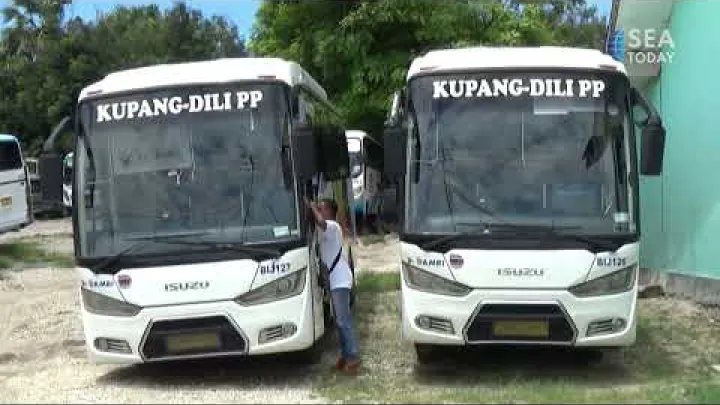
A local travel-group report describes a bus fare of about USD 25, a departure from Kupang at approximately 06:00, and a total journey of around 12 hours. The same report names Timor Tours & Travel and refers to other bus companies. These details are useful as an indicative pattern, but they do not establish a guaranteed current departure point, operator, fare, or border timetable. Confirm those details in Kupang, including where to meet the bus and whether the vehicle continues all the way to Dili.
The route can be appealing if you want to travel overland or keep the transport cost low. Its trade-off is a long day with more variables than a flight. A short delay in Kupang, at immigration, or on the road can affect the time you reach Dili, so avoid treating the reported 12-hour duration as a fixed arrival promise.
Arrange Land-Entry Visa Authorization Before Crossing
Do not assume that the entry procedure at the land border is identical to the procedure that may apply to an eligible traveler arriving at Dili Airport or the Port of Dili. For many travelers, entry through the Batugade/Mota'ain crossing requires a Visa Application Authorization arranged in advance. Practical guidance from Koryo Tours identifies the Timor-Leste Consulate in Kupang and an online application route as possible ways to arrange this authorization.
Requirements are nationality-specific and can change. Before leaving Indonesia for the border, confirm the current land-entry rules with Timor-Leste Immigration or a Timor-Leste consulate. Ask specifically whether your nationality is eligible for the intended route, whether a Visa Application Authorization is required, how far in advance it must be requested, which supporting documents are needed, what fees and payment methods apply, and whether the authorization will be accepted at the crossing on your travel date.
A useful pre-crossing checklist is:
- Carry the passport that was used for the authorization application and confirm that it is valid for the planned journey.
- Keep the Visa Application Authorization or approval evidence in the format requested by the issuing authority, with a backup copy if appropriate.
- Have supporting travel, accommodation, onward, or financial documents available if the current application instructions require them.
- Confirm the border crossing, operating hours, and any Indonesian departure requirements connected with your status.
- Prepare the required fee or payment method and keep important documents separate from ordinary luggage.
Most importantly, do not arrive at Mota'ain/Batugade without the authorization that the current rules require and expect the border office to solve the problem on arrival. A bus ticket does not replace immigration approval. If the consulate or immigration authority gives you a document, check that the names, passport details, and intended entry point match your travel plans.
Prepare for a Long and Variable Road Journey
Plan the Kupang–Dili trip as a full-day journey. The reported 12 hours can become longer because of border formalities, road conditions, traffic, stops, and weather. Departure at about 06:00 may help use the day, but the departure time itself must be confirmed locally rather than assumed from an older report.
Bring drinking water, food for periods when no suitable stop is available, and any medication needed for motion sickness. Wear comfortable clothing and keep your passport, authorization, phone, cash, and other valuables accessible but secure. It is also sensible to carry a charged phone and a small amount of backup power because a long road transfer may provide fewer convenient opportunities to recharge.
Arrange your first accommodation in Dili before departure and make sure you know how the bus operator describes its Dili drop-off point. Do not book a tight same-day flight, ferry, or other fixed connection after the bus journey. The safer plan is to arrive in Dili with time to settle in, especially when the international flight or onward booking is expensive or difficult to replace.
Reach Dili by Sea or Return from Timor-Leste's Islands
Sea travel has a narrower role than air and land travel. The Port of Dili is important for domestic passenger services and cruise calls, while the routes most useful to independent travelers are the domestic connections with Oecusse and Atauro Island.
Understand the International Role of the Port of Dili
The Port of Dili sits on the city waterfront and is the main maritime arrival point in the capital. However, a port shown on a map should not be confused with a regular international passenger-ferry terminal. The available route information does not establish a dependable, independently bookable passenger ferry from Indonesia into Dili. For an international visitor choosing between practical access modes, flying or crossing by land is normally more relevant.
Cruise arrival is a separate arrangement. The cruise line organizes the passenger itinerary, the vessel’s port call, and the instructions for leaving and returning to the ship. Immigration and shore-access procedures may differ from those for an independent traveler buying a one-way ticket. Do not assume that a cruise passenger arrangement creates a public ferry service or that a seaport visa-on-arrival procedure applies to every nationality and travel purpose. Confirm the current instructions with the cruise operator, port, or Timor-Leste immigration authority.
If you are considering a vessel that is not clearly marketed as a passenger service, confirm directly with the Port of Dili or the operator that it accepts the intended type of passenger and documents. A possible cargo, charter, or cruise movement should not be treated as a normal scheduled ferry option.
Travel Between Oecusse and Dili by Ferry
Oecusse is separated from the rest of Timor-Leste by Indonesian territory, so a domestic ferry can be useful for travelers who want to remain within Timor-Leste instead of crossing the Indonesian land border. The reported services include the Berlin Ramelau and Success. A port and logistics profile from the Logistics Cluster describes departures from Dili on Mondays and Fridays, returns from Oecusse on the following day, and a one-way journey of about 8–12 hours.
Those details are a useful service pattern, not a guaranteed current timetable. Confirm the vessel, sailing day, departure time, fare, ticket location, and return arrangement for your dates. The ferry is best understood as a domestic route into Dili from Oecusse or as part of a wider Timor-Leste itinerary. It is not a substitute for the international arrival process when you are starting outside the country.
A Dili–Oecusse domestic flight may be a faster alternative when it is operating and seats are available. Air travel can reduce time on the road and sea, but it does not remove the need to confirm the local schedule. Compare the flight and ferry not only by price, but also by how easily you can change the booking and how much buffer you need before an onward international flight.
Travel Between Atauro and Dili by Ferry
Atauro Island is another domestic destination connected with Dili. The arrival area commonly associated with the island route is Beloi. For a traveler already on Atauro, the ferry back to Dili can be the practical first step before an international departure or a further trip along the Timorese North Coast.
Different service snapshots mention Success, Berlin Nakroma, and earlier fast-ferry or Dragon Boat services. Vessel availability and operating days have changed, so an older list should not be treated as a permanent choice of boats. The same caution applies to reported low single-digit US-dollar fares and crossing times of roughly two to three hours: use them as indicative examples only, not as a live fare or guaranteed duration.
For most visitors, the Atauro ferry is a domestic side-trip or return connection rather than a primary international route into Dili. It may be inexpensive compared with a flight, but the booking process can require more local planning and the sailing can be less predictable. If you are traveling from Atauro to catch a flight, plan to return to Dili well before the flight date instead of relying on a same-day ferry connection.
Verify Ferry Operations Before Departure
Ferry information is not consistently published online in one continuously updated timetable. Some departures, ticket procedures, and vessel changes may be communicated at the port or through a current local contact. Treat a routine service pattern as different from a confirmed sailing.
- Confirm the sailing shortly before travel at the Port of Dili, the relevant island port, or through the current operator. Check the vessel name, date, time, destination, and whether passengers are being accepted.
- Ask where tickets are sold and whether payment must be made in cash. Keep the fare and a small reserve separate from your main luggage.
- Arrive early enough for ticket collection, loading, and any passenger instructions. Do not assume that an online mention of a ferry is an online reservation.
- Consider seasonal conditions. Wet-season weather, maintenance, public holidays, and other operational changes can lead to delays or cancellations.
- Leave an overnight or otherwise substantial buffer before an important flight. A ferry departure should not be the final connection immediately before international air travel.
Confirm the departure at the port shortly before travel, especially during the wet season, and keep an alternative date in mind. This is more useful than planning around an exact fare or a historic sailing day that may no longer apply.
Continue from Dili's Arrival Points to the City Center
Once you reach Dili, the last connection is a road transfer into the central area. Keep this step simple: know which arrival point you are using, arrange help for a late arrival when possible, and confirm the details of any paid transfer before leaving the airport or port.
Choose a Safe, Practical Last-Mile Transfer
Dili Airport is in Madohi, in western Dom Aleixo, while the Port of Dili is on the waterfront. From either point, your accommodation may be in central Dili or another part of the urban area. Exact travel times and fares are not stated here because they depend on the time of day, traffic, vehicle, and current local conditions.
- Prearranged private pickup: This is usually the most predictable choice, particularly for a late-night flight, a first visit, or an arrival after a long overland journey. Ask your accommodation or a trusted operator to provide the driver’s name, telephone number, vehicle description, and meeting point.
- Taxi: A taxi offers flexibility when you have not arranged a pickup. Confirm the vehicle and agree the fare or payment arrangement before departure. If several people approach you, choose the driver or company you have actually agreed to use rather than accepting unsolicited assistance.
- Public transport: A public option may be less expensive, but use it only when current local information confirms the route, operating hours, luggage practicality, and exact stop. Do not rely on an old route description for a late arrival.
If you arrive by bus from Kupang, ask the operator for the exact Dili drop-off point before the bus leaves. A current central terminal name is not established in the available information, and the final stop may not be the most convenient place for your accommodation. Save the accommodation address and telephone number offline so that you can show it to the driver or contact the property without depending entirely on mobile data.
Common arrival problems are often avoidable with a few simple checks. Confirm the vehicle before getting in, keep your passport and phone with you, agree the fare or transfer terms in advance, and do not hand luggage or documents to unsolicited helpers. Arrange accommodation before arrival and ask whether someone can assist if your flight, bus, or ferry arrives later than planned. These precautions do not assume that a particular scam is widespread; they simply reduce confusion when you are tired and unfamiliar with the arrival point.
Conclusion: Build Your Dili Arrival Around Verified Connections
Choose a flight through Denpasar, Darwin, or another confirmed regional gateway when speed and simpler border administration matter most. Choose the Kupang–Mota'ain/Batugade–Dili road route when the overland experience and lower reported fare outweigh the longer, less predictable journey, and arrange any required Visa Application Authorization before departure. Use the Port of Dili ferries mainly for domestic travel from Oecusse or Atauro, not as an assumed international ferry connection.
Whichever route you choose, confirm the operator, schedule, documents, and final Dili drop-off details close to travel. A flexible connection plan, accommodation arranged in advance, and a generous buffer before an important flight will make reaching Dili much easier.
Select area
Create a post
Posting is free and no registration is required.