Timor-Leste Official Languages: Tetum, Portuguese, and More

Timor-Leste has two official languages: Tetum and Portuguese. This direct answer is important, but it is only one part of a broader language system that also includes Indigenous national languages and the working languages Indonesian and English. In daily life, a visitor or new resident may encounter different languages depending on the setting, generation, profession, and location. Understanding these categories helps explain why the language used in a conversation may differ from the language used in a law, school document, or government publication. That distinction is especially useful in Dili, where formal institutions and everyday multilingual communication often meet in the same streets, workplaces, and public services.
What Are the Official Languages of Timor-Leste?
Timor-Leste’s Constitution sets out distinct categories for languages used by the State and by its communities. The categories matter because a language can be important in everyday communication without being an official language, and a language can have an official role without being equally familiar to every person.
Tetum and Portuguese are the official languages
Timor-Leste has two official languages: Tetum and Portuguese. The Constitution gives both languages official status in the Democratic Republic of Timor-Leste. In English-language material, Tetum may also appear as Tetun; “Tetum” is the spelling used in the English text of the Constitution.
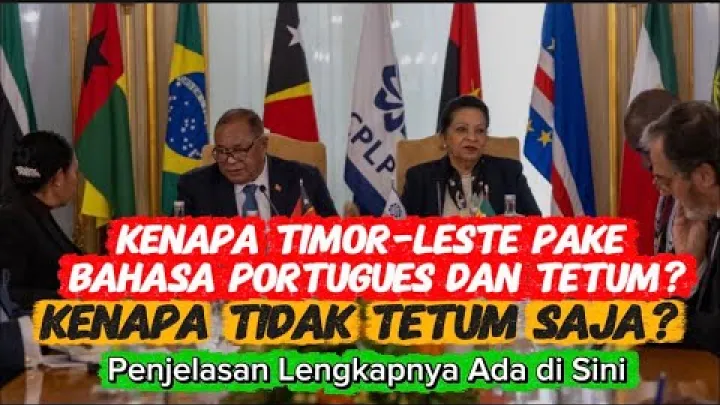
Official status places Tetum and Portuguese within the State’s formal legal and institutional framework. It does not mean that the two languages have the same number of speakers, are used in exactly the same situations, or are understood equally throughout the country. Tetum has an additional role as a national language, reflecting its importance in communication and national life. The constitutional wording can be read in the Constitution of Timor-Leste.
How official, national, and working languages differ
The constitutional categories are best understood as a layered system. Official languages are used for the State’s formal purposes. National languages include Tetum and the country’s other Indigenous languages, which the Constitution says should be valued and developed. This recognition is significant, but national-language recognition is not the same as official-language status.

Indonesian and English have a separate constitutional position as working languages to be used in the civil service where necessary. They are not official languages of Timor-Leste. This distinction is especially useful when reading bilingual documents, job notices, technical reports, or material produced with international partners.
| Category | Languages | Main meaning |
|---|---|---|
| Official languages | Tetum and Portuguese | Languages of the State’s formal framework |
| National languages | Tetum and other Indigenous languages | Languages to be valued and developed |
| Working languages | Indonesian and English | Used in civil service where necessary |
How Tetum and Portuguese Function Differently
Tetum and Portuguese share official status, yet their social and institutional roles often differ. Their use can overlap, and the balance can change between a family home, a public office, a classroom, a court-related setting, and an international meeting.
Tetum as an official and national language
Tetum is widely used for everyday communication and for communication between people from different language communities in Timor-Leste. It is especially important as a shared language in urban life, public discussion, and many ordinary interactions. In Dili, people may encounter Tetum frequently in conversation, local media, shops, and public-facing communication.

Tetum belongs to the Austronesian language family. Tetum Dili, also called Tetum-Prasa, is an influential urban variety associated with the capital and with much public communication. It should not be treated as identical to every form of Tetum spoken across the country. Like many living languages, Tetum has regional and social variation alongside its developing standard written use.
Tetum uses a Latin-based writing system and has received attention for spelling and standardization in public and educational contexts. The National Institute of Linguistics is associated with Tetum standardization work. Written standards can make it easier to prepare school materials, government information, and media content, while spoken forms still reflect local usage.
Portuguese in government, law, and education
Portuguese has a prominent role in formal administration, legislation, legal education, diplomacy, and parts of the education system. Its position is connected to Timor-Leste’s history under Portuguese colonial rule, the independence period, and relationships with Portuguese-speaking countries and institutions. It is therefore both a practical institutional language and part of the country’s wider international connections.
Portuguese may be particularly visible in formal texts, official ceremonies, legal settings, and professional education. However, institutional importance does not mean universal fluency. People’s familiarity with Portuguese can vary according to their educational experience, age, occupation, location, and exposure to the language. For a newcomer, it is safer to view Portuguese as important for formal institutions rather than assume it will be the easiest language for every everyday interaction.
Why equal official status does not mean equal everyday use
Constitutional equality describes legal status, not identical social reach. Tetum is often associated with broad interpersonal communication and accessibility across communities, while Portuguese is strongly associated with formal State functions and Lusophone connections. These are useful general patterns, not fixed rules.
Language choice can change quickly with context. A household may use a local language, friends may use Tetum, a formal document may use Portuguese, and a technical meeting may include English or Indonesian. Students, civil servants, health workers, business professionals, and people who have lived abroad may each have different language repertoires. This is why a simple question such as “what language is spoken in Timor-Leste?” has more than one useful answer.
National and Indigenous Languages Across Timor-Leste
Beyond Tetum and Portuguese, Timor-Leste is linguistically diverse. Indigenous languages carry local histories, oral traditions, family connections, and community knowledge. Their role is central to understanding the country’s cultural life, even when they are not the principal languages of formal national administration.
Examples of national languages and regional patterns
Examples of Indigenous national languages include Fataluku, Makasae, Makalero, Bunak, Mambai, Tokodede, Galoli, Kemak, and Baikeno. This is a selective list rather than a complete inventory. The Constitution’s national-language category recognizes the importance of these languages, while their documentation, written resources, and institutional support can differ.
Regional patterns are useful but should be treated with care. Fataluku is strongly associated with Lautém district, including the area around Lospalos, but a district can contain more than one language community and many residents also use Tetum or other languages. Mobility, marriage, schooling, work, and urban migration further shape which languages are heard in a particular place. A general overview of the language landscape is available through Languages of Timor-Leste, though local language use is best understood through community-level context.
For visitors and organizations, this diversity has practical implications. Tetum may help communication across communities, but local languages can be especially meaningful in family, customary, and village settings. Respectful communication includes asking what language a person prefers rather than assuming that one language will suit every situation.
Austronesian and Papuan language families
Timor-Leste includes languages associated with both Austronesian and non-Austronesian, often called Papuan, language classifications. Tetum is an Austronesian language. Languages such as Fataluku, Makalero, Makasae, and Bunak are often discussed in relation to non-Austronesian or Papuan groupings.
These labels are linguistic classifications, not measures of cultural value or simple statements about identity. Linguists may use different subgroup names or emphasize different evidence when describing relationships among the languages of Timor and nearby islands. The important point for most readers is that Timor-Leste’s linguistic diversity is deep and cannot be reduced to the two official languages alone.
Writing systems and orthographic development
Tetum is written with a Latin-based alphabet and has received formal attention for standardized spelling. This supports its use in education, public information, publishing, and administration. Standardization does not remove all variation, but it creates shared conventions that can help readers and writers communicate across settings.

Other national languages have differing levels of documentation and orthographic development. Some communities, educators, researchers, and local projects use written forms for language teaching, cultural documentation, literacy work, or local publications. There is no single standardized spelling system that applies to all national languages in Timor-Leste.
Uneven written development affects practical opportunities. Where teaching materials and agreed spelling conventions are limited, it can be harder to produce classroom resources, record oral heritage, or provide local-language public information. At the same time, oral use remains an important form of cultural transmission and should not be judged solely by the volume of printed material available.
Indonesian and English as Working Languages
Indonesian and English are part of Timor-Leste’s language environment, but their legal category and typical uses differ from those of Tetum and Portuguese. Their presence reflects history, regional connections, international cooperation, education, and professional needs.
Indonesian's historical and contemporary role
Indonesian became prominent in administration, education, and media during the period of Indonesian occupation. That history gives the language both practical relevance and historical sensitivity. Many people, particularly those educated during that period or connected with Indonesian-language media and regional networks, may have knowledge of Indonesian.
Under the Constitution, Indonesian is a working language, not an official language. It can remain useful for regional communication, cross-border links, research, trade-related contacts, and access to media from Indonesia. Its present-day use is not uniform across all generations or communities, so it should not be assumed to be either absent or universally dominant. The policy distinction between official and working languages is discussed in an RSIS language policy brief.
English in international and technical contexts
English has a working-language role and may be encountered in international organizations, development programs, technical communication, higher education links, and some business or professional settings. It can be valuable where Timor-Leste engages with global partners, but targeted professional use should not be confused with widespread everyday fluency.
English is not an official language of Timor-Leste. It is also not the principal language of the national education system under the formal language framework described for Tetum and Portuguese. International visitors may find English useful in some hotels, projects, offices, or specialized services, particularly in Dili, but should not rely on it as the default language for all interactions. A 2024 discussion in English Today examines this multilingual setting.
Language in Education, Law, and Public Administration
Language policy becomes most visible when people use schools, courts, ministries, health services, and government publications. Formal policy establishes broad goals, while everyday implementation can depend on staff language skills, available materials, and the linguistic background of the community being served.
Tetum and Portuguese in the education system
Timor-Leste’s Education System Framework Law provides the basis for treating Tetum and Portuguese as languages of the education system. The intended relationship is bilingual: Tetum can support comprehension and early learning, while Portuguese has an important role in formal education and access to the country’s Lusophone legal and educational environment.
Classroom practice can be more complex than policy wording. Teachers and students may have different levels of proficiency in Tetum and Portuguese, and many children begin school with an Indigenous language as their strongest home language. Teacher preparation, textbooks, learning materials, and local language backgrounds can all affect how a bilingual policy works in practice.
National languages and Indonesian may remain important resources in a learner’s life, but they should not be confused with the formal legal framework for the main languages of the education system. For families considering schooling or relocation, it is useful to ask a particular school which languages it uses for instruction, explanation, materials, and communication with parents.
Official languages in law, government, and media
Tetum and Portuguese are the core languages of formal government and legal communication. Portuguese is particularly associated with legal and formal written domains, while Tetum can be important for public accessibility and wider communication. Their relationship matters because a State document may have a formal legal form while citizens need information in a language they can readily understand.
The Official Gazette of Timor-Leste is a relevant example of the State’s formal publication system. Government websites and publications can also show how official communication is presented in practice. The Government of Timor-Leste publication pages provide current institutional examples, but language availability can vary by document, department, and purpose.
Indonesian or English may appear in technical, administrative, translated, or international materials. Their presence does not change their constitutional status into official languages. People who need an authoritative legal or administrative text should confirm the relevant publication version and language with the responsible institution rather than assuming that every document is available in both official languages.
Why Language Matters to Timor-Leste's National Identity
Language choices in Timor-Leste are connected to sovereignty, public participation, and cultural continuity. The country’s system reflects both the need for shared national institutions and the reality of many local language communities.
Language, sovereignty, and historical memory
The selection of Tetum and Portuguese as official languages has historical and political meaning in a country shaped by Portuguese colonialism, Indonesian occupation, and the restoration of independence. Tetum is closely associated with communication across communities and Indigenous national identity. Portuguese connects Timor-Leste to legal, educational, diplomatic, and Lusophone institutions.
These roles are not mutually exclusive. One language can support accessible national communication while another supports formal legal continuity and international relationships. The constitutional choice is therefore better understood as a layered response to history and state-building than as a simple competition between two languages.
Balancing national unity with linguistic diversity
Tetum can help people communicate across communities, while Indigenous national languages preserve local identity, oral traditions, customary knowledge, and family ties. Portuguese, Indonesian, and English add other institutional and international connections. This multilingual reality is an asset, but it also creates policy challenges for education, literacy, translation, and public access to information.
A central challenge is expanding literacy in the official languages without marginalizing the languages people use at home and in local communities. Effective language planning must account for the fact that formal administration and daily community life do not always operate in the same language. Respect for local languages can improve participation while Tetum and Portuguese continue to serve national institutions.
Key Takeaways About Timor-Leste's Languages
Timor-Leste’s official languages are Tetum and Portuguese. Tetum is also a national language and is widely used in everyday communication, while Portuguese has a major role in formal administration, law, education, and diplomacy.
The country also recognizes the value of its many Indigenous national languages, including languages associated with communities in places such as Lautém district and Lospalos. Indonesian and English are working languages rather than official languages. For anyone studying, working, relocating, or visiting, the most useful approach is to expect a multilingual setting: Tetum is often practical for ordinary communication, Portuguese is important in formal institutions, and local language knowledge remains deeply meaningful in community life.
Select area
Create a post
Posting is free and no registration is required.