Mongolia National Symbols: Emblem, Animal, Bird and Flower
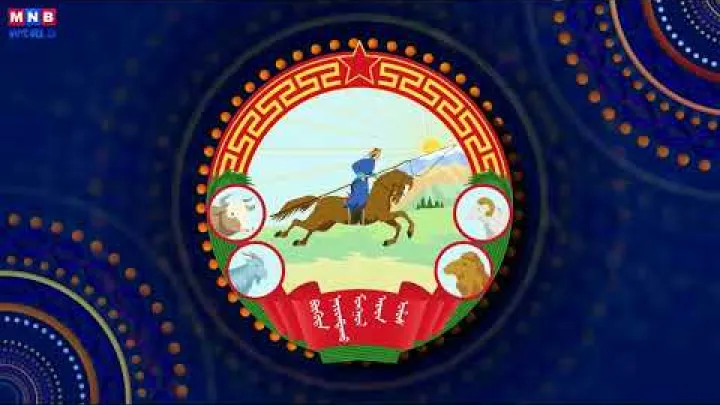
Mongolia's national symbols bring together constitutional emblems, steppe wildlife, spiritual heritage, and everyday culture. The clearest legal starting point is Article 12 of the Mongolian Constitution, while several popular symbols have a broader cultural or conservation status. This guide explains what each symbol represents and separates formal state recognition from reported national designations. It also addresses the commonly searched questions about Mongolia's national animal, bird, flower, tree, fruit, and motto.
Understanding Mongolia's National Symbols
National symbols do not all have the same status. Some are established in constitutional or government records, while others become meaningful through cultural practice, heritage recognition, conservation work, or widespread public use. That distinction is especially important in Mongolia, where a symbol may be closely connected with national identity without being one of the country's formally defined state symbols.
Official State Symbols and Cultural Symbols
Article 12 of Mongolia's Constitution identifies the State Emblem, Banner, Flag, Seal, and Anthem as symbols of the country's independence and sovereignty. The constitutional list provides the strongest basis for calling an item an official state symbol. The University of Minnesota Human Rights Library reproduces this constitutional provision in English.
This article concentrates mainly on the symbols beyond the flag and anthem. It therefore gives special attention to the State Emblem, the Soyombo, the Great White Banner, the Takhi, the Saker falcon, and Ber tsetseg. It also covers the morin khuur, buuz, and Eternal Blue Sky as widely recognized cultural symbols rather than presenting them as constitutional state symbols.
The following summary shows how the terms should be understood:
| Symbol | Status used here | Main association |
|---|---|---|
| State Emblem | Constitutional state symbol | Independence, sovereignty, and national identity |
| Great White Banner | Constitutional ceremonial symbol | Unity, statehood, and historical continuity |
| Soyombo | State emblem element and independent national sign | Continuity, balance, and Mongolian identity |
| Takhi | Widely recognized national animal | Freedom, endurance, and the horse-centered steppe |
| Mazaalai | Reported national pride animal | Rarity, resilience, and conservation responsibility |
| Saker falcon | Reported national bird | Open landscapes, falconry, and wildlife protection |
| Ber tsetseg | Reported national pride flower | Peaceful life and respect for nature |
| Morin khuur | Widely recognized cultural instrument | Horse culture, music, and heritage |
| Buuz | Widely recognized food symbol | Hospitality, family, and shared celebrations |
How to Read Official Versus Cultural Recognition
A simple rule helps: constitutional text, legislation, or a government resolution establishes formal status; cultural use and popular recognition establish broader symbolic importance. A national animal, national pride animal, national bird, and national pride flower may therefore describe different kinds of recognition.
When a symbol is formally established, an authoritative record should identify the institution and the act that created or confirmed the designation. When no such record is clear, more careful wording is appropriate. Terms such as reported national designation, national pride symbol, widely recognized cultural symbol, or important conservation symbol are more accurate than automatically using official national symbol.
This matters for school research, museum writing, translation, and government-related information. Tourism pages and informal lists can show how a symbol is promoted, but promotional language is not by itself proof of legal status. If exact status matters, consult the Constitution and a current Mongolian state record, and check whether the document says adopted, designated, protected, or simply recognized.
Mongolia's State Emblem, Soyombo, and Great White Banner
Mongolia's coat of arms, the Soyombo, and the Great White Banner express the country's statehood and historical identity in different ways. The State Emblem has a formal constitutional role, the Soyombo functions as a powerful national sign within and beyond the emblem, and the Great White Banner represents ceremonial continuity.
What the State Emblem Represents
Mongolia's State Emblem is a constitutionally recognized symbol of independence and sovereignty. It is used as an expression of the state itself, rather than simply as a decorative image of the country. For that reason, the State Emblem has a more clearly formal status than symbols that appear mainly in cultural or tourism lists.
The coat of arms is generally described as a circular composition with a blue-sky background and a central Soyombo. Descriptions of its imagery also identify a horse, mountains, a lotus, the Dharma wheel, and a ceremonial scarf or khadag among its important visual elements. Together, these features connect the emblem with the open landscape, Buddhist and spiritual heritage, the horse-centered history of the steppe, and the continuity of Mongolian statehood.
Interpretations of individual elements can vary depending on the historical or cultural explanation being used. It is safer to describe the overall message as sovereignty, continuity, spiritual heritage, and connection with the natural environment than to present every popular explanation as a fixed legal definition. The emblem should also be discussed separately from the flag, whose Soyombo imagery has its own design history and symbolism.
The Soyombo as a National Symbol
The Soyombo is both a central element of the State Emblem and an independent national sign. It appears in official and public visual identity and is immediately associated with Mongolia. Its use beyond the coat of arms explains why many discussions of Mongolia's national symbols list it separately.
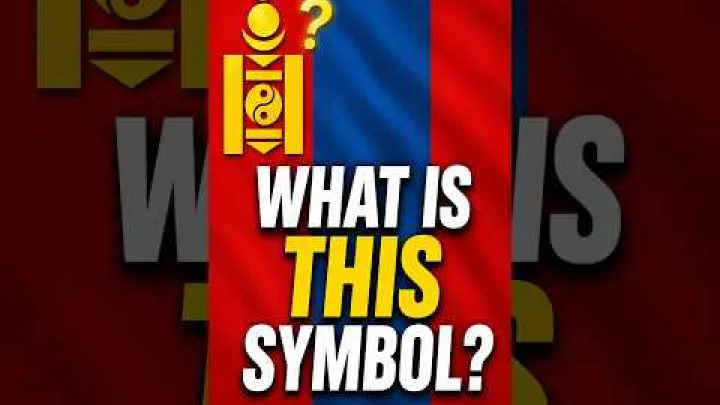
The symbol has a vertical structure with a flame at the top, sun and moon forms, and geometric shapes below. Public interpretations connect these parts with themes such as continuity, life, balance, prosperity, honesty, protection, and vigilance. These explanations are useful for understanding its cultural meaning, but they should not be treated as one universally fixed legal translation for every shape.
The Soyombo therefore operates on two levels. Within the State Emblem, it contributes to the visual identity of the sovereign state. In wider cultural use, it serves as a compact expression of Mongolian history, identity, and enduring national presence.
The Great White Banner as Ceremonial Heritage
The Great White Banner is recognized in Mongolia's constitutional framework as the traditional banner of the unified Mongol Empire and a ceremonial state symbol. Its status is distinct from that of the modern national flag. The Constitution's reference to the Banner places it within the country's formal state symbolism, while its historical associations give it a strong ceremonial and heritage role.

The banner is commonly connected with unity, statehood, historical continuity, and the horse-centered heritage of the steppe. Those themes explain why it remains important even for readers who encounter it mainly in descriptions of national ceremonies and historical tradition. The most reliable general explanation is its role as a link between the modern Mongolian state and earlier Mongol statehood.
Additional claims about exact construction, materials, ritual use, or the details of particular ceremonies should be made only when supported by a specific historical or government record. The essential distinction is that the Great White Banner is a ceremonial heritage symbol, not another name for Mongolia's flag.
Mongolia's National Animal and Bird
Wildlife symbols are among the most recognizable parts of Mongolia's national identity. The Takhi represents the country's horse culture and conservation story, while the Saker falcon reflects the open steppe, falconry traditions, and the need to protect migratory wildlife.
The Takhi as Mongolia's National Animal
Direct answer: The Takhi, also known as Przewalski's horse, is widely presented as Mongolia's national animal and is an important national symbol. Some public descriptions call it the official national animal, but Mongolia's constitutional list of state symbols does not name an animal. The safest general wording is therefore that the Takhi is Mongolia's widely recognized national animal and national symbol, while its precise formal designation should not be confused with a constitutional state symbol.
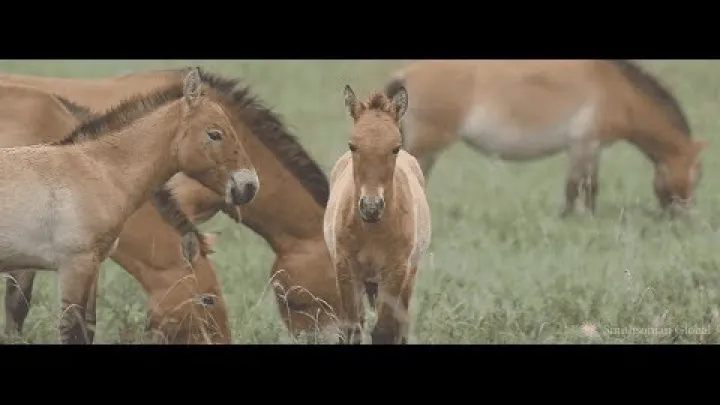
The Takhi represents freedom, endurance, resilience, and the deep importance of horses in Mongolian history and daily life. It should not be confused with Mongolia's domesticated horses. The Takhi is a wild horse, and its cultural importance comes partly from the idea of a native wild animal returning to the steppe rather than from the country's much broader horse-riding tradition alone.
The animal is also a conservation symbol. The American Museum of Natural History describes the Takhi as an important national symbol for Mongolians and as a significant case study in reintroducing wild horses to Mongolia. This makes the Takhi a useful example of how a national symbol can support public attention to habitat, reintroduction, and long-term wildlife protection.
Symbolic recognition does not by itself guarantee conservation success. The status of wild herds, habitat, and management can change, so current ecological claims should be based on a recent conservation or government record. For a general article, it is enough to connect the Takhi with Mongolia's steppe heritage and the continuing effort to protect a distinctive wild species.
Mazaalai as a National Pride Animal
Direct answer: Mazaalai, the Gobi bear, is often described in Mongolian national-pride discussions as a national pride animal. It is a separate category from the Takhi's widely recognized national-animal status. Presenting Mazaalai as a national pride symbol acknowledges its importance without claiming that it occupies the same formal or popular position as the Takhi.
The Mazaalai's symbolic value comes from rarity, vulnerability, resilience, and the responsibility to protect Mongolia's Gobi environment. A rare native animal can represent national conservation responsibility even when it is not listed among the constitutional state symbols.
Because a specific government decision and date are not identified in the material supporting this overview, formal writing should use the cautious phrase national pride animal or national conservation symbol unless a Mongolian state record confirms a different designation. Current population figures should also be omitted unless they come from a recent authoritative wildlife source.
The Saker Falcon as Mongolia's National Bird
Direct answer: The Saker falcon is Mongolia's reported national bird. Mongolian cultural-government material discusses the Saker falcon in this national-bird context, as shown by Culture.gov.mn. A report from the Convention on Migratory Species records that the Saker falcon was officially designated as Mongolia's national bird.
The Saker falcon fits Mongolia's national imagery because it is associated with open steppe landscapes, speed, independence, and falconry traditions. Falconry also gives the bird a connection with skill, prestige, and the long relationship between people and wildlife on the steppe. In a national-symbol context, the bird represents both cultural heritage and a living part of Mongolia's natural environment.
The national-bird designation is also connected with conservation policy. The CMS material places the designation in 2012 and records a five-year moratorium announced by the Mongolian government. That is historical context, not proof of a current capture, export, or quota rule. Readers seeking present-day legal information should consult current Mongolian wildlife regulations rather than relying on an old policy reference or an informal tourism claim.
Mongolia's National Flower and Other Nature Symbols
Nature symbols give Mongolia's national identity a visual connection with the steppe, the Gobi, and the country's distinctive wildlife. They also show why status labels matter: the terms national pride flower and national pride animal may be used even when an item is not part of the constitutional list of state symbols.
Ber Tsetseg as the National Pride Flower
Direct answer: Ber tsetseg is commonly identified as Mongolia's reported national pride flower. English-language references often associate the name with Scabiosa comosa, but the wording national pride flower should be preserved rather than automatically changed to the stronger claim national flower.
Ber tsetseg is commonly linked with peaceful life and respect for nature. These associations make the flower a useful cultural symbol of harmony between people and Mongolia's landscapes. They are interpretive meanings, however, rather than a substitute for a formal legal definition.
For a concise and accurate description, name Ber tsetseg, state that it is a reported national pride flower, and explain its cultural associations. Detailed claims about botanical classification, distribution, cultivation, or conservation should be added only when supported by an appropriate botanical or Mongolian institutional record.
What Mongolia's Nature Symbols Represent
The main nature symbols share several themes, but each has a different status and emphasis:
- Takhi: freedom, endurance, wildness, and the continuing importance of horses.
- Mazaalai: rarity, resilience, vulnerability, and national conservation responsibility.
- Saker falcon: open steppe landscapes, falconry, prestige, and wildlife protection.
- Ber tsetseg: peaceful life and respect for nature.
This comparison is an interpretation of recurring cultural meanings, not a list of legal definitions. It shows how Mongolia can use animals and plants to express both national character and environmental responsibility. A symbolic designation can encourage awareness, but it does not automatically create a new protected area, wildlife rule, or conservation program.
Cultural Symbols Recognized Beyond State Law
Some of Mongolia's strongest national symbols are encountered through music, food, family life, and ideas about the sky and landscape. Their importance comes from repeated cultural use rather than from inclusion in Article 12 of the Constitution.
Morin Khuur as a National Cultural Instrument
The morin khuur, or horsehead fiddle, is a widely recognized Mongolian cultural instrument and national instrument in popular usage. Its most distinctive feature is the carved horsehead at the top of the instrument. Its strings and bow are traditionally associated with horsehair, reinforcing the wider connection between music, horses, and steppe life.
The instrument is performed in cultural settings and helps carry Mongolian musical traditions across generations. Its horsehead design also links it to the same equine heritage represented by the Takhi and the Great White Banner. The morin khuur should be called a national cultural instrument or widely recognized cultural symbol, not a constitutional state symbol, unless a specific legal source establishes otherwise.
Buuz as a Widely Recognized Food Symbol
Buuz are steamed filled dumplings and one of the most widely recognized food symbols of Mongolia. They are often described in popular cultural and travel writing as a national dish, but that phrase refers to culinary prominence rather than a constitutional designation.
Buuz represent hospitality, family preparation, shared meals, and major celebrations. Their symbolic value comes from practice: people make, serve, and eat them together. This is an example of how a food can become part of national identity through ordinary cultural life even when no specific law designates it as a national symbol.
Eternal Blue Sky as a Recurring Cultural Idea
Eternal Blue Sky is a recurring cosmological and national-identity idea in discussions of Mongolia. It appears in broad interpretations of the State Emblem, the Soyombo, and the relationship between Mongolian identity and the open steppe. The phrase helps connect state imagery, landscape, continuity, and spiritual heritage.
It should not automatically be presented as Mongolia's official national motto. A cultural concept can influence national symbolism without being formally codified as a motto. Eternal Blue Sky is therefore best described as a recurring cultural idea or identity theme, not as a confirmed legal slogan.
The idea is also more complex than a single simplified explanation. Mongolian religious, historical, and political traditions have developed over time, so a short article should describe Eternal Blue Sky as an important broad theme rather than claiming that it explains every aspect of Mongolian culture.
National Tree, Fruit, and Motto Claims
National-symbol lists often add a tree, fruit, or motto to make the list appear complete. For Mongolia, these claims require more caution than the constitutional symbols and the better-supported animal and bird designations.
How to Treat National Tree and Fruit Claims
There is no clearly verified official national tree or national fruit established by the authoritative material used for this overview. This is a qualified conclusion, not a claim that no Mongolian institution has ever discussed an important tree, berry, or plant.
A tree or fruit may be important to a region, community, landscape, or conservation project without being a national symbol. An informal list, tourism article, commercial page, or regional cultural description is not enough to establish a countrywide official designation. Such a species should be described as culturally important, locally significant, or ecologically valuable unless an authoritative national record supports a stronger label.
For readers comparing national symbols, the practical approach is to ask whether the claim identifies a law, constitutional provision, government decision, or official institutional record. If it does not, retain qualified wording and avoid presenting a national tree or national fruit as settled fact.
Does Mongolia Have an Official National Motto?
The available evidence does not verify a formally codified national motto for Mongolia. Mongolia's national identity is often discussed through values such as independence, sovereignty, unity, justice, and the Eternal Blue Sky, but recurring values are not automatically an officially adopted motto.
Do not turn one of these themes into a quotation and label it Mongolia's official slogan without an adoption record. The same caution prevents Eternal Blue Sky from being misclassified as a legal motto. It is also useful to keep this question separate from the State Anthem: an anthem can express national values without serving as a formally designated motto.
Key Takeaways About Mongolia's National Symbols
Mongolia's most secure formal symbols are found in the constitutional framework: the State Emblem, Banner, Flag, Seal, and Anthem. Beyond the flag and anthem, the State Emblem and the ceremonial Great White Banner have the clearest constitutional foundation, while the Soyombo is a major national sign used within the emblem and in wider public identity.
The Takhi is widely recognized as Mongolia's national animal, the Saker falcon is the reported national bird, and Ber tsetseg is the reported national pride flower. Mazaalai is best described as a national pride or conservation animal unless a specific official record confirms another status. The morin khuur, buuz, and Eternal Blue Sky are important cultural symbols, while a clearly verified official national tree, fruit, or motto is not established here. Keeping these categories separate gives a more accurate picture of how Mongolia's legal identity, cultural heritage, and natural environment come together.
Select area
Create a post
Posting is free and no registration is required.