Brunei Immigration Procedures: Entry, Stay and Departure
Brunei immigration procedures involve more than presenting a passport at the border. Depending on your travel status, you may need to complete electronic arrival or departure registration, show documents that support your trip, follow the conditions of an immigration pass, or make a separate currency declaration. This guide explains the practical steps before entry, at immigration control, during a stay, and before departure. It focuses on administrative procedures rather than nationality-specific visa eligibility.
What Brunei Immigration Procedures Include
Immigration procedures are the steps used to record, assess, and manage a person's entry, permitted stay, and departure from Brunei Darussalam. The right process depends on the traveller's nationality, route, purpose of travel, and whether they are a visitor, transit passenger, worker, student, dependant, or long-term resident.
Immigration Procedures Versus Visa Requirements
A visa requirement answers whether a traveller needs advance permission to seek entry based on nationality and travel purpose. Immigration procedures cover what happens around that journey: completing an electronic travel record, presenting documents at the border, receiving an authorized period of stay, and complying with the conditions attached to that permission.
The Brunei E-Arrival Card is an electronic registration record; it is not a visa and does not replace a visa, visa exemption, work authorization, study permission, or other entry approval that may apply to you. A person may need both the correct entry permission and the relevant arrival registration. Likewise, holding a passport from a country with a particular visa arrangement does not remove the need to comply with border instructions.
Brunei's Immigration Act provides the legal framework for immigration into Brunei, including passes and offences connected with immigration status. This article gives practical general information, not individual legal advice.
| Question | Usually concerns | Practical action |
|---|---|---|
| May I travel to Brunei? | Visa or entry eligibility | Check current official guidance for your passport and purpose. |
| What must I do before the trip? | Immigration procedure | Check registration, documents, and border declarations. |
| How long may I remain? | Entry record or pass | Read and record the permission issued on entry. |
| May I work or study? | Purpose-specific authorization | Confirm the relevant permit before starting activity. |
Identify the Procedures That Apply to Your Travel Status
Start by identifying your actual travel status rather than using a general visitor checklist for every trip. A short-term visitor normally needs to focus on travel documents, the current E-Arrival process, border questioning, and the authorized stay recorded at entry. A transit passenger may have a different path if they remain airside, but may need to meet entry procedures if they collect baggage, change terminals, stay overnight, or leave the controlled area.
Workers, students, dependants, and residents should treat their travel as permit-based. Their relevant documents may include a pass, approval, sponsor or employer papers, and evidence connected with the approved purpose of stay. A change from tourism to employment, or from a brief visit to study, should not be assumed to be permitted simply because entry was granted.
A useful decision path is:
- If you will pass through Brunei immigration control, identify the entry and registration steps for your passport and route.
- If you will work, study, live with a dependant, or remain for an extended period, identify the relevant pass or permit before travel.
- If you are only transiting, establish whether you remain in the controlled transit area or must enter Brunei.
- If you are carrying substantial cash or bearer negotiable instruments, check the separate financial declaration rule.
Prepare a simple file containing your passport, itinerary, accommodation or contact details where relevant, onward or return travel evidence if requested, and documents supporting your stated purpose. For category-specific questions, contact the Department of Immigration and National Registration rather than relying on a procedure described for another traveller type.
Prepare Before Entering Brunei
Preparation reduces delays at check-in and at the border. Complete only the steps that apply to your route and status, and make sure the information in each electronic record matches your passport and travel booking.
Check Your Passport and Entry Documents
Check the validity and physical condition of your passport before booking non-refundable travel. Official travel guidance states that a passport used to enter Brunei should have at least six months of validity from the date of arrival and should not be damaged or have missing pages. Confirm this against the current guidance for your own nationality and travel circumstances.
Also compare your intended purpose with the documents you hold. A holiday, business visit, family visit, study programme, paid employment, unpaid work, and long-term residence can involve different permissions. Carry documents that can clearly support the purpose you will state to an immigration officer, such as an onward itinerary, invitation, school documentation, or employer-related approval where applicable.
Check that names, passport numbers, dates of birth, and travel dates are consistent across your passport, booking, permission letter, and electronic forms. If your passport has recently been renewed, do not assume that an earlier registration or approval automatically transfers to the new document. Ask the issuing authority or carrier how to update a record before departure.
Do not use one country's travel advice as a complete statement of Brunei policy for every passport. Nationality-specific visa rules, exemptions, and advance application requirements are separate from Brunei online immigration registration. Check current information from Brunei government authorities, the relevant Brunei diplomatic mission, and your transport operator before departure.
Register for the Brunei E-Arrival Card Online
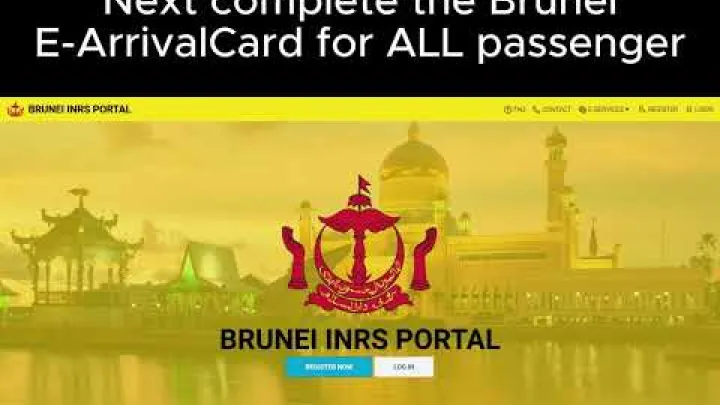
The official Brunei INRS Portal provides an E-Arrival Cards service and includes registration and login functions. The E-Arrival Card is used for electronic registration of foreign nationals arriving in or departing from Brunei. It should be treated as a travel registration record, not as proof that a visa or other entry permission has been approved.
For Brunei arrival card registration, open the official Brunei INRS Portal directly rather than following links in old travel guides, messages, or unofficial websites. Create an account or log in if the live system requires it, select the relevant E-Arrival process, and enter your information exactly as it appears in your passport and travel documents. Review names, passport number, nationality, travel dates, and journey details carefully before submission.
If you are completing the Brunei E-Arrival Card form for a family or group, check whether each traveller must have a separate record or whether the portal offers a group option. Do not create duplicate submissions merely because a confirmation email or screen is delayed. First check the portal account, reference, or support instructions, and correct an error through the method provided by the live system.
The portal interface, submission window, route coverage, and required fields can change. Confirm the current workflow shown in the official system, including whether an E-Arrival Card is required for your specific route and direction of travel. Save the submitted card reference and, where practical, keep both a digital copy and a printable copy. This can be useful if airline staff or border officers ask you to retrieve the record.
Do not assume that a confirmation alone guarantees admission. Immigration officers can still assess your documents, purpose of visit, and compliance with entry conditions at the border.
Check Health Declarations and Other Pre-Arrival Forms
Health-related entry measures are separate from the immigration arrival card. The official HealthInfo travel page directs travellers to the BruHealth portal, which may be used for current arrival-related health processes. Requirements can depend on public-health conditions and may change more quickly than ordinary immigration procedures.
Immediately before travel, check the official health page for the current declaration requirement, timing, information requested, and any available alternative process if you cannot use the portal. Do not rely on older pandemic-era instructions, screenshots, or a friend's previous experience. If a health form applies, complete it separately and retain any confirmation requested for travel.
Other forms may apply only to particular circumstances. For example, a traveller carrying a high amount of cash has a financial-border obligation that is different from health screening and immigration entry registration. Treat each form as a separate requirement with its own threshold and instructions.
Complete Border Formalities on Arrival
At an air, land, or sea entry point, keep your documents accessible and ensure your answers match the information you submitted. Operating arrangements can differ between control posts, so follow the instructions at your point of arrival.
Pass Immigration Control and Confirm Your Entry Record
At immigration control, present your passport and any applicable supporting documents. Be ready to provide the E-Arrival record or its reference if required, explain the purpose of the visit, and answer questions accurately. An officer may ask about the length of stay, accommodation, onward travel, employment, or other facts relevant to your entry.

Have your accommodation address, local contact, and onward travel details easy to find rather than stored only in an inaccessible email account. If someone else arranged the trip, make sure you still know the basic itinerary and purpose of travel. Clear, consistent answers can help resolve routine questions without confusing a registration issue with a visa or status decision.
After clearance, check the entry record, passport stamp, electronic permission, pass, or other record used for your entry. The important point is the authorized period and the conditions recorded for you, not the length you expected when planning the trip. If the record does not appear to match the permission you were given, ask the officer while you are still at the checkpoint or contact immigration promptly.
Keep a photograph or copy of the record and note the expiry date in a calendar. This is especially important when you have a short visit, a connecting journey, or a later domestic arrangement that could make it easy to lose track of the authorized end date.
Handle Transit and Other Special Arrival Situations
Transit does not always mean that a traveller is outside Brunei's entry procedures. A passenger who remains in an airside transit area may have a different process from a passenger who must pass immigration control. Whether you need to collect checked baggage, change to a separate ticket, stay overnight, leave the airport, or use accommodation can change the situation.
Missed connections and route changes can also turn a planned transit into an entry question. If you must pass border control, your passport, entry eligibility, and any applicable electronic registration should be reconsidered before you proceed. Do not assume a blanket transit exemption applies to every nationality, ticket type, or airport arrangement.
Before departure, confirm the transit procedure with your airline and seek official immigration guidance if the itinerary is unusual. If disruption occurs during the journey, ask airline staff what is required before collecting baggage or leaving the controlled area. This is more reliable than deciding based on another passenger's travel experience.
Manage Your Immigration Status During a Stay
Entry permission is only the start of immigration compliance. During a stay, the central task is to follow the period, conditions, and purpose attached to your particular record, pass, or permit.
Keep Your Stay Lawful and Track Pass Conditions
A lawful stay depends on the permission granted to you and the conditions attached to it. Do not assume that permission to enter as a visitor permits work, study, residence, or a longer stay. Likewise, a later travel change does not automatically extend a pass or remove conditions that were imposed when you entered.
Record the expiry date and any stated conditions as soon as your entry is confirmed. If plans change, contact Brunei Immigration before expiry to ask about the appropriate official route. This is important if you need to depart later than planned, seek another form of permission, or resolve a problem such as a cancelled flight or document issue.
Overstaying or remaining without appropriate permission can have serious consequences under Brunei immigration law. Do not wait until the final day to address a status issue. Keep copies of any applications, responses, and travel disruption evidence, but remember that an application or informal enquiry is not the same as an approved extension or replacement permission.
When contacting Immigration, state your nationality, current location, pass or entry category, expiry date, and the problem you are trying to solve. Ask what action is required and keep the name of the office, any case or reference number, and written instructions. This creates a clearer record than relying on a verbal assumption that you may remain or change activities.
Follow Work, Study, and Long-Term Permit Procedures
Employment requires the appropriate authorization. A visitor should not assume that a visitor entry status allows paid work, unpaid work, practical training, or other activity that may be treated as employment. The correct process depends on the role, employer, duration, and immigration category.
Students, workers, dependants, and other residents may have separate passes or permits, supporting documents, sponsor responsibilities, and renewal processes. A school may need to guide a student through education-related immigration arrangements, while an employer may have responsibilities connected with a worker's authorization. These categories should not be treated as interchangeable.
Before starting work or study, confirm the permitted activity, the relevant document's validity, and the responsibility of each party with the appropriate authority. The Brunei Immigration Department publishes departmental information and contact details that can help direct status and border questions to the correct channel. Do not rely on a universal renewal cycle, medical process, or reporting schedule because requirements can be category-specific.
Keep copies of the pass, approval letter, passport identity page, sponsor details, and renewal submissions in a secure place. If an employer, school, or sponsor is handling part of the process, confirm who is responsible for filing, collecting, and updating each document. A change of employer, course, sponsor, or immigration purpose should be raised before the activity changes, not after a new arrangement has begun.
Confirm Foreigner Registration, Address Changes, and Reporting Duties
Long-term residents should ask the Department of Immigration and National Registration which updates are required if recorded information changes. Relevant changes can include a residential address, employer, passport replacement, family status, sponsor, or other details connected with a pass or permit.
Do not transfer rules from another country to Brunei. Some countries require all foreign guests to register private accommodation with police, or require routine periodic reporting by every foreigner. The available information does not establish a Brunei-wide rule of that kind for all visitors, so it is safer not to assume that a hotel, host, tourist, worker, or resident has the same obligation.
Instead, check the instructions attached to your own permission and ask the official department, employer, school, sponsor, or accommodation provider when they have a defined role. If a periodic report, registration update, or address notification is required for your category, follow the timing and method given by the responsible authority. Keep confirmation of any completed update.
When reporting a change, use the same spelling and document number shown on your current immigration record. Ask whether the update must be made in person, online, through a sponsor, or through another designated office. Until the authority confirms that the change has been accepted, keep the original documents and any evidence that you submitted the update.
Follow Currency Reporting Rules at the Border
Currency reporting is a financial compliance matter. It is separate from a visa, an E-Arrival Card, and an immigration officer's decision to admit a traveller.
Declare Cash or Bearer Negotiable Instruments at the Threshold
Guidance from the Brunei Darussalam Central Bank states that a person carrying physical currency or bearer negotiable instruments amounting to BND 15,000, or the equivalent in foreign currency, or more must make a declaration to the Financial Intelligence Unit. Bearer negotiable instruments can include instruments that can be transferred by physical possession, so do not treat the rule as applying only to banknotes.
If you are carrying BND 15,000 or its equivalent or more, complete the current CBNI declaration before crossing the border. Use the latest instructions from BDCB, follow the required form and submission method for the direction of travel, and retain evidence of the declaration. Check the combined value of currencies and relevant instruments rather than looking only at one currency amount.
Allow time to deal with the declaration before reaching the checkpoint, and keep the declared amount and supporting details consistent with what you carry. If your route includes more than one border crossing, check whether the declaration must be made for each relevant entry or exit. A declaration does not grant immigration permission, and an immigration record does not replace the declaration. If you are unsure whether an item or amount falls within the rule, seek official clarification before travel rather than guessing at the border.
Complete Brunei Departure Procedures
Departure should be planned as carefully as arrival. Check your status record, travel documents, route requirements, and any electronic process early enough to correct a missing record or account-access problem.
Recheck Exit Documents and Departure Registration
Before leaving Brunei, make sure you have your passport, confirmed travel itinerary, and any documents connected with your immigration status. Workers, students, and residents may have additional category-specific matters to resolve before travel, particularly where a pass, re-entry arrangement, employer process, or sponsor instruction applies.
Official Brunei consular information describes the E-Arrival Card as electronic registration for foreign nationals arriving or departing from Brunei. Confirm whether your journey and current status require an E-Arrival or other exit registration, and complete the live official workflow through the appropriate channel before reaching the exit checkpoint. The process may not be identical for every traveller or route.
Check the details on any submitted departure registration against your passport and itinerary. Keep the reference available on your device and, if practical, in print. If you cannot retrieve a record, have a name or passport-number mismatch, or discover a possible status issue, seek help before travel rather than waiting until boarding time.
Build extra time into the journey if you need to resolve a missing registration, pass question, or currency declaration. Airline check-in staff may identify a document problem, but they cannot decide whether Brunei Immigration will extend, replace, or alter your permission. The relevant Brunei authority must address an immigration-status issue.
Leave Before Permission Expires or Seek Official Help Early
Plan to leave Brunei before the authorized period of stay ends unless you have obtained valid alternative authorization. A booked ticket alone does not change the expiry date on an entry record, pass, or permit.
If illness, cancelled transport, a lost passport, or another serious disruption affects your departure, contact immigration and any other relevant authority as early as possible, preferably before the expiry date. Keep evidence of the disruption, official correspondence, and any steps you take to resolve the issue. This documentation can help explain events, but it does not itself replace immigration permission.
Your embassy or consulate may assist with passport replacement, communication, or welfare support. However, consular assistance does not override a decision by Brunei immigration authorities. For a status problem, the authoritative answer must come from the relevant Brunei office.
Use a Brunei Immigration Checklist by Traveller Type
Use these lists as a final planning tool. They are not a substitute for the current instructions that apply to your passport, route, and immigration category.
Short-Term Visitor Checklist
- Check passport validity, condition, and entry eligibility for your nationality and purpose of travel.
- Confirm whether you must complete the current Brunei E-Arrival Card process and save the registration reference.
- Check the latest HealthInfo or BruHealth instructions for any health-related arrival declaration.
- Keep travel, accommodation, and onward-journey information accessible for immigration control.
- On arrival, record the authorized stay and conditions shown on your entry record or permission.
- If carrying BND 15,000 or its equivalent or more in cash or bearer negotiable instruments, make the required declaration.
- Before departure, check the current exit registration process and leave before your authorized stay expires.
Worker, Student, and Long-Term Resident Checklist
- Keep the relevant pass, permit, approval, and sponsor or employer documents available and current.
- Confirm that your planned work, study, residence, or dependent activity is permitted by your immigration status.
- Track expiry dates well in advance and use the official procedure for renewal, extension, replacement, or status changes where available.
- Ask whether your category requires updates after a change of address, employer, passport, sponsor, or family circumstances.
- Confirm whether any registration or periodic reporting duty applies specifically to your pass or permit.
- Before international travel, check any re-entry, exit, or sponsor-related requirements that may apply to your category.
- Use the Department of Immigration and National Registration for immigration status questions, the Brunei INRS Portal for the current E-Arrival workflow, HealthInfo for relevant health travel processes, and BDCB for currency reporting rules.
The most reliable approach is simple: use official, current instructions for your own travel status, enter accurate information, retain confirmation records, and address any problem before it becomes an overstay or departure delay.
Select area
Create a post
Posting is free and no registration is required.