Brunei Country Facts: Quick Facts, Geography & Economy
Brunei Darussalam is a small, high-income country on the island of Borneo in Southeast Asia. It is widely known for its Malay Islamic Monarchy, substantial oil and natural-gas resources, extensive forests, and a territory divided into two separate parts. These Brunei country facts provide a clear country profile, from basic identifiers and geography to people, history, government, and the economy. Figures are dated where possible because population, economic, and development data change over time.
For many readers, the key point is scale: Brunei has a relatively small population and land area, yet it plays a distinct role in Borneo and in the wider Southeast Asian region. Its capital, Bandar Seri Begawan, is also its largest city, while energy activity is concentrated especially in the western part of the country. Understanding the relationship between territory, natural resources, and the monarchy helps explain many features of modern Brunei.
Quick Facts About Brunei Darussalam
The following overview answers the most common questions about Brunei basic information. “Brunei” is the usual short name; “Brunei Darussalam” is the official name used in formal and international settings.
Official Name, Capital, Largest City, and Form of Government
The official name is Brunei Darussalam. Its capital and largest city are both Bandar Seri Begawan; they are not separate places. The city is the national administrative centre and the main urban focus for government services, commerce, education, and many national institutions.
Brunei is in Southeast Asia, on the island of Borneo. The country describes its political identity through the concept of a Malay Islamic Monarchy, commonly called Melayu Islam Beraja. External descriptions often use terms such as hereditary monarchy or absolute monarchy because executive authority is concentrated in the Sultan. The country’s own terminology is important because it connects the monarchy with Malay identity and Islam. A historical U.S. Department of State profile identifies Brunei Darussalam as the official name and describes the state as a Malay Islamic Monarchy.
Population, Area, and Administrative Divisions
The World Bank recorded Brunei’s total population at about 452,500 people in 2023. This is an international estimate rather than a census count. Brunei’s 2021 population census reported a little over 440,000 residents, so the difference reflects both population change and the use of different reference dates and methods.
Brunei has a total area of about 5,765 square kilometres. Land-area datasets may show a lower figure, about 5,270 square kilometres, because they exclude inland water. Total area and land area should therefore not be treated as interchangeable measures when comparing Brunei with another country.
There are four districts:
- Brunei-Muara District, the smallest district by area and the main population and administrative centre, including Bandar Seri Begawan and Muara.
- Belait District, the largest district, associated closely with the oil and gas industry and with towns such as Seria and Kuala Belait.
- Tutong District, located between Brunei-Muara and Belait.
- Temburong District, the eastern district, physically separated from the main western part of Brunei by Sarawak, Malaysia.
When using area figures, first check the reference year, unit, and definition. A total-area figure includes water within the national boundary, while a land-area figure does not. This simple distinction can create apparently conflicting comparisons even when both sources are accurate.
Currency, Languages, Codes, and Time Zone
Brunei uses the Brunei dollar, with the currency code BND. Standard Malay is the official language. English is widely used in education, business, technical work, and international communication, but it does not have the same official status as Standard Malay.
| Item | Brunei fact | Meaning |
|---|---|---|
| Currency | Brunei dollar, BND | National currency |
| Official language | Standard Malay | Official state language |
| Calling code | +673 | International telephone code |
| ISO alpha-2 | BN | Two-letter country identifier |
| ISO alpha-3 | BRN | Three-letter country identifier |
| Internet domain | .bn | Country-code top-level domain |
| Time zone | UTC+8 | One time zone year-round |
Brunei does not observe daylight saving time, so its standard time remains UTC+8 throughout the year. The Brunei dollar is customarily used at par with the Singapore dollar under a long-standing currency interchangeability arrangement. This arrangement does not mean that the two countries share one currency or one monetary system; it means that the currencies have a specific reciprocal use arrangement.
Geography and Environmental Setting
Brunei’s geography is shaped by its Borneo location, tropical climate, river systems, forested interior, and coastal position facing the South China Sea. Its unusual two-part territory is one of the most important facts to understand before looking at settlement and infrastructure.
Location, Borders, and the Two Parts of Brunei
Brunei lies on the northwest coast of Borneo. It faces the South China Sea to the north and is surrounded on land by the Malaysian state of Sarawak. Indonesia occupies the larger southern and eastern part of Borneo, while Malaysia also occupies northern and western parts of the island.
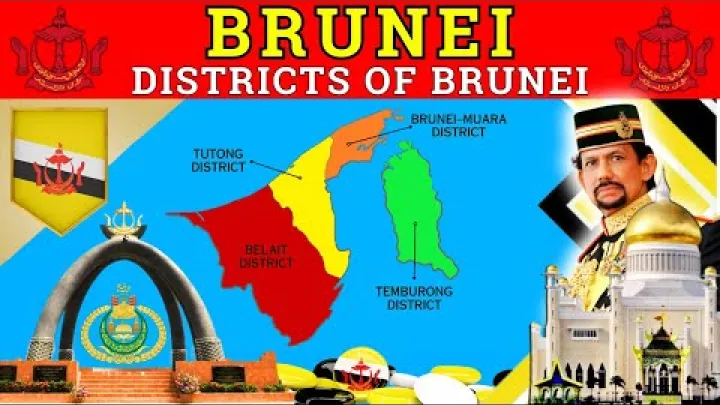
The country consists of a larger western section and the smaller eastern Temburong section. Sarawak separates Temburong District from Brunei’s western districts. This territorial arrangement is why maps of Brunei show two non-contiguous sections rather than one continuous block of land.
Bandar Seri Begawan stands in the western section, near the Brunei River. Muara, northeast of the capital, is an important coastal and port area. Temburong, whose district centre is Bangar, is farther east. These places show how Brunei’s geography combines a coastal capital region, industrial western districts, and a more separated eastern district with extensive forest cover.
Terrain, Climate, Rivers, and Forest Cover
Much of western Brunei consists of coastal plains, river valleys, low hills, peat swamps, mangroves, and inland forest. The terrain becomes more rugged toward the interior and in Temburong. Bukit Pagon, on the border area with Sarawak, is generally identified as Brunei’s highest point, at about 1,850 metres above sea level.
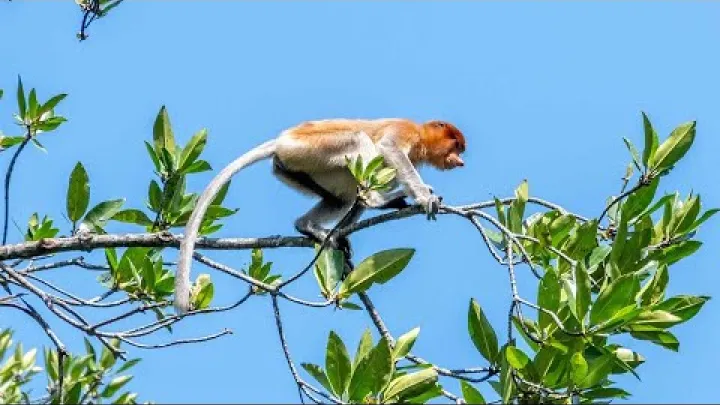
Brunei has an equatorial climate. Temperatures are high throughout the year, humidity is usually substantial, and rainfall is common in every month. Rather than having four temperate-style seasons, the country experiences wet conditions influenced by regional monsoon patterns. Rainfall, river levels, and local access conditions can still vary by place and time of year.
Rivers have long influenced settlement and movement. The Brunei River is central to the capital area and to Kampong Ayer, the well-known water settlement near Bandar Seri Begawan. Mangroves and wetlands occur along coastal and estuarine areas, while inland forests cover a large share of the country. These ecosystems support biodiversity and also affect where roads, towns, farms, and industrial facilities can be developed.
Forest cover is therefore more than a scenic feature. It helps explain why population and economic activity are concentrated in selected coastal and western corridors, while large areas of the interior remain comparatively lightly settled. Environmental conditions also matter for drainage, water management, and the planning of infrastructure across a humid tropical landscape.
People, Language, and Religion
Brunei’s population is small by Southeast Asian standards, but its society includes Malay and indigenous communities, Chinese Bruneians, and other residents. Malay language, Islam, and the monarchy have a particularly prominent role in public life and national identity.
Population Trends and Urbanization
With about 452,500 people in the World Bank’s 2023 estimate, Brunei has a much smaller population than neighbouring Malaysia and Indonesia. The country’s settlement pattern is uneven. Brunei-Muara District, especially the Bandar Seri Begawan urban area, is the principal concentration of population, government offices, higher education, and many services.
Other important centres have different functions. Kuala Belait is a key town in Belait District, while nearby Seria is strongly associated with the petroleum industry. Tutong is the district centre of Tutong District. Bangar is the main town of Temburong District. These places are significant local centres, but their roles and administrative status are not identical to that of the capital.
Population figures should be read with care. A census counts people according to rules set for a particular date, whereas international databases often publish annual estimates or projections designed for cross-country comparison. For current demographic indicators such as population growth, urban population share, or age structure, the World Bank Data page provides a useful starting point because it labels individual indicators and their years.
Urbanization in Brunei should not be understood only as the growth of one dense city. It also reflects the concentration of employment, public services, housing, roads, and commercial activity around the capital region and several western towns. Rural and forested areas remain important parts of the national territory, particularly outside the Brunei-Muara core.
Ethnic Communities and Languages in Daily Life
Malay identity has a central position in Brunei’s official national framework. Official demographic descriptions commonly include Malay and several indigenous communities, although statistical categories may group distinct peoples together. Chinese Bruneians and other resident communities are also part of the country’s social composition.
Standard Malay is the official language used in formal state settings. In daily life, people may also use Brunei Malay and other local Malay varieties. English has a major practical role, especially in education, professional settings, business, science, and communication with international partners. It is useful to distinguish official-language status from the languages that people use in homes, workplaces, schools, or communities.
Indigenous languages remain part of Brunei’s cultural landscape, and Chinese languages are used within some families and communities. Language use varies by generation, location, education, and social setting. It is more accurate to recognize this multilingual reality than to assume that a single language describes every resident’s daily experience.
For international students, workers, and visitors, English can be important for many practical interactions, while knowledge of Malay can help with local communication and cultural understanding. Neither point changes the legal fact that Standard Malay is the official language of the state.
Islam, Religious Diversity, and National Identity
Islam is Brunei’s official religion and has a significant institutional and public role. Islamic traditions are visible in national ceremonies, public institutions, education, and elements of law and administration. The Sultan also holds an important religious role alongside his position as head of state.
The national philosophy of Melayu Islam Beraja is commonly translated as Malay Islamic Monarchy. In plain terms, it brings together Malay identity, Islam, and loyalty to the monarchy as core elements of the state’s national vision. This philosophy helps explain why cultural, religious, and political themes are often discussed together in official life.
Brunei also has established minority religious communities, including Christians and Buddhists. Official status for Islam does not mean that other faith communities are absent. A country profile should distinguish between the state’s official religious framework and the religious diversity of its residents, rather than making broad assumptions about individual belief or practice.
This context is useful for anyone studying Brunei’s public institutions or national holidays. It also helps explain why national identity is not described only in geographic or ethnic terms, but through the linked concepts of Malay culture, Islam, and monarchy.
Human Development and Social Indicators
Brunei is generally classified as a country with very high human development. The UN Development Programme reports a Human Development Index value of 0.837 for 2023, placing Brunei in the very high human development category. The HDI combines indicators related to health, education, and income; it is not a complete measure of every household’s experience or every aspect of social well-being.
Brunei’s high social indicators are closely connected to decades of hydrocarbon income and public investment. Revenue from oil and natural gas has supported state capacity and public services. That relationship is important, but it should not be simplified into a claim that all social or economic outcomes are identical across communities or that one indicator describes living standards in full.
The UNDP Data Futures Exchange presents the HDI result and related development indicators with defined reporting periods. Life expectancy, national income, schooling, and similar measures should always be read with the source’s stated year and methodology, particularly when comparing Brunei with another country.
Government, History, and National Identity
Modern Brunei combines a long sultanate tradition with institutions shaped by the twentieth century, the 1959 constitution, and full independence in 1984. Historical continuity is a major part of how the country explains its national identity.
The Monarchy and Constitutional Framework
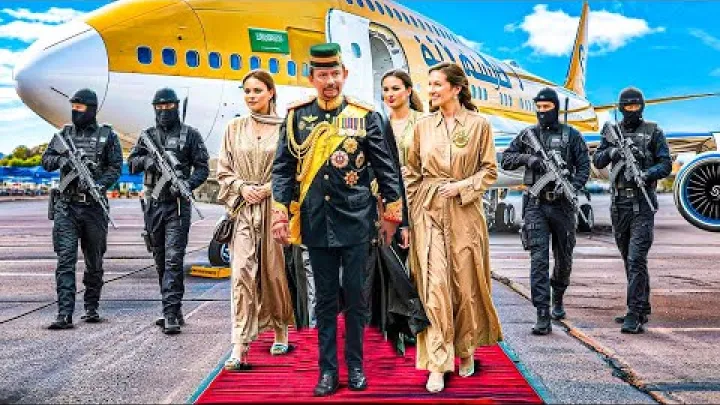
Brunei is ruled by the Sultan and Yang Di-Pertuan, who is head of state and holds extensive executive authority. The Sultan also serves as head of government and has an important position in religious affairs. This concentration of roles is a defining feature of Brunei’s political system and differs from systems in which a ceremonial monarch is separate from an elected executive government.
The 1959 Constitution is a key reference point in Brunei’s modern constitutional development. It established a framework for the state and its institutions while retaining the central role of the monarchy. Consultative and administrative bodies operate within this monarchical framework; they should not automatically be interpreted through the expectations used for multiparty parliamentary democracies.
Descriptions of the system vary in emphasis. Brunei’s own national language emphasizes the Malay Islamic Monarchy, while outside observers may describe it as an absolute or highly centralized hereditary monarchy. Both descriptions aim to identify important features, but the first explains the country’s stated national philosophy and the second emphasizes the location of executive power.
For readers comparing governments, it is useful to separate several functions that may be held by different people in other states: head of state, head of government, religious authority, and the leadership of executive ministries. In Brunei, these functions are closely connected to the office of the Sultan.
From Historic Sultanate to Independence
Brunei has a long history as a sultanate in northern Borneo. Its historical influence changed considerably over time and should not be equated with the borders of the modern state. The present country emerged through changing regional relationships, local authority, and colonial-era arrangements.

A major turning point came in 1888, when Brunei became a British protectorate. The arrangement preserved the sultanate but placed important aspects of external affairs under British influence. Later constitutional developments gave Brunei greater internal self-government while the protectorate relationship remained relevant to its external status.
Brunei became a fully independent state on 1 January 1984. Independence is a central national milestone because it linked the modern sovereign state to the continuing institution of the sultanate. The historical account is therefore not simply one of colonial rule followed by a new republic; it is the history of a monarchy that retained continuity while moving into a new independent era.
This continuity is visible in state symbolism and in the importance given to the Sultanate in national identity. It also helps explain why Brunei’s government, official philosophy, and historical narrative are often discussed together rather than as separate topics.
Economy, Towns, and Infrastructure
Brunei’s economy has been shaped primarily by petroleum and natural gas. Energy wealth has supported public revenue and a high-income profile, while also creating a long-term need to broaden the economic base beyond hydrocarbons.
Oil, Natural Gas, and Economic Diversification
Crude oil, petroleum products, and liquefied natural gas have traditionally been the foundation of Brunei’s exports and government finances. The country’s modern economic development is closely associated with these resources, particularly production in and around Belait District. Hydrocarbon income has helped fund public investment and has contributed to Brunei’s comparatively high income level.
This resource-based model also creates exposure to changes in global energy prices, production volumes, and demand. A single year of strong or weak gross domestic product growth does not establish a permanent trend. GDP and GDP per capita can vary depending on whether they are expressed in current prices, constant prices, purchasing-power terms, or local currency, so a figure is meaningful only when its measurement type and year are stated.
Economic diversification is a broad national priority. Wawasan Brunei 2035, or Brunei Vision 2035, sets out a long-term national direction that includes developing a well-educated and skilled population, improving quality of life, and building a sustainable and dynamic economy. Diversification discussions commonly include downstream industry, services, food production, digital activity, tourism, and investment, although policy goals should not be presented as guaranteed results.
The practical relationship is straightforward: energy exports have generated the resources that underpin much of the state’s economic capacity, while diversification seeks to reduce dependence on one sector over time. This is why Brunei can have strong national income indicators while still treating economic broadening as an important strategic issue.
Economic Centres, Ports, and National Connectivity
Bandar Seri Begawan is the country’s administrative and service centre. Government departments, national institutions, commercial services, and much of the urban population are concentrated in or near the capital region in Brunei-Muara District. Kampong Ayer, located near the capital on the Brunei River, is an important historic and living water-settlement area within this wider urban landscape.
Belait District is central to the energy economy. Seria is widely associated with oil and gas activity, while Kuala Belait is a major town and district centre near the western border with Sarawak. Their importance is industrial and regional rather than administrative in the same way as the national capital.
Muara is a major port location on the coast and provides a key maritime gateway. Brunei also relies on road networks, air connections, and maritime facilities to link its population centres with regional markets. The country’s divided territory makes connectivity particularly relevant: Temburong District is geographically distinct from the western districts, and Bangar serves as its principal town.
At a national level, roads, bridges, port facilities, and the airport support movement within the country and connections beyond Borneo. The exact availability, routes, schedules, or operating conditions of transport services can change, so readers making travel or relocation decisions should use current operator and government information for those practical details.
Brunei in International Data and Identification Systems
Country identifiers make Brunei easier to recognize in databases, telephone systems, online services, trade records, and international forms. These codes are useful, but each belongs to a different system and has a different purpose.
ISO Codes, Calling Code, and Internet Domain
Brunei’s ISO 3166-1 alpha-2 code is BN, and its ISO 3166-1 alpha-3 code is BRN. The two-letter code is often used in compact data fields, country selectors, shipping systems, and international statistics. The three-letter code is common where a more readable or less ambiguous identifier is needed.
The country-code top-level domain is .bn. This is used in internet addresses associated with Brunei. The international telephone calling code is +673, which is used when dialing Brunei from another country. These identifiers are related to the same country but are not interchangeable: ISO codes classify countries, a calling code routes international telephone calls, and a domain suffix identifies a national internet domain space.
| System | Identifier | Typical use |
|---|---|---|
| ISO alpha-2 | BN | Short data and country fields |
| ISO alpha-3 | BRN | International datasets and records |
| Telephone | +673 | International calling |
| Internet domain | .bn | National web addresses |
The code BN is listed for Brunei Darussalam in the ISO 3166-1 alpha-2 system, while .bn is the associated country-code domain in common internet use. A general overview of this ISO system is available through ISO 3166-1. For formal technical, compliance, or registration work, use the relevant standards body, telecommunications authority, or domain registry rather than relying only on a general country profile.
How to Interpret Brunei's Country Statistics
Country statistics are most useful when readers identify four things: the source, reference year, unit, and definition. This matters for Brunei because it is a small country where modest numerical changes can look large in percentage terms, and because national and international sources may be designed for different purposes.
Population is a clear example. A census count measures residents using the census authority’s rules on a particular date. An international population series may be an annual estimate or projection. Neither is automatically wrong, but they answer slightly different questions. The same issue applies to city population: one source may count only a municipal boundary, while another may include a built-up area, district, or wider metropolitan population.
Area data also require a definition. Brunei’s total area is commonly presented as about 5,765 square kilometres, while land-area datasets exclude water. Gross domestic product can be measured in current prices or inflation-adjusted prices; GDP per capita depends on both the GDP measure and the population estimate used. Development indexes combine several components and are released for particular reporting years.
When comparing Brunei with another country, do not copy a number without its label. Check whether it is a census count, estimate, projection, total area, land area, nominal GDP, real GDP growth rate, or an index value. Older United Nations summaries can still be useful for historical context, but they should not be described as current data when newer national or international datasets are available.
This approach turns country facts into more reliable information. It also prevents a common error: treating a precise-looking number as timeless when it actually reflects a specific year, boundary, calculation method, or statistical purpose.
What These Brunei Country Facts Reveal
Brunei is a compact Southeast Asian state with a distinctive combination of Borneo geography, forested territory, hydrocarbon wealth, and a continuing sultanate. Bandar Seri Begawan is both the capital and the largest city, while Belait District and towns such as Seria and Kuala Belait are closely tied to the energy sector. Temburong’s separation from the western districts is another essential geographic fact.
The country’s official identity as a Malay Islamic Monarchy connects its government, religion, and national philosophy. At the same time, Brunei’s population includes multiple communities and uses more than one language in daily life. Its high human-development standing and high-income profile are closely linked to resource revenue, while diversification remains important for the future.
For the most accurate Brunei country profile, use these stable facts as a foundation and then update time-sensitive numbers such as population, GDP, city size, and development indicators from current official or international datasets. That distinction makes it easier to understand both what is enduring about Brunei and what may change from year to year.
Select area
Create a post
Posting is free and no registration is required.