Singapore National Symbols: Flower, Animal, Bird & More

Singapore national symbols include more than the familiar flag and anthem. They bring together formal state emblems, civic words, a national flower, and public-facing designs that express shared identity in different ways. This guide explains which symbols appear in Singapore’s official framework, what they represent, and why popular icons such as the Merlion, crimson sunbird, and tembusu need more careful labels. It also answers common questions about Singapore’s national animal, national bird, national tree, and national fruit.
What Counts as a National Symbol in Singapore
Singapore uses symbols for different purposes: some represent the sovereign Republic, some express civic values, and some help the public identify with the nation. The status of a symbol matters. A familiar image can be culturally important without being a formally designated national symbol.
Singapore's official symbols beyond the flag and anthem
The National Flag and the National Anthem are foundational symbols, but they are not the whole picture. The official framework presented by the National Heritage Board also includes the State Crest, or National Coat of Arms; the National Flower; the National Pledge; the Public Seal; and the Lion Head symbol.
These symbols work in different forms. The State Crest and Public Seal are formal visual emblems of the Republic. Vanda Miss Joaquim is a botanical symbol. Majulah Singapura and the National Pledge express national aspirations in words. The Lion Head is a modern emblem intended for wider public expression. Together, they show that a national symbol can be visual, verbal, natural, ceremonial, or legal.
For a quick lookup, use the word “official” for entries in Singapore’s government national-symbol material or in legislation. Use “heritage” for an object recognised for cultural or environmental value, and “cultural icon” for a familiar image whose importance is public or promotional. Online lists may use different scopes—some include the flag and anthem, while others focus on additional symbols—so a different list is not necessarily a contradiction.
Official, unofficial, and heritage designations
An official national symbol is one recognised in Singapore’s national-symbol framework or by legislation. It should not be confused with an unofficial designation, which may be widely used by the public or supported by a civil-society organisation. A third category is a heritage object: a tree, building, artwork, or place that has recognised cultural value without becoming a national symbol.
This distinction prevents several common errors. The lion is Singapore’s strongest animal image, but that does not automatically make it a legally designated national animal. The crimson sunbird is often called the national bird, but its designation is unofficial. The tembusu has strong heritage and currency associations, yet a heritage-tree label is not the same as an official national-tree designation. Likewise, the Merlion is internationally recognisable but has a different role from the State Crest.
The National Coat of Arms or State Crest
The National Coat of Arms, also called the State Crest, is Singapore’s principal heraldic emblem. It presents central ideas of nationhood in a formal design used to represent the sovereign Republic.
Design elements and their meaning
At the centre of the State Crest is a red shield bearing a white crescent moon and five white stars. A lion stands on one side of the shield and a tiger on the other. Below them is a scroll bearing the words Majulah Singapura.
The red and white colours are associated with universal brotherhood and equality, as well as purity and virtue. The crescent is commonly explained as representing a young nation on the rise. The five stars stand for democracy, peace, progress, justice, and equality. These are the established meanings of the main elements rather than simply decorative details.
The lion refers to Singapore’s Lion City identity. The tiger reflects historical and regional associations with the area. Together, the supporters make the crest distinct from the National Flag, even though both share the crescent-and-stars motif. The official description of the crest’s elements is set out in the Singapore Arms and Flag Rules.
Why the State Crest is a formal national emblem
The State Crest represents the Republic in formal state contexts. Its role is more solemn and institutional than that of a general-purpose logo. It may be seen in official settings where the authority and identity of the state need to be clearly expressed.
The crest is not interchangeable with every lion image used in Singapore. In particular, it differs from the Lion Head symbol, which was created for broad public identification and participation. The full State Crest has a specific arrangement of the shield, supporters, stars, crescent, and motto, and it carries formal significance as a state emblem.
Its display, reproduction, and commercial use are subject to legal or regulatory controls. Before reproducing the State Crest, placing it on products, or using it in promotional material, consult current National Heritage Board or statutory guidance. This is especially important for organisations, publishers, event organisers, and businesses, because a respectful cultural reference is not necessarily permission to reproduce the formal emblem.
Singapore's National Flower: Vanda Miss Joaquim
Singapore’s national flower is Vanda Miss Joaquim, an orchid often searched for as the Singapore national flower or orchid Singapore national flower. It is one of the country’s clearest and most widely recognised natural symbols.
Selection, identity, and national meaning
Vanda Miss Joaquim was selected as Singapore’s National Flower for its resilience and its ability to bloom throughout the year. These qualities make it a fitting symbol for a tropical city-state that values endurance, energy, and continued progress. The National Heritage Board identifies resilience and year-round flowering as the reasons for its selection.
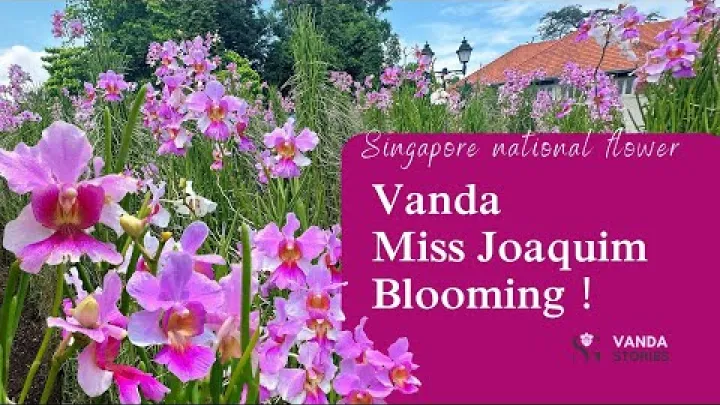
The orchid’s cultivated hybrid identity is also often understood as a reflection of creativity and a society shaped by diverse influences. This is a useful cultural interpretation, rather than a legal definition of the flower’s meaning. Its bright appearance and regular flowering have made it a familiar symbol in public displays, educational materials, and representations of Singapore abroad.
For visitors and students, the flower offers a practical way to recognise that national identity in Singapore is not expressed only through official buildings or ceremonies. It also appears through living plants, horticulture, and everyday visual culture.
The Lion Head Symbol
The Lion Head is a simplified, modern emblem that gives Singaporeans and organisations a public-facing national symbol distinct from the formal State Crest.
A modern symbol for public expression
The Lion Head is a stylised red lion design that draws on Singapore’s Lion City identity. Its lion is related in theme to the lion on the State Crest, but the two symbols are not substitutes for one another. The State Crest is a formal emblem of the Republic; the Lion Head was designed for more open public use.
Official guidance associates the lion with courage, strength, and excellence. The Lion Head’s five-part mane echoes the five ideals represented by the stars: democracy, peace, progress, justice, and equality. This visual connection helps the design communicate national values without reproducing the entire State Crest.
The Lion Head is recognised as a National Symbol under the National Symbols Act 2022, which took effect on 1 August 2023. It is therefore suitable for individuals, community groups, and organisations that want to show national affiliation in an appropriate way. The National Heritage Board provides guidance on its recognition and role.
Singapore's Verbal National Symbols
National identity is also expressed through shared words. Singapore’s motto and National Pledge communicate forward movement, common citizenship, and the values expected of a multi-racial nation.
Majulah Singapura as motto and anthem title
Majulah Singapura means “Onward Singapore.” It is the national motto and also the title of Singapore’s National Anthem. On the State Crest, the phrase appears on the scroll below the shield, linking the motto directly to the Republic’s most formal emblem.
Its short, forward-looking message expresses progress and collective purpose. The phrase is in Malay, which connects it to Singapore’s historical and regional setting. In this article, its main importance is as a motto shared with the anthem title, rather than as a substitute for a full explanation of the anthem itself.
The National Pledge and civic unity
The National Pledge is an official verbal symbol used in civic and educational life. It expresses a commitment to building a democratic society based on justice and equality, regardless of race, language, or religion. It also places unity at the centre of national belonging.
In this sense, the Pledge complements the values represented by the five stars on the State Crest. The crest condenses those ideals into an image, while the Pledge presents civic commitment as words spoken together. It is an important reminder that national symbols do not have to be objects, flags, or logos; they can also be shared public texts.
The Public Seal of Singapore
The Public Seal is another official emblem, but its purpose is more administrative and representative than public-facing.
Composition, purpose, and official status
The Public Seal of Singapore consists of the National Coat of Arms encircled by the words “Republic of Singapore.” It represents the Republic in formal legal and administrative contexts. The National Heritage Board describes this composition and its representative function.
The difference between the Public Seal and the State Crest is mainly one of function. The State Crest is the national heraldic emblem itself. The Public Seal incorporates that emblem in a form associated with official authentication and representation. Neither is a tourism logo, a decorative motif, or a public mascot.
This distinction also explains why Singapore has both symbols. The crest conveys state identity in a broad formal sense, while the seal serves a more specific official role within the Republic’s administrative life.
Unofficial and Cultural Symbols Associated with Singapore
Some of Singapore’s best-known symbols sit outside the core official list. They remain meaningful, but readers should use accurate terms such as “unofficial,” “heritage,” “tourism mascot,” or “cultural icon.”
Is there an official national animal of Singapore?
The lion is Singapore’s most powerful animal symbol, but it should not automatically be described as a legally designated national animal. The reviewed official national-symbol framework identifies the State Crest and Lion Head, both of which use a lion, but does not list a separate national animal.

For that reason, the most accurate short answer to “What is the Singapore national animal?” is that Singapore has no clearly identified official national animal in the core national-symbol list, while the lion functions as its de facto animal emblem. It appears on the State Crest, inspires the Lion Head, and is central to the Lion City identity.
The symbolic lion should not be mistaken for evidence that lions are native to modern Singapore. Its importance is historical and cultural. The animal gives Singapore a memorable national image even though the formal legal status belongs to particular emblems, not to a standalone national-animal title.
The crimson sunbird as an unofficial national bird
The crimson sunbird is widely cited as Singapore’s unofficial national bird. This description is useful when clearly qualified: it is associated with Nature Society Singapore rather than presented as a government-designated national symbol.
For searches such as “Singapore national bird” or “national bird Singapore,” the careful answer is therefore the crimson sunbird, unofficially. Its vivid colouring and presence in the local natural environment make it an appealing bird symbol, but civil-society recognition and formal state designation are not the same thing.
Using the unofficial label respects both parts of the story. It acknowledges the bird’s cultural relevance while avoiding the misleading impression that it has the same standing as Vanda Miss Joaquim or the State Crest.
National tree and national fruit: what the evidence supports
The tembusu is an important Singapore tree, but available official national-symbol material does not identify it as the national tree of Singapore. It is better described as a heritage tree and a prominent cultural and environmental emblem. The National Library Board notes that the tembusu is recognised as a heritage tree and appears on the reverse of the Singapore five-dollar note issued in the Portrait series.
That currency connection gives the tembusu a strong place in public memory. Still, “heritage tree” is a specific form of recognition and should not be expanded into an official national-tree designation. For readers searching “Singapore national tree,” this distinction is more accurate than simply naming a tree without context.
If a form or classroom exercise asks for Singapore’s national tree, a careful answer is “tembusu—heritage tree, not a confirmed official national tree.” This wording keeps the useful cultural association while distinguishing it from a formal designation. The same approach applies to fruit: identify durian, rambutan, pineapple, or another food as a cultural association unless authoritative material gives it an official title.
Similarly, the reviewed official national-symbol list does not identify a national fruit. Fruits such as durian, rambutan, pineapple, and others may be associated with local food culture, but none should be presented as Singapore’s official national fruit without a reliable formal designation. The absence of a national-fruit title does not reduce their culinary or cultural importance.
The Merlion as a tourism mascot and national icon
The Merlion is a mythical creature with a lion’s head and a fish body. It is one of Singapore’s most recognisable images and is commonly understood as the country’s official tourism mascot. Its lion component connects to the Lion City name, while the fish body refers to Singapore’s origins as a maritime settlement.
Its visibility in souvenirs, waterfront landmarks, travel imagery, and international promotion makes the Merlion a powerful national icon. However, cultural prominence is not identical to membership in the core official national-symbol list. The Merlion is best understood as a tourism and cultural symbol, rather than Singapore’s official national animal or a replacement for the State Crest.
This classification is useful for international readers: the Merlion may be the image they encounter first, while Singaporeans may also recognise the distinct civic, legal, and historical roles of the crest, Lion Head, flower, Pledge, and Public Seal.
What Singapore's National Symbols Represent Together
Singapore’s symbols form a layered picture of national identity. The State Crest and Public Seal express state authority and the Republic’s formal identity. The National Pledge and Majulah Singapura express civic commitment and progress. Vanda Miss Joaquim represents resilience in a living national symbol, while the Lion Head offers a shared emblem for public expression.
A layered national identity
Across these symbols, recurring ideas include unity, equality, justice, progress, resilience, and the Lion City identity. They do not all serve the same purpose, and that is precisely why their status should be described carefully. A formal state emblem is not a public logo; a heritage tree is not automatically a national tree; and an iconic tourism figure is not necessarily an official national symbol.
The most reliable core answers are the State Crest, Vanda Miss Joaquim, the Lion Head, the Public Seal, the National Pledge, and Majulah Singapura, alongside the National Flag and National Anthem. The lion, crimson sunbird, tembusu, and Merlion add important cultural context when labelled accurately. Understanding these layers gives a fuller view of how Singapore represents its history, values, nature, and public identity.
Select area
Create a post
Posting is free and no registration is required.