Singapore Flag: Design, Meaning, History, and Rules
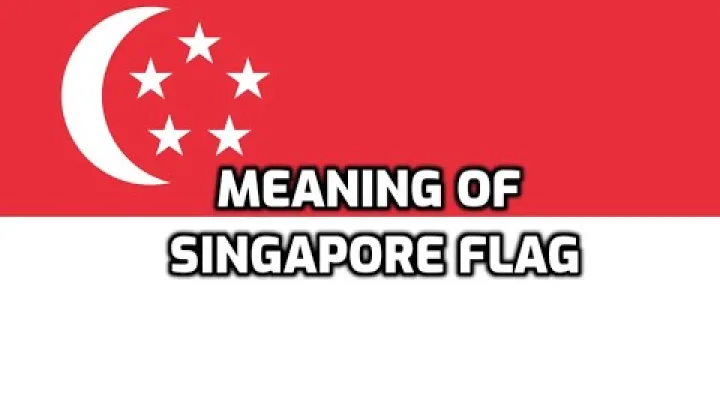
The Singapore flag is easy to recognise once its small white symbols are noticed: a red upper half, a white lower half, and a crescent with five stars near the top-left corner. Its design carries official ideas about equality, purity, national development, and shared civic ideals. This guide explains the Singapore national flag in words, its history from 1959, its place in public life, and the main points to consider when displaying it. It also shows how to tell it apart from Indonesia’s similarly coloured flag.
For someone searching for a Singapore flag image, picture, or emoji, the essential description is simple: red above white, with a white crescent and five white stars in the upper-left red section. That text description identifies the flag even when an image is unavailable, too small to read, or shown without a label.
What the Singapore Flag Looks Like
The flag of Singapore uses a simple two-colour layout with a distinctive white device in one corner. The visible elements matter because red and white alone are not enough to identify the flag correctly.
A clear text description of the design
The Singapore flag is a horizontal bicolour, meaning it has two horizontal bands of colour. The top half is red and the bottom half is white. In the upper-left part of the red band, nearest the flagpole, is a white crescent moon. Beside the crescent are five small white stars, each with five points.

The crescent opens toward the five stars. Together, the stars are arranged in a circle-like five-point grouping within the open side of the crescent. This detail is the quickest way to identify a Singapore flag picture when no label is present. The design is part of Singapore’s wider system of national symbols, described by the National Heritage Board.
In a text-only description, picture a rectangle divided horizontally across its centre. The red band is above the white band, and the crescent-and-stars device sits toward the pole rather than in the middle of the flag. This placement is important: moving the symbols to the centre or the fly end would change the recognisable arrangement.
Proportion, colors, and visible details
The flag’s height-to-length proportion is 2:3. Its red and white bands are equal in height, so neither colour occupies more of the field than the other. The crescent and stars are white and sit entirely in the upper red section rather than crossing into the white band.
In everyday digital images, red may appear lighter or darker because of screens, lighting, printing, or image compression. It is more useful to identify the flag by its two equal bands and the crescent-and-stars arrangement than by trying to judge a precise shade from a photograph. For official production or formal display, use the relevant current specification rather than treating an informal screen colour as an official standard.
The flag’s uncluttered layout also makes it adaptable to different sizes, from a small national flag emoji or online icon to a large flag displayed on a building. At small sizes, the five stars may merge visually, so the crescent and the general star grouping are the most useful clues. At larger sizes, the equal bands and five-pointed stars should be clearly visible.
How to identify it at a glance
Look first for three features: red above white, a white crescent, and five white stars in the upper-left red area. The side nearest a flagpole is called the hoist side; the opposite edge is the fly side. In normal orientation, Singapore’s crescent and stars are at the hoist side, not the far right.
This makes the Singapore national flag distinct even at a distance. A plain red-over-white flag without the crescent and stars is not Singapore’s flag. The same checklist is useful whether a reader encounters a physical flag, an icon, a sports display, or an image online.
Singapore Flag Colors and Symbolism
Singapore provides established national meanings for the principal elements of its flag. These meanings should be distinguished from personal, religious, or political interpretations that viewers may attach to the design. The National Heritage Board’s national symbols resource is a useful local reference for the official explanations.
The official meaning of red and white
Red represents universal fellowship and equality. White represents pervading and everlasting purity and virtue. These are the established explanations of the Singapore flag colours, not claims that the colours describe the results of national policy or the experience of every person in Singapore.
The pairing gives the flag a clear visual contrast while expressing ideals intended to apply across a diverse society. Red and white appear on many national flags, but their presence elsewhere does not give them the same official meaning as they have in Singapore. The colours therefore have both an immediate visual function and a stated civic meaning.
Why the crescent is used
The white crescent represents a young nation on the ascendant. It is a forward-looking national image: Singapore was developing its own identity and institutions when the flag was adopted.

Crescents are often associated with Islam in other national settings. Singapore’s official explanation, however, identifies the crescent as a symbol of a rising young nation rather than as a declaration of one religion. This distinction is important in Singapore’s multireligious context, where the flag is intended as a common national symbol.
The crescent is consequently best understood in relation to the flag’s other elements. It does not stand alone as a religious badge; it forms part of a national design that combines the idea of an ascending nation with the five civic ideals represented by the stars.
What the five stars represent
The five stars stand for five ideals: democracy, peace, progress, justice, and equality. They are read as a group, not as five separately labelled symbols. There is no need to assign one named ideal to one particular star.
Placed with the crescent, the stars make the flag’s civic message visible in a compact form. The ideals express national aspirations and remain central to the flag’s public meaning, without requiring the flag to be treated as a measure of every aspect of present-day life.
History of the Singapore National Flag
The current design dates to Singapore’s move toward self-government. Its continuity has made it a familiar emblem through major constitutional and political changes.
Adoption in 1959
Singapore adopted the national flag in 1959, the year it became self-governing. The new design was created in a period when Singapore needed symbols that could represent a local political identity after the colonial period.

The flag was introduced together with other state symbols, including the coat of arms and anthem. Its red-and-white field and carefully selected crescent and stars offered a design that was simple to reproduce yet rich in stated national meaning. A concise account of the flag’s origins and symbolism is available from Britannica.
Adoption in 1959 is the key date for the modern Singapore flag. It distinguishes the design from earlier colonial-era symbols and explains why the flag is closely connected with the beginning of Singapore’s self-governing period. The flag was designed to represent Singapore itself rather than simply reproduce the symbols of a larger imperial administration.
Continuity through Malaysia and independence
A short timeline helps explain the flag’s enduring role:
- 1959: Singapore became self-governing and adopted the flag.
- 1963: Singapore joined Malaysia, while the flag continued to represent Singapore.
- 1965: Singapore became independent, retaining the same flag design.
The design remained visually unchanged through these transitions. That continuity gave Singapore a stable public symbol while its constitutional position changed. The flag’s continued use does not mean that every political context was identical, but it does show the lasting importance of the design created in 1959.
For modern readers, the sequence explains why the flag can be discussed in connection with both Singapore’s self-government and its independence. The same basic design crossed those milestones, allowing it to serve as a continuous visual reference for Singapore’s political identity.
Rules for Displaying and Using the Singapore Flag
The national flag is a protected national symbol, not simply a decorative pattern. Singapore’s rules distinguish between lawful use and respectful practice, and the applicable details matter most when a flag is used in public, business, products, events, or altered artwork.
The current legal framework
The National Symbols Act 2022 is Singapore’s current legal framework for national symbols. The National Symbols Regulations 2023 provide detailed provisions on the national flag and came into operation on 1 August 2023. The regulations address contexts including display outside buildings and the use of representations of national symbols.
Rules can be amended and their application depends on the exact use. Before using the Singapore flag commercially, on clothing, in advertising, or in a modified design, check the current Act, Regulations, and official guidance through Singapore Statutes Online. This is especially important where a product, campaign, performance, digital asset, or public event could change the flag’s appearance or purpose.
Correct orientation and condition
In its normal display orientation, the crescent and five stars belong in the upper-left corner of the red section, nearest the pole or hoist side. A flag hung upside down, turned so that the symbols are on the wrong side, or displayed in a way that obscures the design does not present the national flag correctly.
For a home, office, event venue, or building frontage, use a clean, complete flag and position it so the design can be seen clearly. If displayed outside a building, the regulations provide that it must be displayed on or in front of that building. Practical official examples also emphasise the upper-left placement of the crescent and stars in respectful display.
Before putting up a flag, check it from the viewing side rather than assuming that the pole side will automatically produce the correct orientation. This is particularly useful when a flag is mounted on a wall, hung across a frontage, or placed on a temporary event structure. Keep the symbols unobstructed and remove the flag from display when it is torn, badly faded, or otherwise damaged.
Replace a flag that is torn, faded, or damaged. Follow official guidance for respectful disposal rather than leaving a worn flag on display or discarding it carelessly. The government’s National Symbols Annex illustrates respectful and disrespectful uses.
Commercial, decorative, clothing, and digital use
Using flag imagery on a product, advertisement, item of clothing, invitation, social-media graphic, or event backdrop can raise different issues from displaying an intact flag. A patriotic intention alone does not make every altered, distorted, or commercial representation appropriate.
A respectful reproduction preserves the recognisable design and does not create a misleading impression. By contrast, a design that changes the crescent, removes stars, adds unrelated branding across the flag, or uses the flag as a casual visual effect may require closer consideration under the current rules. For a specific commercial or creative use, assess the actual design and context against official guidance rather than relying on general assumptions.
There is also a practical difference between a small, recognisable representation used to identify Singapore and an artwork that substantially changes the national symbol. If the flag is combined with logos, slogans, photographs, costumes, merchandise, or promotional claims, consider how the complete composition will be understood. When the use is commercial or public-facing, the current legal text should guide the decision instead of a general belief that patriotic content is automatically permitted.
The Singapore Flag in Culture and Public Life
The flag is both a formal state symbol and a familiar public sign of shared national identity. It becomes especially visible at major civic occasions while also appearing in education and official ceremonies.
National Day and everyday displays
Singapore’s National Day falls on 9 August, marking independence in 1965. Around this date, the flag is especially visible in public celebrations, on buildings, in community spaces, and at some homes and institutions. The increased presence of red and white gives the National Day period a recognisable visual character.
Not every household or organisation displays a flag, and individual participation varies. Even so, the seasonal displays make the national flag a common public expression of remembrance, celebration, and belonging for Singaporeans and visitors alike.
For visitors, the flag may be seen alongside National Day events, public decorations, community activities, and official venues. For residents, it can be part of the visual rhythm of the National Day period without being an everyday feature at every location. This balanced view avoids treating a seasonal public display as evidence that every household participates in the same way.
Schools, ceremonies, and the wider national-symbol system
In schools and formal civic settings, the flag helps introduce students and participants to Singapore’s national identity. It is closely associated with ceremonies and with other recognised symbols, including the national anthem and coat of arms.
This repeated use gives the flag a role beyond identification. It links formal occasions, civic education, and public observance to a shared visual symbol. Singapore’s Ministry of Culture, Community and Youth groups the flag with the country’s other national identity and symbol resources, reflecting this broader role.
The wider national-symbol system helps explain why the flag is treated differently from an ordinary red-and-white graphic. In a ceremony, classroom, or public institution, it works together with words, music, pledges, and other symbols to create a formal expression of national identity. The exact practices can differ by setting, but the flag remains the most immediately recognisable visual element.
How the Singapore Flag Differs from Similar Flags
Red over white is a simple arrangement used elsewhere, so small visual details are important. The most likely confusion is with Indonesia’s flag.
Singapore and Indonesia
Singapore and Indonesia both use a red upper band and a white lower band. At a distance, or in a small low-resolution image, the two flags can appear similar. The practical difference is decisive: Singapore has a white crescent and five white stars in the upper-left red area; Indonesia has no crescent or stars.

Do not rely on subtle differences in red tone to identify either flag. Instead, look for the white symbols. If they are present, the flag is Singapore’s; if the red-over-white field is plain, it is Indonesia’s national flag.
This distinction is useful when comparing flag pictures in a search result, identifying a flag at a regional event, or reading a small icon. Check the upper-left red area first. The presence of the crescent and five stars is more reliable than judging colour, fabric, lighting, or image quality.
Regional context without confusing the designs
Red and white also appear in other Southeast Asian flags, but shared colours do not mean shared symbolism or common origins. Malaysia’s flag, for example, has red and white stripes as well as a blue canton containing a yellow crescent and star, making it far more elaborate than Singapore’s two-band design.
| Flag | Main field | Quick identifier |
|---|---|---|
| Singapore | Red over white | White crescent and five stars |
| Indonesia | Red over white | No symbols |
| Malaysia | Red and white stripes | Blue canton with yellow symbols |
For quick identification, start with the overall layout, then check the upper-left area. Singapore’s white crescent and five stars are the defining feature. Malaysia’s stripes and blue canton make it visually distinct, while Indonesia’s plain red-and-white field lacks the symbols that identify Singapore.
Why the Singapore Flag Remains Significant
The Singapore flag combines a readily recognisable design with stated ideals of fellowship, equality, purity, virtue, democracy, peace, progress, and justice. Since its adoption in 1959, it has remained unchanged through self-government, merger, and independence.
For visitors, students, and residents, understanding the flag means more than knowing its colours. It also means recognising the importance of correct orientation, respectful condition, and careful use in public or commercial settings. Its visibility on National Day and in civic life continues to connect a compact visual design with Singapore’s national story.
In practical terms, identify the flag by its red-over-white field and the white crescent with five stars; understand the official meanings without adding unsupported interpretations; and consult Singapore’s current national-symbol rules when the proposed use is commercial, altered, or otherwise unusual. Those points cover the essential design, meaning, history, comparison, and respectful-use questions surrounding the Singapore national flag.
Select area
Create a post
Posting is free and no registration is required.