Macau National Symbols: Flag, Emblem, Lotus & More

Macau national symbols are best understood as regional symbols because Macau is a Special Administrative Region of the People’s Republic of China. The territory’s clearest official emblems are its regional flag and regional emblem, both of which feature a lotus, a bridge, sea water, and five stars. The lotus is also widely recognized as Macau’s regional flower and appears in public art, festivals, and official cultural promotion. This guide explains what is legally defined, what is culturally recognized, and why claims about a Macau national animal, bird, tree, fruit, or motto require caution.
What “Macau National Symbols” Means
The phrase “Macau national symbols” is common in searches, but “Macau regional symbols” is more precise. That distinction matters because Macau does not have the constitutional status of an independent country and does not create a separate national-symbol system in the same way as a sovereign state.
Macau Is a Special Administrative Region, Not a Sovereign Country
Macau is formally the Macao Special Administrative Region of the People’s Republic of China. It has its own regional flag and regional emblem, while China’s national flag and national emblem also apply within the territory.
Article 10 of the Basic Law of the Macao Special Administrative Region makes this relationship clear. It provides for the display of China’s national flag and national emblem and also recognizes a regional flag and regional emblem for Macau.
In practical terms, a symbol unique to Macau should normally be called a regional symbol. A symbol that belongs to China as a whole should be identified as a national symbol of the People’s Republic of China, not as a Macau-specific symbol. This wording avoids suggesting that Macau is a separate sovereign country while still recognizing its distinct local identity.
Official Designations Versus Cultural Recognition
Macau’s legal framework expressly identifies a regional flag and a regional emblem. It does not provide a complete official list covering a national animal, national bird, national tree, national fruit, and national motto.
This creates several levels of recognition. The regional flag and emblem are the clearest legally defined symbols. The lotus has strong official and public cultural recognition and is commonly described as Macau’s regional flower. Other landmarks, plants, animals, foods, or phrases may be representative of local life without having a formal regional designation.
Readers should therefore distinguish between the terms official regional emblem, widely recognized cultural symbol, and local icon. They can overlap, but they do not mean exactly the same thing. A tourism authority may promote an object as an important symbol, while the law may formally define only the flag and emblem.
Macau’s Official Regional Flag and Emblem
Macau’s two main regional symbols use a closely related visual language. Both place the lotus at the center of a design that also refers to Macau’s geography and its relationship with China.
The Regional Flag: Lotus, Bridge, Water, and Stars
Macau’s regional flag has a green field. In the center is a white lotus above a stylized bridge and sea water, with five gold stars arranged above the flower. These elements make the flag immediately different from the red national flag of the People’s Republic of China while still providing a visible connection to the wider national identity.
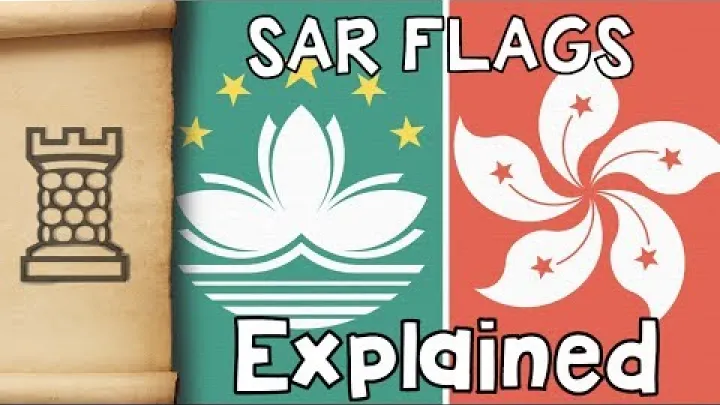
The bridge is commonly identified as the Governor Nobre de Carvalho Bridge, one of Macau’s best-known links across the waters between the peninsula and Taipa. Its inclusion places a recognizable feature of Macau’s built environment inside the regional design. The water below it reflects the territory’s coastal and island setting.
The lotus is the dominant visual element. It is not placed as a small decorative detail; it forms the center of the flag and rises above the bridge and water. This position helps explain why the flower is so strongly associated with Macau’s identity and why the flag is often used when people ask about Macau’s national flower.
A commonly given interpretation is that the lotus’s three petals represent the Macau Peninsula, Taipa, and Coloane. This interpretation connects the flower with the territory’s main geographic parts, but it should be described as an interpretation of the design rather than as the complete legal wording of Article 10. The legal description identifies the lotus, bridge, sea water, and stars without setting out every commonly reported symbolic meaning.
The five stars are generally understood as a visual link to China. Together, the stars and the Macau-specific lotus, bridge, and water create a regional identity that is distinct but not separate from the national framework.
The Regional Emblem and Its Bilingual Identity
The regional emblem repeats the main elements of the flag: five stars, a lotus, a bridge, and sea water. Its presentation is circular and seal-like, making it suitable for formal identification and official use rather than the rectangular display associated with a flag.
The emblem also includes Chinese and Portuguese wording identifying the Macao Special Administrative Region of the People’s Republic of China. This bilingual presentation is an important part of Macau’s formal identity. It reflects the territory’s legal and historical context and ensures that the regional designation appears in both of its official languages.
The flag and emblem are closely related, but they are not interchangeable names for one object. The flag is a field designed for display, while the emblem is a circular identity mark. Both are current regional symbols, and neither should be confused with the national emblem of the People’s Republic of China.
Historical coats of arms connected with Portuguese administration belong to an earlier period. They may be relevant to the history of Macau’s heraldry, but they are not the current regional emblem. For present-day references, the green regional flag and the circular regional emblem are the appropriate official symbols.
The Lotus as Macau’s Regional Flower
If the question is “What is Macau’s national flower?”, the direct answer is the lotus. The more technically accurate wording is that the lotus is Macau’s regional flower or official cultural symbol, rather than the national flower of a sovereign Macau.
What the Lotus Represents
The lotus is central to both Macau’s regional flag and regional emblem. Its prominent position makes it the most visible botanical symbol of the territory. The Macao Government Tourism Office describes the lotus as Macao’s official symbol, while local descriptions also refer to it as the regional flower.
The Macau Post Daily has described the lotus as Macau’s regional flower and connected it with purity and incorruptibility. These meanings are cultural and interpretive. They help explain the flower’s public importance, but they should not be treated as a complete legal definition of every element in the flag.
The lotus is also commonly associated with unity and prosperity in public explanations of Macau’s symbols. The three-petal interpretation links the flower with the territory’s main geographic parts, while the flower’s central position can be read as an image of cohesion. Its continued use in civic events and public displays also gives it an association with growth, good fortune, and a prosperous future.
These interpretations should be presented with suitable wording. It is accurate to say that the lotus represents Macau’s regional identity and is widely associated with purity, unity, and prosperity. It is less accurate to claim that every one of these meanings is separately established by law.
How Macau Celebrates the Lotus
The lotus is visible beyond official government emblems. Lotus Square and its Golden Lotus sculpture provide a prominent public-art example of the flower’s place in Macau’s civic landscape. The sculpture and the square make the symbol easy to encounter even for visitors who do not study the regional flag or emblem.

The Macao Lotus Flower Festival provides another example of public recognition. The Macao Government Tourism Office presents the festival as a tribute to the lotus and describes floral displays connected with the event.
Government news coverage has also documented the festival as a public cultural program, including themed floral displays and activities. The Macao SAR Government has published information about festival programming and dates for specific editions.
Public art, festivals, and tourism promotion demonstrate the lotus’s cultural importance. They do not, by themselves, create a new legal category such as a separate national flower. When planning a visit to Lotus Square or a festival event, check the current official listing for access information, dates, and programming because event details can change.
Macau National Animal, Bird, Tree, Fruit, and Motto
Searches for Macau national symbols often expect a complete list that includes an animal, bird, tree, fruit, and motto. The clearest legal evidence supports Macau’s regional flag and emblem, but it does not establish a Macau-specific official designation for each of those additional categories. The careful answer is therefore to report the status of each category without guessing a species, plant, food, or slogan.
What the Available Evidence Confirms
The following wording gives a precise answer to the main search categories:
- Macau national animal: No Macau-specific official regional animal is verified by the constitutional provisions that define Macau’s regional symbols.
- Macau national bird: No Macau-specific official regional bird is established in those provisions.
- Macau national tree: No Macau-specific official regional tree is established in those provisions.
- Macau national fruit: No Macau-specific official regional fruit is established in those provisions.
- Macau national motto: No separate Macau-specific motto is established by the regional flag and emblem provisions.
For a concise reference list, these categories should therefore be recorded at different levels: the flag and emblem are legally defined regional symbols; the lotus is officially promoted and widely recognized as a regional flower; and the remaining categories have no Macau-specific designation confirmed by the available legal and government sources. This is more accurate than forcing every category into a definite symbol.
This does not prove that no government department, cultural institution, school program, or tourism campaign has ever used an animal, plant, food, or phrase to represent Macau. It means that such a claim should not be presented as a formal Macau national symbol without clear authoritative support.
The wording on the regional emblem is also not automatically a motto. It identifies the territory in Chinese and Portuguese. An identifying name and a slogan or motto serve different purposes, so the emblem’s bilingual wording should not be listed as Macau’s national motto.
Similarly, a symbol that applies to China as a whole may be relevant in Macau, but it is not unique to Macau. Any China-wide national animal, bird, flower, tree, fruit, or motto should be labeled as a symbol of the People’s Republic of China rather than assigned to Macau.
Why Wildlife and Tourism Icons Are Not Automatically Symbols
A local animal or bird can be important for conservation, education, or tourism without being an official regional emblem. The same distinction applies to trees in public landscapes, fruits sold in local markets, foods associated with the territory, landmarks shown in visitor materials, and slogans used for a particular campaign.
Three descriptions help keep these categories separate:
- Official regional symbol: A symbol clearly established by law or by an authoritative government designation, such as Macau’s regional flag and emblem.
- Widely recognized cultural symbol: An object or image repeatedly used in local public life and official cultural promotion, such as the lotus.
- Representative local icon: A landmark, species, food, plant, or phrase that people associate with Macau but that does not have a confirmed formal designation.
Before calling something Macau’s national animal, bird, tree, fruit, or motto, use a simple verification rule. Look for clear wording in a current law, Macao SAR Government statement, or authoritative institutional source. Check whether the source is describing Macau specifically or China as a whole. Finally, preserve the source’s level of certainty: if it says “associated with,” “代表,” “symbolic,” or “popular,” do not rewrite that language as “official national symbol.”
When formal status cannot be supported, safer wording is still useful. You can describe an item as a “local icon,” “representative cultural image,” or “symbol commonly associated with Macau.” This gives readers meaningful information without turning a tourism association or popular claim into an official designation.
Conclusion: A Regional Symbol System Centered on the Lotus
Macau’s official symbol system is compact and clearly centered on the lotus. The regional flag and regional emblem are the main legally defined Macau-specific emblems, and both combine the lotus with five stars, a bridge, and sea water.
The lotus is widely recognized as Macau’s regional flower and official cultural symbol. Its associations with purity, incorruptibility, unity, and prosperity explain its presence in public art and the Macao Lotus Flower Festival. By contrast, claims about a Macau national animal, bird, tree, fruit, or motto should be described as unverified unless a current authoritative source gives the category a clear official designation.
Select area
Create a post
Posting is free and no registration is required.