Luang Prabang Getting There: Flights, Rail, Buses & Boats

Getting to Luang Prabang is straightforward once you choose the right arrival gateway, but the best route depends heavily on where you start and how much time you have. Flights and the Laos–China Railway are the quickest options for many travelers, while buses reach places beyond the rail line and the Mekong slow boat offers a slower, scenic journey from the Thai border. This guide compares the main ways to reach Luang Prabang, including the final transfer from the airport, railway station, bus terminal, or river pier. Transport schedules and operating arrangements can change, so use this as a route-planning guide and confirm date-specific details when you book.
How to Get to Luang Prabang at a Glance
Luang Prabang can be reached by air, rail, road, or river. There is no single best choice: a short rail trip may be ideal from Vientiane or Vang Vieng, while travelers entering Laos near Huay Xai may prefer the Mekong or a road-and-rail combination.
Compare Air, Rail, Road, and River Travel
| Option | Best for | Relative speed | Planning level |
|---|---|---|---|
| Flight | Regional arrivals and limited time | Fast | Book in advance |
| Train | Vientiane, Vang Vieng, northern rail corridor | Fast | Seats can be in demand |
| Bus or minibus | Towns away from rail stations | Slow to moderate | Confirm terminal and vehicle |
| Slow boat | Huay Xai and Mekong experience | Slow | Allow two travel days |
Air travel reduces travel time but can cost more and may involve baggage rules or a separate airport transfer. Rail is usually the most comfortable fast overland option on the Vientiane–Boten corridor, although the station is outside central Luang Prabang. Buses and minibuses are more flexible for remote northern destinations, but road journeys can be long. The slow boat is primarily an experience: it trades speed and fixed planning for time on the Mekong River.
For budgeting, compare the complete journey rather than only the advertised ticket. A flight may add baggage and airport-transfer costs; a train ticket may require paid transport to and from stations; and a bus or boat itinerary may include extra accommodation or local transfers. Booking difficulty also varies: rail seats and international flights are usually easier to plan ahead, while local buses and slow boats may depend more on what is operating at the time.
Choose a Route by Your Starting Point and Time
From Vientiane, compare a train, domestic flight, and road service. From Vang Vieng, the train is usually the simplest direct overland choice. From Thailand, flying from Bangkok is often the quickest route, while Chiang Rai or Chiang Mai travelers can cross near Huay Xai and continue by boat, road, or rail. From Vietnam, a flight through Hanoi is generally simpler than a long overland itinerary. Travelers from China or the far north of Laos can use the northern railway corridor if their date, ticket availability, and border arrangements fit.
Choose the fastest route when you have a fixed hotel booking, tour departure, or limited holiday time. Choose the river route when the journey itself is a major part of the trip. A multi-leg route can be rewarding, but it requires more tolerance for changes, waiting, and possible overnight stops. If you are comparing two routes, write down the first departure point, every transfer, the final arrival gateway, and the amount of buffer between connections.
Fly to Luang Prabang International Airport
Luang Prabang International Airport, usually shown as LPQ, is the city’s air gateway. It can be especially useful for travelers arriving from regional hubs or for those who want to avoid a long mountain road journey.
Domestic Flights from Vientiane and Other Lao Cities
The principal domestic air connection is between Vientiane and Luang Prabang. A flight is short compared with traveling by road, although airport check-in, baggage collection, and transfers mean that the total door-to-door advantage may be smaller than the flight time suggests. Domestic availability can vary by season and airline operations.
Some booking services list domestic connections involving Vientiane, Luang Prabang, Luang Namtha, Savannakhet, and Pakse; use a current search such as Baolau to see what is actually offered for your date. Treat any route beyond Vientiane as a current-booking question rather than a permanent service pattern. Compare the final price, checked-baggage allowance, and change conditions before deciding that flying is better value than rail.
For a domestic connection, allow time for the trip to Vientiane’s airport, check-in, and baggage procedures even when the aircraft journey itself is brief. If you are arriving in Laos on a separate international ticket, leave enough time between tickets to handle delays and baggage collection rather than assuming that a same-day connection will be protected.
International Flights from Regional Gateways
Bangkok and Hanoi are important regional gateways for Luang Prabang. Current airport departure information has also shown services connected with Bangkok and Kunming, but routes, airlines, and frequencies can change. A direct flight can be much more practical than crossing a land border and spending a full day or more on buses, particularly if you are carrying luggage or arriving after an international connection.
When comparing flights, check whether the itinerary is one ticket or separately booked flights. A self-made connection leaves you responsible for delays and missed onward flights. Also check which Bangkok airport is used, whether a transit requires an airport change, and whether the fare includes the baggage you need.
Regional flight options may be seasonal, intermittent, or limited to particular days. Search for the exact travel date and confirm the departure airport, arrival time, baggage conditions, and any transit requirement before treating a displayed itinerary as a workable connection.
Plan Around Airport Arrival Times
Use LPQ’s live arrival or departure information to understand whether your flight is running close to schedule; the Luang Prabang Airport Guide provides a useful status reference. A late-day arrival may not fit comfortably with an early morning train, bus, or river departure on the following leg.
If your flight arrives late or is an important connection, plan to stay in Luang Prabang overnight rather than trying to force a same-day onward transfer. Leave an overnight or generous connection buffer after a late flight, especially when your next transport departs only once daily or has a limited boarding window.
Take the Laos–China Railway
The Laos–China Railway has transformed travel along the main north–south corridor. It is often the preferred overland route for travelers coming from Vientiane or Vang Vieng, and it can also be part of a longer route from northern Laos.
Train from Vientiane or Vang Vieng
From Vientiane, rail is usually the main fast overland choice to Luang Prabang. From Vang Vieng, it is particularly convenient because it avoids a long road journey. A current booking listing indicates that high-speed trains between Vang Vieng and Luang Prabang can take about 50 minutes to 1 hour 5 minutes, while an ordinary train is listed at about 1 hour 15 minutes; see Baolau for indicative journey comparisons.
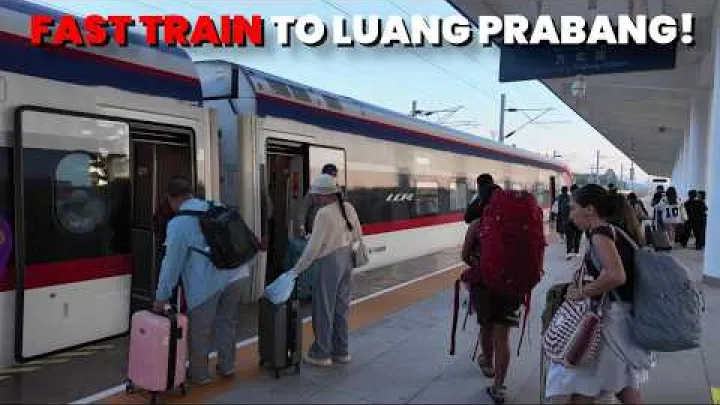
High-speed and ordinary services should not be treated as identical. The faster service may be more attractive for a short itinerary, while the ordinary service can be a useful alternative when its timing suits. Neither comparison replaces checking the service offered on your travel date. Luang Prabang railway station is outside the historic center, so include the final road transfer when comparing train time with a flight or bus.
Rail is fast between stations, but the practical journey also includes getting from your accommodation to the departure station, station-entry procedures, and the transfer from Luang Prabang railway station into town. This makes the train especially appealing when both ends of the journey are near the rail corridor, but less straightforward for travelers starting in a remote village.
Reach Luang Prabang from the Northern Rail Corridor
Travelers already near the Boten–Vientiane railway corridor can travel south toward Luang Prabang through the northern stations. This can suit people arriving from China or staying near northern rail-accessible towns. However, the route should be planned as a series of connections rather than assumed to be a seamless journey.
Huay Xai is not on the railway. From that Thai-border town, a traveler who wants to use rail normally needs a road leg to a northern station, such as Nateuy, followed by a southbound train. This can be faster than spending two days on the slow boat, but it adds a vehicle change, coordination risk, and potentially an overnight stay if the road arrival does not align with a train.
A road-to-rail itinerary works best when the road arrival and train departure leave a generous gap. Keep the stations distinct in your planning: Huay Xai is the border gateway, Nateuy is a rail-access point, and Luang Prabang railway station is the arrival gateway for the city. Ask the road operator where you will be dropped and how you will reach the station before purchasing separate tickets.
Buy Tickets and Prepare for Station Procedures
Ticket channels may include station ticket offices, city ticket offices, official digital tools, and authorized booking services. Availability differs by route and date, and popular departures may be harder to secure than less convenient services. Before going to a ticket office, confirm its current payment method, identification requirements, booking window, and any service charge. Bring the travel document used for the booking and make sure the name matches it.
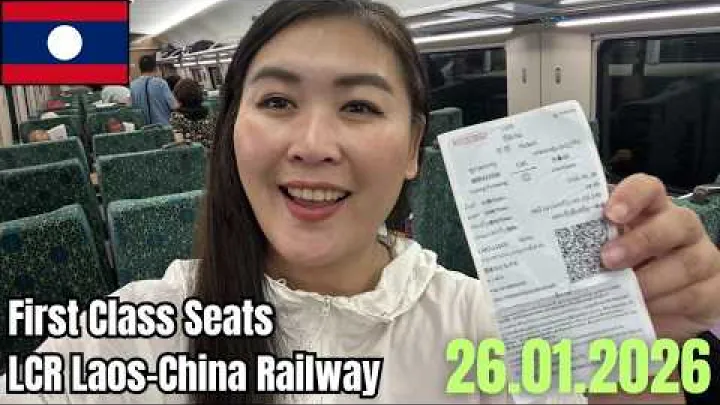
Plan the station transfer as part of the journey rather than as an afterthought. Allow time to reach Luang Prabang railway station, enter the station process, and find your departure area. On arrival, have your accommodation name and destination area ready for the final local transfer.
Before buying, check five details: the exact station, train type, departure date and time, passenger-name requirements, and the cancellation or change conditions. If using a booking intermediary, confirm whether the quoted amount includes a service fee and how you will receive the ticket. Do not assume that a ticket screenshot, foreign payment card, or digital booking method is accepted in every channel.
Handle Schedule Changes and Disruptions
Rail services can be affected by weather, maintenance, technical issues, or operational changes. If a train is essential to a flight connection, border crossing, or fixed accommodation booking, do not build the itinerary around a very narrow margin. Check the latest railway, road, and flight status with the relevant operator or station before departure, and consider what you would do if the planned service cannot run.
Travel Overland by Bus or Minibus
Road transport remains important in Laos because many towns are not directly served by the railway. It can also be the practical fallback when rail tickets are unavailable or when a road departure better matches your plans.
Bus from Vientiane or Vang Vieng
Buses and minibuses follow the north–south road network between Vientiane, Vang Vieng, and Luang Prabang. They are a traditional option and may suit travelers whose departure time does not match the train. They are generally slower and less predictable in comfort than rail, especially over longer distances.
Road time depends on the vehicle type, traffic, weather, roadworks, and conditions along the route. Before buying, confirm the actual departure terminal, whether the vehicle is a larger bus or a minibus, its luggage policy, and where in Luang Prabang it is expected to arrive. These details matter more than an old online timetable.
Ask whether the ticket is for a direct vehicle or a connection arranged through a local agent. Also establish whether luggage travels in a separate compartment, whether the vehicle collects passengers from several points, and whether the stated arrival is at a central stop or a terminal outside town. These questions help you compare a nominally cheaper bus with the extra time and final transfer it may require.
Northern Laos Connections via Luang Namtha and Phonsavan
Luang Namtha, Phonsavan, and smaller northern towns may require road transport because their practical links to Luang Prabang are not as direct as the main rail corridor. Routes can be direct on some days, while others involve a change in another town. Vehicles may make frequent local stops, and the trip can be substantially more demanding than the map suggests.
From Luang Namtha, ask whether the proposed service goes directly to Luang Prabang or requires a transfer. From Phonsavan, establish the departure point, expected arrival terminal, and whether the road journey operates on your intended day. Do not assume that a route advertised by a guesthouse or traveler report is a daily through-service.
For either starting town, keep accommodation and onward plans flexible enough to absorb a late arrival. If the route requires a change, write down the intermediate town and ask where the second vehicle departs; a transfer at a local terminal may not be covered by the first ticket.
Cross-Border Buses from Thailand
The main northern Thailand overland pattern begins in Chiang Mai or Chiang Rai, continues to the border area near Huay Xai, and then uses a Lao connection toward Luang Prabang. After entering Laos, the main choices are a slow boat from Huay Xai, a road journey toward the railway at Nateuy, or a bus or minibus route where available.

Separate this plan into three parts: travel within Thailand, the border crossing, and the Lao onward connection. That makes it easier to identify where a delay or changed service could affect you. Do not rely on a direct international bus unless the operator confirms it for your specific date; border procedures, vehicle changes, and frequency can alter the practical itinerary.
When comparing the options, flying is generally the simplest for a fixed arrival, the slow boat offers the strongest Mekong experience, and road-to-rail is an overland alternative that requires the most coordination. Keep passports and travel documents accessible during the border leg, and avoid booking a tightly timed onward departure immediately after the crossing.
Cross-Border Buses from Vietnam
Overland travel from Vietnam to Luang Prabang is possible in route patterns that may involve Vinh and Phonsavan, Thanh Hoa and Sam Neua, or Dien Bien Phu and Muang Khua. These are long-distance regional journeys, not simple city-to-city transfers. A route may require several tickets, a border crossing, and an overnight stop before reaching Luang Prabang.
| Vietnam corridor | Possible Lao direction | What to establish first |
|---|---|---|
| Vinh | Phonsavan and onward | Whether a through-ticket exists |
| Thanh Hoa | Sam Neua and onward | Vehicle changes and operating days |
| Dien Bien Phu | Muang Khua and onward | Border and onward transport timing |
A flight through Hanoi may be substantially easier when time, comfort, or reliable onward plans matter. Before committing to a land route, distinguish between a geographically possible corridor and a currently bookable through-service. Confirm border documentation requirements directly with the relevant authorities and confirm the bus arrangement with the seller.
Take the Mekong Slow Boat from Huay Xai
The slow boat from Huay Xai is one of Laos’s best-known overland journeys. It is not the fastest way to Luang Prabang, but it is a memorable option for travelers who want to experience the Mekong River rather than simply reach the destination.
Follow the Huay Xai–Pakbeng–Luang Prabang Route
The traditional route has two daytime river legs: Huay Xai to Pakbeng, an overnight stay in Pakbeng, then Pakbeng to Luang Prabang. Each day can be long, and the total experience depends on river conditions, the boat, passenger numbers, and boarding arrangements. The overnight stop is an essential part of the standard journey, not merely a short break between boats.
A recent traveler account describes the two-day structure and daily legs of roughly 6 to 8 hours, while also illustrating why this should be treated as an indicative experience rather than a fixed timetable. Read Adventures of Jellie for a practical description of the Huay Xai–Pakbeng route. Choose this route for scenery, a slower pace, and the social experience of travel, not for a tight arrival deadline.
Choose Between Local and Comfort-Oriented Boats
Basic local slow boats and higher-comfort or packaged services can differ greatly in seating, personal space, food, guiding, booking support, and the handling of the Pakbeng overnight stay. A lower-priced ticket may involve simpler facilities and fewer included services. A packaged option may reduce planning work, but its value depends on exactly what is included.
Decide first what matters most: the lowest cost, a more comfortable seat, less uncertainty, meals, a guide, or help with accommodation. Ask the seller whether food, drinking water, hotel arrangements, luggage handling, and assigned seating are included. Avoid judging a service by its label alone, and do not base your budget on old advertised prices.
Check River Conditions and Departure Arrangements
River levels, weather, fuel, passenger demand, and local operating decisions can affect departures and travel time. Slow-boat tickets may be sold at the pier, through guesthouses, or by local agencies rather than through one central booking system. Confirm the boat’s departure point, departure time, fare, operating status, seating arrangement, and expected arrival locally on the day before travel.

Check current river and weather conditions before committing to the slow boat, particularly if you have a fixed onward journey after reaching Luang Prabang. Keep a road or rail alternative in mind if conditions or operations do not suit your schedule.
Connect from the Arrival Gateway to Central Luang Prabang
Every long-distance arrival requires a final local journey to your accommodation. Keep the plan simple: know the name of your hotel or guesthouse, carry its address or map location, and confirm where your long-distance transport actually arrives.
From LPQ to the Historic Center
LPQ is outside the main historic area, so arriving passengers need a short road transfer into town. Accommodation can often help arrange a pickup, and airport or clearly identified local providers may offer other options. Arrival time can affect the number of vehicles available and the price offered.
This is a last-mile transfer, not usually a difficult journey, but arranging it in advance can make a late arrival more comfortable. If you have not prearranged transport, ask for the fare and destination before starting the ride rather than assuming a standard tariff.
From Luang Prabang Railway Station to Town
Luang Prabang railway station is outside the historic center. After leaving the platform and station area, travelers generally continue by tuk-tuk, shared vehicle, or another local transfer. Train arrivals can create a rush for vehicles, so identify your accommodation area before approaching drivers.
Use a clearly identified transfer and agree the fare before boarding a tuk-tuk or shared vehicle. Confirm whether the price is for the vehicle or per passenger, and make sure the driver understands the destination. If sharing, ask whether the vehicle will leave immediately or wait for more passengers.
From Bus Stations and Mekong Piers
Bus arrivals may use a terminal away from the historic center, sometimes referred to locally as the Naluang or Southern Bus Station. Slow boats generally arrive in the Luang Prabang river-pier area, which may be closer to central accommodation. Names and arrival points can change, so confirm the exact terminal or pier printed on your ticket before departure.
Send your accommodation the likely arrival point if you want pickup help. Otherwise, keep a simple final-transfer plan and enough local payment flexibility for a ride into town. This is especially useful after a long bus trip or a full day on the river.
Typical Routes from Major Gateways
These route summaries turn the transport options into practical choices. They are not substitute timetables: compare them against the departures available on your dates.
From Vientiane
For most travelers, rail is the main fast overland option from Vientiane. A domestic flight can work well when airport timing is better than train timing or when you prefer to avoid the station transfer. Buses are the slower backup for travelers who cannot obtain a suitable rail ticket or prefer a road departure.
Choose rail if time and seat availability are your priority. Choose a flight if the full airport-to-hotel timing is favorable and the fare works for your budget. Choose a bus if minimizing ticket cost or matching a particular departure matters more than speed. The experience-focused option is not the direct Vientiane route, but adding a river journey elsewhere in a longer Laos itinerary.
From Vang Vieng or Northern Laos
| Starting point | Practical route | Main detail to confirm |
|---|---|---|
| Vang Vieng | Direct train | Seat and departure time |
| Luang Namtha | Road route or rail-access combination | Directness and changes |
| Phonsavan | Road connection | Operating day and arrival point |
| Huay Xai | Slow boat or road to Nateuy rail | Connection feasibility |
From Vang Vieng, a train is normally the most direct option when service and seats are available. From Luang Namtha and Phonsavan, road travel may be more realistic, though it can be long and involve changes. From Huay Xai, decide between the slower scenic boat and the more complex road-to-Nateuy rail approach. Your luggage, comfort needs, and willingness to manage multiple tickets should influence the choice.
From Thailand
Flying from Bangkok is usually the fastest practical choice, particularly for travelers with limited time. Entering Laos through the Chiang Rai or Chiang Mai region and continuing via Huay Xai provides a more overland-focused trip. From Huay Xai, the slow boat offers the highest scenic value, while a road-to-rail connection may offer a faster but more complicated onward route.
Rank the choices simply: fly for speed, take the slow boat for the Mekong experience, and use border-road-rail combinations when you want to keep traveling overland but do not want two full river days. Build extra time around the border crossing and each vehicle change.
From Vietnam or China
From Vietnam, flying through Hanoi is often the fastest and least complicated route to Luang Prabang. The overland corridors through Dien Bien Phu, Phonsavan, Sam Neua, or other border regions are better suited to travelers making a flexible regional journey rather than those needing a predictable arrival time.
From China or the northern border area, rail can be attractive where a current passenger service, ticket, and border documentation arrangement are available. Do not assume that rail access across the border will match your travel date or that a route has one simple through-ticket. Confirm the current passenger route and immigration process before making non-refundable plans.
Final Recommendation for Getting to Luang Prabang
For most visitors, the best way to get to Luang Prabang is to fly when arriving from a regional hub, take the train from Vientiane or Vang Vieng, and use buses only when your starting point is outside the main rail corridor. The Huay Xai slow boat remains the best choice when the Mekong journey is part of the reason for traveling in Northern Laos.
Plan the complete journey rather than only the long-distance ticket: include the airport, station, terminal, or pier transfer at both ends. Select a route with enough time for the connections you actually have, then confirm the operational details close to departure. That approach gives you the best balance of speed, comfort, cost, and flexibility on the way to Luang Prabang.
Select area
Create a post
Posting is free and no registration is required.