Phonsavan Getting There: Flights, Buses and Vans

Getting to Phonsavan, the main base for the Plain of Jars, requires more planning than travel between Laos’s best-connected cities. A domestic flight can save many hours, while buses and vans cost less but use long mountain roads. This guide compares the main gateways, explains what can realistically be booked online, and helps you build an itinerary that can absorb changing transport conditions. Timetables, vehicles, and fares should be treated as date-specific until confirmed for your journey.
How to Get to Phonsavan: The Main Choices
Phonsavan is in Xiangkhouang Province in northeastern Laos. Most visitors arrive from Vientiane or Luang Prabang, while Vang Vieng can be a useful intermediate starting point for travelers already moving north. Your choice is usually between flying to Xieng Khouang Airport or taking an overland bus or van to Phonsavan town.
Choose Between Flying and Traveling Overland
Choose a flight if time is limited, mountain roads are a concern, or you are arriving in Laos from abroad and want the simplest onward route. Xieng Khouang Airport, using the code XKH, serves the Phonsavan area. A flight is far shorter than an all-day or overnight road journey and avoids many hours of bends, variable road surfaces, and rest-stop timing.
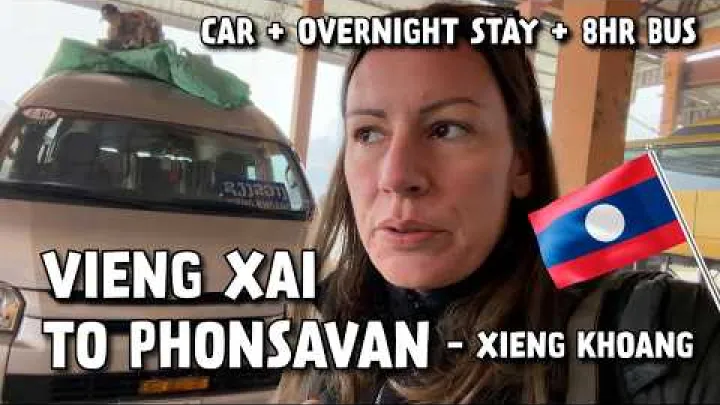
Choose a bus or van if your budget is the priority, if you prefer a continuous overland route, or if air service is unavailable on your dates. Buses are generally the lower-cost option and may suit travelers with a flexible schedule. Vans can be convenient where they offer local pickup or more practical departure times, but space and comfort can be limited. Do not make the decision from an old timetable: service patterns can change, especially on domestic routes with limited frequency.
A simple rule is to fly when arriving time and comfort matter most; take a larger daytime bus when cost matters and you have time; and consider a van only when the current vehicle, pickup point, and journey expectations suit you.
Use Vientiane, Luang Prabang, or Vang Vieng as the Main Planning Gateways
Vientiane is the strongest planning base. It combines Wattay International Airport, domestic flight options, travel agents, and the northern bus network. The Vientiane Northern Bus Terminal is the key local anchor to ask about for services toward Xiangkhouang and Phonsavan, although the departure point printed on your own ticket is the one that matters.
| Gateway | Likely option | Planning confidence |
|---|---|---|
| Vientiane | Flight, bus, or van | Best documented |
| Luang Prabang | Van or bus | Check live availability |
| Vang Vieng | Local van | Often locally arranged |
Luang Prabang is a logical northern gateway, particularly for travelers combining the city with the Plain of Jars, but online listings can be incomplete and journey times are substantial. Vang Vieng may have locally arranged vans even when a major booking site shows no route. Treat a missing online result as a reason to ask locally, not as proof that travel is impossible.
Choose the gateway that matches your existing itinerary rather than automatically backtracking to Vientiane. From Vientiane, compare a flight with a long overland journey. From Luang Prabang, allow a full day for the road or investigate a Vientiane connection only after both flight sectors are visible. From Vang Vieng, plan extra time to arrange a local van and confirm where it departs. In every case, Phonsavan town and Xieng Khouang Airport are separate arrival points, so leave room for the final local journey after the main transport segment.
Flying to Phonsavan Through Xieng Khouang Airport
Air travel is the fastest approach to Phonsavan when a suitable domestic service is operating. It is also the least demanding option physically, but domestic flights in Laos can have limited schedules. Search for XKH rather than assuming that a general search for Phonsavan will show every available option.
Vientiane to Xieng Khouang Airport by Air
The Vientiane to Xieng Khouang corridor is the best-established direct air option in the available route information. It is particularly useful after an international arrival at Wattay International Airport, provided the domestic departure fits your arrival time. Flying replaces a long road journey with a short domestic sector, though the overall day still includes airport travel, check-in, baggage collection, and the onward ride into Phonsavan town.
Historic fare and duration comparisons consistently show the broad pattern: air travel costs more than a bus but takes dramatically less time. Exact prices depend on the travel date, booking conditions, baggage allowance, and available inventory. Start with the official Lao Airlines booking and flight-information pages for current results rather than relying on an aggregator’s route page.
Only name an operating airline once the live result for your date shows that carrier and a bookable flight. This is more reliable than assuming that a carrier serving Laos generally also serves XKH on every day or season.
Luang Prabang to Phonsavan by Air: Treat Direct Flights as Uncertain
Older travel information sometimes lists a direct air link between Luang Prabang and Xieng Khouang. Current route visibility is not consistent enough to plan around that service without a live search showing seats. The presence of Luang Prabang Airport and XKH in older databases does not establish that a regular LPQ–XKH flight is operating on your dates.
If no direct flight appears, the practical alternatives are an overland journey from Luang Prabang or a connection through Vientiane where compatible flights actually exist. A route through Vientiane can be comfortable but may add airport time, a layover, and an overnight stay. It is a conditional option, not a default shortcut.
How to Verify a Phonsavan Flight Before Booking
Search the airline’s own system using XKH, then read the result as a specific itinerary rather than a general route promise. Confirm the date, departure airport, arrival airport, local departure time, operating carrier, and whether the displayed fare is still available at the final payment stage. An older guide, a route map, or an initial aggregator result may show a route that does not have seats for your day.
- Check that the itinerary says Xieng Khouang Airport, XKH, not another Laos airport.
- Read the baggage allowance and charges for additional luggage.
- Allow a realistic connection in Vientiane, including immigration and baggage collection after an international flight.
- Check change and cancellation conditions before selecting a non-refundable fare.
- Save the confirmation, airline contact details, and the flight number on your phone.
Before paying, check live availability and the operating airline again, especially when considering a flight from Luang Prabang. Arrange the brief onward journey from XKH to your accommodation separately after you know the actual flight arrival time.
Taking a Bus or Van from Vientiane
Vientiane offers the widest choice of overland planning tools for Phonsavan. The route is long enough that vehicle type, departure timing, and the arrival hour can matter as much as the ticket price. Use online listings as a starting point, then make sure your ticket details match the service you intend to board.
Find the Correct Vientiane Bus Terminal
The Vientiane Northern Bus Terminal is the main local reference point for northern and Xiangkhouang-bound transport. However, Vientiane has more than one bus terminal, and some tickets may specify a different station, a roadside boarding point, or a hotel pickup. A station name used casually by a seller may not be precise enough for a traveler unfamiliar with the city.
First reserve or buy the ticket. Next, read the printed or digital boarding details for the terminal, meeting point, date, and departure time. Then ask the seller, your accommodation, or the terminal staff to confirm the exact location and expected Phonsavan arrival point. Confirm whether hotel pickup is included rather than assuming it is.
Do this before setting out for the station. The practical risk is not only missing a departure; it is arriving at the wrong Vientiane terminal because a third-party timetable or verbal direction was treated as final.
Compare Day Buses, Overnight Buses, and Vans
A daytime bus gives you daylight views and makes it easier to judge stops and road conditions, but it uses a large part of the day. An overnight bus can preserve daytime sightseeing time and may reach Phonsavan in the morning, though sleep quality varies considerably. A full-size bus often provides more personal space than a van, while a van may offer a more convenient pickup arrangement or an available departure when bus seats are limited.

Route listings for Vientiane to Phonsavan have shown buses around the lower-cost range near US$19 and combined bus-and-van options around US$21, but these are indicative snapshots, not a fare promise. The current 12Go listing can help compare what is being shown for your date.
For motion-sensitive travelers, a larger daytime vehicle is usually the easier starting preference when available. Travelers with very limited time may prefer flying. Those who want to avoid night travel should choose a daytime service even if it requires an extra night in Vientiane or Phonsavan.
Buying and Boarding a Vientiane–Phonsavan Bus
You can book through an online platform, a local travel agency, or a bus counter. Online booking is useful for comparing routes and reserving a seat before arrival. Agencies can be useful when you need help identifying the actual departure point. A station counter can be practical for near-term travel, but availability may be limited and ticket records may be simple or handwritten.

- Confirm whether the vehicle is a bus, sleeper bus, minibus, or a bus-and-van combination.
- Ask how the seat or sleeper berth is assigned and whether you must exchange an electronic voucher.
- Confirm luggage handling and any separate baggage or station charge.
- Keep the ticket, booking reference, and a screenshot of the boarding instructions available offline.
- Arrive with enough time to locate the counter or vehicle without rushing.
A low price does not by itself show that a vehicle will be more comfortable or better suited to a long mountain journey. Choose based on the actual vehicle type, departure arrangement, and your ability to rest before or after the trip.
Traveling from Luang Prabang or Vang Vieng
Travel from Laos’s popular northern destinations is possible, but it is less standardized online than travel from Vientiane. Expect mountain-road conditions and avoid planning this journey as a quick transfer between tightly timed activities.
Luang Prabang to Phonsavan by Van or Bus
The Luang Prabang to Phonsavan route is an established overland connection of roughly 350 km, but it is a demanding mountain journey. Vans are commonly listed; larger buses or sleeper services may appear on some dates. Online estimates can range widely, from about 7 hours to much longer, and that broad range should not be treated as a reliable same-day itinerary estimate.
For ordinary planning, reserve the whole day and avoid booking a tour, flight, or essential appointment immediately after the stated arrival time. Longer outcomes can result from weather, roadworks, vehicle changes, traffic, or extended stops. Vans may be cheaper, with listings sometimes starting near US$15, but lower cost can mean tighter seating and less luggage space. The route page on 12Go is useful for checking current displayed options and ranges.
Take the road route when you want a direct overland connection and can give it a full day. An indirect flight via Vientiane is worth considering when comfort and reduced road exposure are more important than the extra airport process.
Vang Vieng to Phonsavan by Local Van
Local traveler reports indicate that van transport between Vang Vieng and Phonsavan can be available, even though the route may be hard to find on large booking platforms. This is a route where guesthouses, local travel agencies, and station staff may have better current information than a generic online search.
Ask for the current departure point, vehicle type, luggage policy, and likely arrival location in Phonsavan. Allow time in Vang Vieng to arrange the ticket locally rather than expecting immediate online confirmation. Reports of a van service are useful leads, but they are not evidence of a fixed daily timetable or a guaranteed fare.
When an Indirect Flight via Vientiane Makes Sense
When no direct Luang Prabang–XKH flight is operating, flying through Vientiane can make sense for travelers who strongly prefer airports to a long mountain road. The trade-off is a second flight, time in transit, and the need for a workable connection. It is most attractive when you have enough days, the flight schedules align, and the fare fits your budget.
It is less attractive when the connection is tight, requires separate tickets with no protection, or would leave you stranded overnight if the first flight changes. For a short trip with a limited budget, the direct overland route may be simpler. For a comfort-focused itinerary with schedule flexibility, the Vientiane connection can be a reasonable alternative once both sectors are confirmed.
Reaching Phonsavan from Southern Laos or Abroad
Travelers starting farther south should think in stages. Phonsavan is not a simple extension of every Laos transport corridor, so route logic matters more than finding a single through-ticket.
From Pakse, Savannakhet, or Thakhek
From Pakse, Savannakhet, or Thakhek, plan to connect through a larger hub rather than expecting a straightforward direct service to Phonsavan. Vientiane is the most practical interchange to investigate because it offers access to both the XKH air corridor and northern overland services. Check each segment separately: a bus operator’s network coverage does not necessarily mean there is a same-day, bookable through itinerary.
Give yourself recovery time between long legs. A plan that combines a southern overnight bus, a terminal change in Vientiane, and another long mountain journey may be possible on paper but can become exhausting and fragile. Splitting the trip with a night in Vientiane is often the more manageable pattern.
From International Arrivals via Vientiane
Wattay International Airport in Vientiane is the practical first gateway for many international visitors going to Phonsavan. From there, you can take a same-day domestic flight if the schedules give ample time, stay overnight and fly or take a bus the next day, or use an overnight bus when that fits your arrival and comfort preferences.
A same-day domestic connection is best reserved for an itinerary with a generous buffer after immigration, baggage collection, and movement through the airport. An overnight stay in Vientiane reduces pressure and gives you time to resolve a delayed international arrival. An overnight bus can reduce hotel costs, but it also begins a long road journey after a flight.
Think of the itinerary as a pattern rather than a guaranteed connection: arrive in Vientiane, complete airport formalities, then continue only when the confirmed domestic service or bus departure leaves a comfortable margin.
Compare Time, Cost, Comfort, and Booking Difficulty
The comparison below is designed to help with a first decision. Durations and prices are broad planning ranges, not schedules. Season, exchange rates, vehicle supply, pickup arrangements, and booking date can all change the final result.
Typical Flight, Bus, and Van Trade-Offs
| Route and mode | Typical time | Indicative one-way cost | Best for | Booking ease |
|---|---|---|---|---|
| Vientiane to XKH flight | Short flight; airport time extra | Usually above bus cost | Limited time, comfort | Check airline live |
| Vientiane bus | Long day or overnight | About US$19 shown in listings | Lower-cost travel | Moderate |
| Luang Prabang van or bus | About 7 hours or longer | From about US$15 shown | Direct northern route | Variable |
| Vang Vieng local van | Long mountain journey | Ask locally | Flexible local plans | Often local only |
Compare the fare in the currency displayed at checkout and establish what it includes. Confirm whether transfers, hotel pickup, luggage, ticket-exchange requirements, and station fees are included before deciding that one option is genuinely cheaper.
Use the table as a filter rather than a promise. A flight may look expensive until the value of a saved day is considered; a cheap van may become less attractive if it requires a separate taxi, has limited luggage space, or arrives too late for check-in. For an overland trip, compare the whole travel day, not just the vehicle’s advertised hours. If the displayed option gives no clear arrival point or vehicle description, treat that uncertainty as part of its booking difficulty.
Online Booking Platforms versus Local Counters
Online platforms are helpful for route discovery, date comparisons, visible operator names, and electronic reservations. They can be especially useful for Vientiane departures. Baolau describes its Laos bus inventory as connecting multiple stations and stops and can be another route-search tool for travelers who prefer electronic tickets; see Baolau for currently displayed options.
Local counters, agencies, and guesthouses remain valuable for routes that are poorly indexed online, especially from Vang Vieng. They may know about a current van, a changed pickup point, or a service that is sold locally. That practical advantage does not remove the need to read the ticket details carefully.
Whether you book online or in person, establish the boarding location, whether an electronic confirmation must be exchanged, the departure date and time, and the intended arrival point in Phonsavan. Arrive early enough to find the right counter or vehicle, particularly when the station layout is unfamiliar.
Weather, Comfort, and Arrival Planning
The journey to Phonsavan is part of the trip, not merely a transfer. Mountain terrain, long vehicle hours, and late arrivals can affect how much you enjoy the first day. Plan for the conditions most relevant to your chosen mode.
Mountain Roads and Heavy Rain Can Change the Plan
Overland approaches to Phonsavan cross mountainous terrain. Heavy rain, mist, road damage, and localized disruption can extend travel well beyond an advertised duration. Individual traveler stories of major delays should be read as examples of what can happen, not as a forecast for every journey.
Check recent road conditions locally before departure, especially in wet weather, and avoid making a tight onward flight, bus, or tour connection after a mountain journey. Build a buffer before fixed commitments. This is more useful than trying to predict an exact journey time from an old online listing.
Night Travel, Vehicle Comfort, and Motion Sickness
Night buses can save daylight hours and may reduce the need for an extra night of accommodation, but they also mean less visibility on winding roads and uncertain sleep. A larger bus may offer more room than a van, yet seating layouts, air conditioning, toilet access, stop frequency, and luggage arrangements vary by vehicle. Do not assume a particular comfort or safety standard from the vehicle label alone.
If night travel on winding mountain roads concerns you, choose a reputable operator or a daytime service where available. Travelers prone to motion sickness may prefer a seat with less perceived movement when they can choose, carry water and any suitable medication, and avoid starting the journey overtired. Families, older travelers, and anyone who finds long road travel difficult should allow a quieter day after arrival.
Plan Your First Hours in Phonsavan
Actual arrival time affects accommodation check-in, meals, local transport, and the timing of a Plain of Jars visit. Confirm your lodging location and any requested pickup before you leave the departure city. Keep the contact details and address accessible offline, since late arrivals can make local arrangements less straightforward.
- Save your accommodation name, address, and contact number.
- Tell the property if your bus, van, or flight is likely to arrive late.
- Keep essential medication, water, a warm layer, and valuables with you rather than in inaccessible luggage.
- Confirm the next day’s Plain of Jars transport only after your actual arrival is clear.
If a bus or van arrives after local businesses have closed, having the accommodation address and a working contact number is especially useful. Keep the first evening simple, and do not assume that an advertised arrival time leaves enough daylight for a full Plain of Jars outing. Arrange the next day around the transport and energy you actually have, rather than around the original booking estimate.
Keep your first sightseeing commitment flexible until the actual arrival time in Phonsavan is confirmed. A relaxed first evening and a full following day usually make the visit more enjoyable than trying to force a site visit immediately after a long road transfer.
Final Route Choice for Phonsavan
For most travelers, Vientiane is the easiest gateway: fly to XKH when time and comfort are priorities, or use a bus when budget matters and a long road journey is acceptable. From Luang Prabang, plan on an overland van or bus unless a live airline search shows a workable alternative. From Vang Vieng and southern Laos, local information and staged connections are often more useful than a single online search.
Book the transport that matches your available days rather than the shortest advertised duration. With a confirmed departure point, realistic time buffer, and flexible first hours in Phonsavan, you can arrive ready to explore the Plain of Jars instead of recovering from an avoidable transport problem.
Select area
Create a post
Posting is free and no registration is required.