Seoul Travel Guide: First-Time Trip Planning Tips

Seoul is a useful starting point for a South Korea travel guide because royal heritage, modern districts, food, cafes, parks, and an extensive public transport network are all part of the same large capital. The city is easy to explore when each day is organized around nearby neighborhoods, but its size, hills, seasonal weather, and different district atmospheres can make an unplanned trip tiring. This Seoul travel guide explains how to choose the best time to visit, where to stay, how to move between Incheon International Airport, Gimpo International Airport, and central Seoul, and how to build a realistic itinerary. Use it as a planning framework, then explore more detailed accommodation, transport, and activity guides for the areas that match your interests.
Start With a Quick Seoul Trip Overview
A successful first visit depends less on seeing every famous place and more on making sensible choices about time, location, and daily travel. Begin by deciding how much usable time you have and which parts of Seoul matter most to you.
What Makes Seoul Easy and Challenging for First-Time Visitors
Seoul combines a historic capital, a dense modern city, residential neighborhoods, major shopping areas, riverside parks, mountains, and a wide range of Korean and international food. A visitor can spend one morning near a palace, an afternoon in a cafe district, and an evening beside the Han River without leaving the metropolitan area.
The tourism infrastructure is strong, and major subway stations commonly use color-coded lines and multilingual signs. However, Seoul is not a small city. Long cross-city journeys, steep streets in some areas, busy commuting periods, different neighborhood identities, and occasional language barriers can affect the experience. A good plan groups activities geographically, leaves time for meals and walking, and uses one convenient base rather than changing hotels repeatedly.
Choose Your Seoul Trip Length
Choose the length of your Seoul trip according to your interests, arrival and departure times, and tolerance for commuting. A short first visit can focus on one historic cluster, one contemporary district, and one river or skyline experience. If your arrival is late or your departure is early, count only the hours you can realistically use rather than treating those days as full sightseeing days.
With more time, you can slow down, return to a favorite area, add markets and cafes, or explore neighborhoods away from the main visitor routes. Group places by district instead of crossing the city several times in one day. Travelers with additional days can consider a nearby Gyeonggi destination such as Suwon, but only when the connection and the regional contrast suit their interests better than another full day in Seoul.
Choose the Best Time to Visit Seoul
Seoul has four distinct seasons, and the best time to visit depends on whether you value comfortable walking, seasonal scenery, lower demand, or indoor attractions. Treat weather and event timing as planning factors rather than fixed promises.
Seasonal Weather and Outdoor Comfort
Spring and autumn are often comfortable seasons for walking through historic areas, shopping districts, and parks. They are also popular periods for seasonal scenery, so demand can rise when blossom or foliage conditions are attractive. The timing of flowers and autumn color varies by year and location, so avoid building a trip around a single promised date.
Summer can be hot, humid, and rainy. Plan shorter outdoor walks, use museums, department stores, cafes, and other indoor options, and consider placing outdoor activities in the morning or evening. Winter is cold and outdoor comfort can be limited, although travelers who enjoy seasonal events or nearby winter activities may still find it appealing. General seasonal guidance is available from Intrepid Travel, but check a current Seoul forecast before fixing outdoor-heavy days and deciding what to pack.
Crowds, Prices, Holidays, and Event Timing
Blossom, foliage, festivals, school breaks, and major events can increase demand for flights and accommodation. National holidays and large events may also change crowd levels, opening patterns, or the rhythm of central districts. These periods can be enjoyable, but they require more patience and earlier attention to lodging and reservations.
Shoulder periods may offer a more balanced combination of availability and comfortable sightseeing, but Seoul remains a working metropolis throughout the year. A quieter travel period does not mean empty palaces, markets, or public transport. Compare demand, weather, and the activities you want most instead of naming one month as the universal best time to visit.
Understand Seoul's Layout and Pick a Base
Before choosing a hotel, learn to read Seoul as a group of connected areas rather than one single center. The Han River is a useful geographic reference, but the most practical decision is usually which neighborhood cluster you want near your door each day.
Read Seoul by the Han River and Neighborhood Clusters
The Han River provides a broad orientation: Gangbuk generally refers to areas north of the river, while Gangnam refers broadly to areas south of it. This distinction is useful, but it does not describe one uniform experience on either side. The historic core around Jongno includes palaces, Bukchon, Insadong, and other traditional areas, while districts south of the river include major commercial, residential, business, and entertainment centers.
![Preview image for the video "Seoul, Korea - Walking Tour of Neighborhood - 4K - Seogyo-dong [Mapo-gu 3] 19(3)-11".](/sites/default/files/styles/media_720x405/public/oembed_thumbnails/2026-09/9RMHctdSZyZ84Mt-WefXi-fUOD6K60lMkO2s5uSCWMc.jpg.webp?itok=82cpdu9J "Preview image for the video \"Seoul, Korea - Walking Tour of Neighborhood - 4K - Seogyo-dong [Mapo-gu 3] 19(3)-11\".")
Think in clusters such as Jongno and the old city, Myeongdong and central shopping, Hongdae and its surrounding cafe streets, Gangnam, Itaewon, Yeouido, and the eastern or western Hangang parks. Each cluster can feel like a small city for a day. Hangang parks are also both a leisure corridor and a useful reference for understanding how different parts of Seoul connect. Planning by cluster reduces backtracking and leaves more time for ordinary street life.
Best Areas to Stay for a First Seoul Trip
No neighborhood is equally convenient for every attraction. Compare atmosphere, subway access, evening activity, noise, accommodation style, airport connections, and the amount of walking you are comfortable doing.

| Area | Strength and atmosphere | Trade-off and best fit |
|---|---|---|
| Jongno and Insadong | Palaces, traditional streets, tea houses, and heritage access | Best for history-focused visitors; evenings may be calmer |
| Myeongdong | Central shopping, beauty retail, and a broad hotel choice | Good for first-timers seeking centrality; busy and commercial |
| Hongdae | Cafes, music, youth culture, and nightlife | Good for evening energy; check noise and late-night habits |
| Gangnam | Modern commercial areas, restaurants, and business access | Good for contemporary city life; farther from the historic core |
| Itaewon | International dining, varied nightlife, and hillside streets | Good for mixed dining; atmosphere and terrain vary by block |
| Yeouido | Business district, riverfront access, and open spaces | Good for river walks or business trips; less central for heritage days |
For many first-time visitors, Jongno or Insadong makes heritage sightseeing simple, while Myeongdong offers a central base with strong shopping access. Hongdae suits travelers who expect to spend evenings out, and Gangnam suits those who prefer a modern southern Seoul setting. The best choice is the one that supports your normal daily routine, not merely the one with the lowest nightly price.
Match Your Base to Your Travel Style
- Heritage-focused travelers: Choose Jongno or Insadong to keep palaces, Bukchon, and traditional streets close to the start of the day.
- Shoppers: Consider Myeongdong for beauty and retail access, or choose another district if you prefer department stores, boutiques, or design areas.
- Nightlife and cafe visitors: Hongdae and Itaewon offer different evening styles, while Seongsu may suit a more cafe and design-oriented plan.
- Families and slower travelers: Prioritize a quiet room, an easy subway connection, elevator access, and short routes back to the accommodation.
- River or business travelers: Yeouido can reduce daily travel when riverfront walks or business appointments are central to the trip.
Bukchon Hanok Village should be understood as a traditional residential area, not simply as a tourist accommodation zone. If you stay in or near a hanok guesthouse, expect quiet streets, narrow lanes, and possibly less late-night convenience than in a major commercial district. Before booking, check stairs, bathroom arrangements, heating or cooling, luggage storage, room size, and noise expectations. An airport hotel can also be sensible for a very late arrival or very early departure when reducing transfer stress matters more than staying in central Seoul.
Get to Seoul and Move Around the City
Airport transfers and daily transport are easier when you choose them according to your accommodation and luggage rather than relying on one universal method. Build the first journey before arrival so that you are not making a complex decision while tired.
Incheon and Gimpo Airport Transfers
Incheon International Airport is the main international gateway for Seoul. Gimpo International Airport is closer to central Seoul and serves domestic flights as well as some regional routes. From Incheon, the Airport Railroad, or AREX, connects the airport with Seoul Station. VisitKorea describes AREX as the fastest way between Incheon and Seoul Station.
- Choose AREX when a rail connection to Seoul Station fits your accommodation and you prefer a predictable route. Compare the express and all-stop services according to the station access and transfer you need.
- Choose an airport limousine bus when a stop near your accommodation can avoid stairs or several subway changes, especially with large luggage.
- Choose a taxi when you value door-to-door travel, arrive at an inconvenient hour, travel with a group, or have luggage that makes transfers difficult.
- From Gimpo, compare the available rail, bus, and taxi routes with your exact neighborhood. Its closer location does not make every route equally simple.
Before arrival, confirm the current airport route, operating hours, ticket rules, and service availability on the relevant airport or rail operator website. Your hotel location may make a stop near the accommodation more useful than the fastest route to Seoul Station.
Subways, Buses, and Transportation Cards
The Seoul Metropolitan Subway is the main visitor transport system for many journeys. Lines are color coded, and stations commonly display signs in Korean, English, and Chinese. Visit Seoul provides general guidance on subway, bus, and transportation-pass use.
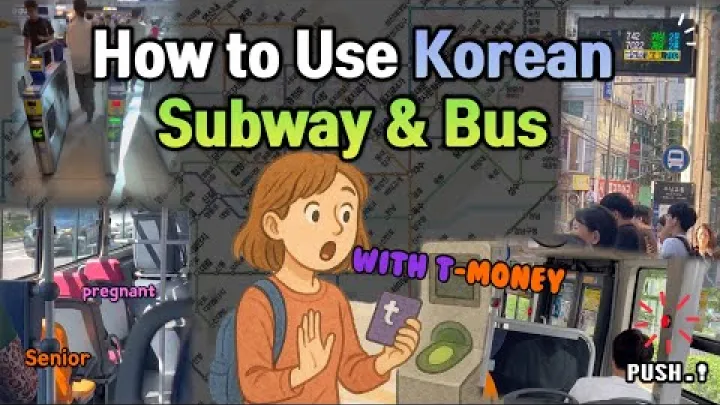
A reusable transportation card such as Tmoney is practical for repeated journeys. Add value, tap when entering and leaving where required, and keep the card available rather than buried in a wallet. A single-use journey ticket can work for an occasional ride, but it is less convenient when you are making several trips. Use buses to reach parks, hillside areas, or streets that are not close to a subway station; bus navigation may require more help from a current transit app.
Bus and subway transfers can make a cross-neighborhood day more efficient, but rules, fares, operating hours, and card conditions can change. Save a current subway map, allow extra time during peak commuting periods, and confirm the current fare and transfer rules before your first journey.
Maps, Taxis, Walking, and Tourist Information
Use two types of navigation support: an official Seoul guide map or downloadable subway map for orientation, and a current navigation or transit app for live route decisions. Save your accommodation name, address, and phone number before leaving the airport. An offline map and a Korean-language version of the destination address are useful backups if mobile data, translation tools, or an app interface becomes unreliable.
Walking is often the best way to understand a neighborhood, but hills, heat, rain, and long blocks can make a route more demanding than it appears on a map. Taxis are useful for late-night travel, heavy luggage, or routes poorly served by rail. Prefer a metered ride where appropriate, and if a non-metered fare is offered, agree on the price before boarding.
Tourist information centers can help with maps, route questions, translation support, and current local information. Treat them as a practical backup when a route is confusing or you need help communicating a destination.
Plan What to Do by Neighborhood and Theme
Seoul has enough attractions for several trips, so a theme-based plan is more useful than a checklist. Choose a few anchor experiences and leave space for meals, small streets, shops, and unexpected discoveries.
Historic Seoul: Palaces, Bukchon, Insadong, and Jongno
Jongno is the main planning area for a heritage-focused day. Gyeongbokgung Palace, Changdeokgung Palace, Jongmyo Shrine, Bukchon Hanok Village, Insadong, and nearby traditional streets can be grouped into a broad historic Seoul plan. VisitKorea describes Bukchon as a traditional area surrounded by major heritage sites, including Gyeongbokgung, Changdeokgung, and Jongmyo.
You do not need to enter every site to understand the historic core. Choosing one or two major heritage visits leaves time for walking, tea houses, markets, or quiet observation. Check each site's current opening information, entry arrangements, garden access, and special programs when they affect your schedule rather than assuming that an old itinerary still applies.
Bukchon requires a different behavior from a palace courtyard or commercial street. It is a living residential neighborhood, so keep voices low, avoid blocking lanes or entrances, do not enter private property, and take photographs without treating homes as exhibition displays.
Contemporary Seoul: Shopping, Cafes, Design, and Nightlife
Myeongdong is a practical choice for shopping and beauty retail. Hongdae is associated with cafes, music, youth culture, and nightlife, while Gangnam offers a modern commercial atmosphere and many restaurants. Itaewon is useful for international dining and varied evening activities. These areas are not interchangeable, so choose one according to the experience you want rather than trying to visit all of them in one rushed evening.
Dongdaemun Design Plaza, Ikseon-dong, and Seongsu provide examples of design, cafes, boutiques, adaptive reuse, and newer urban experiences. Treat them as thematic options rather than mandatory attractions. Venues, access arrangements, and neighborhood popularity can change, so allow your plan to follow the places and activities that genuinely interest you.
Han River Parks, Namsan, Markets, Food, and Cafes
Hangang parks give a trip a slower outdoor rhythm. Yeouido Hangang Park works well for visitors staying near the business district or central west Seoul, while Banpo Hangang Park can fit a central or southern Seoul plan. Ttukseom, Nanji, and Mangwon offer alternatives connected to different neighborhoods. Select the park that fits your route instead of crossing the city only to reach a particular riverside name.
Namsan and N Seoul Tower are useful skyline and evening-view options that can pair with central districts. Food can organize a day just as effectively as a formal attraction: combine a market or Korean meal with a specialty cafe, street food stop, or international dining area. Pair outdoor anchors with an indoor museum, shopping area, meal, or cafe so the day remains comfortable when conditions or energy levels change.
Set a Realistic Seoul Travel Budget
Build your Seoul budget by separating daily in-city costs from airfare, major shopping, and special purchases. This makes it easier to compare accommodation choices and understand which activities are raising the total.
Accommodation, Food, Transport, and Attraction Cost Drivers
Accommodation usually creates the largest daily difference. Hostels and guesthouses can reduce the room cost, while private rooms, mid-range hotels, apartments, and luxury properties increase it. District, season, room type, booking timing, cancellation terms, and the number of people sharing a room all matter. A cheaper room far from your main activities may also create more transport and time costs.
- Lower-cost plan: Use a hostel or guesthouse, eat mainly at casual Korean restaurants or markets, use public transport, and emphasize walks, parks, and free neighborhood exploration.
- Mid-range plan: Choose a private room or mid-range hotel, mix casual meals with cafes and selected paid attractions, and use occasional taxis when they save significant effort.
- Higher-cost plan: Stay in a prime district or luxury property, choose premium dining and experiences, use more taxis, and allow room for shopping, beauty services, special exhibitions, or paid viewpoints.
Food costs vary between street food, markets, everyday Korean meals, cafes, international restaurants, and premium dining. Transport is often a more predictable category than lodging, but airport transfers and taxis can change the balance. Set your budget using current accommodation listings, menus, transport information, attraction prices, and exchange rates. These examples are planning categories, not guaranteed rates.
Save Money by Reducing Backtracking and Booking Carefully
The simplest way to save money is to design shorter routes. Staying near a useful subway connection and grouping Jongno, shopping, river, or nightlife plans by day reduces both fares and time lost in transit. A transportation card and repeated bus-subway use are generally more practical than paying for separate journeys each time.
Balance paid attractions, shopping, beauty treatments, premium cafes, and taxis with free or low-cost activities such as neighborhood walks, markets, public spaces, and river parks. Include luggage costs, airline baggage limits, hotel cancellation terms, and a realistic allowance for impulse shopping. A distant low-cost base may not be economical if it causes long transfers every day.
Prepare for Entry, Safety, and Local Etiquette
Administrative preparation and everyday courtesy affect the trip as much as sightseeing. Deal with entry requirements first, then prepare a small safety plan and learn the behaviors that are especially important in residential and traditional areas.
Entry Rules and Documents to Verify
Entry requirements depend on your nationality, passport, travel purpose, and length of stay. Before purchasing nonrefundable travel, consult the relevant Korean authorities and your own government about visa-free tourism, visas for other purposes, and any electronic travel authorization that may apply. A rule for a short tourist visit should not be assumed to cover study, work, business, or a longer stay.
The linked U.S. Department of State advisory states that, for applicable visa-free travelers, a K-ETA will be required before travel beginning January 1, 2027. This is a time-sensitive checkpoint, not a nationality-independent conclusion. Verify the requirement for your passport and travel date through current official Korean entry information, and confirm whether an application, exemption, visa, or other document applies to your particular trip.
Safety, Demonstrations, and Emergency Help
Seoul is generally manageable for visitors who take normal precautions, but no large city should be described as risk-free. Keep valuables secure in crowded areas, know how to return to your accommodation, and use extra care when traveling late or when tired.
If you see a demonstration, confrontation, or unusual police deployment, keep your distance and follow local instructions. Do not assume that every police presence represents an immediate personal threat, but do not move toward a gathering simply to watch or photograph it. For emergencies, save 112 for police, 119 for fire and ambulance services, and 1330 for tourist assistance. Visit Seoul also advises visitors to contact the nearest police station or dial 112 after an incident.
Before departure, review the current travel advisory for your nationality and store the emergency numbers in your phone. If you need help, a police station or tourist information service may be able to provide guidance and interpretation support where available.
Etiquette in Traditional and Residential Areas
Simple courtesy prevents most friction. Keep your voice low in shared spaces, queue in an orderly way, allow passengers to leave a train before boarding, and avoid blocking escalators, sidewalks, shop entrances, or narrow lanes. Follow signs and staff instructions even when an area appears informal or crowded.
Bukchon Hanok Village is a clear example of why tourist behavior must change between districts. Residents use its narrow streets as part of daily life, so do not shout, play loud music, enter private property, lean on homes, or take intrusive photographs. A doorway or window is not a public attraction simply because it appears in a travel post.
Remove shoes when requested in a residence, temple, guesthouse, or another indoor setting where this is customary. This is a courtesy expectation in relevant places, not a rule that applies to every indoor location. Ask before photographing people, private activities, or small businesses, and leave shared spaces as you found them.
Turn the Guide Into a Practical Itinerary
A useful itinerary has one main geographic cluster each day and enough space for food, transfers, queues, rest, and spontaneous exploration. The following framework can be adjusted for weather, energy, and personal interests.
A Three-Day First-Timer Framework
- Day one: historic Seoul. Base the day around Jongno, one major palace such as Gyeongbokgung Palace or Changdeokgung Palace, Bukchon, Insadong, or another nearby traditional area. Choose only the sites that fit your walking pace, and leave time for a meal or tea stop.
- Day two: choose one contemporary cluster. Select Myeongdong for shopping, Hongdae for cafes and nightlife, Gangnam for modern city life, or Itaewon for international dining. Do not treat all four as required stops. A focused day gives you time to browse, eat, and understand the district.
- Day three: river, skyline, or everyday Seoul. Combine Yeouido Hangang Park, Banpo Hangang Park, another suitable riverside area, Namsan, or N Seoul Tower with a market, meal, cafe, or indoor alternative. Choose the side of the city that connects naturally to your accommodation.
This framework is not a fixed timetable. Travelers who prefer history can use the third day for another heritage area, while shoppers and cafe visitors can replace a palace day with Myeongdong, Seongsu, or Hongdae. Keep one flexible indoor or neighborhood option available instead of filling every hour with ticketed attractions.
Extend a Longer Stay and Add a Nearby Gyeonggi Day Trip
During a five-to-seven-day stay, slow down rather than simply adding more attractions. Revisit a favorite theme, spend longer in markets and cafes, add another Hangang park, explore less central districts, or divide the historic core into two easier days. This creates room for ordinary routines and reduces the fatigue caused by constant cross-city travel.
Suwon or another nearby Gyeonggi destination can be an optional day trip when you want a regional contrast and the transport connection is manageable. Use a simple decision rule: choose the day trip if you have enough usable time, the route is straightforward for your group, conditions suit the plan, and you prefer seeing beyond Seoul. Stay based in Seoul unless the additional destination has a clear purpose and does not turn the trip into a sequence of transfers.
Final Takeaways for Planning a Seoul Trip
The strongest Seoul itinerary begins with a realistic base, not a long attraction list. Choose a neighborhood that supports your main interests, organize days around Jongno, Gangnam, Hongdae, Myeongdong, Itaewon, Yeouido, or another clear cluster, and use the subway with buses, walking, and taxis as supporting options.
Allow the season, airport, budget, energy level, entry requirements, and preferred pace to shape the details. With that foundation, Seoul can offer royal history, contemporary neighborhoods, river walks, Korean food, cafes, and everyday city experiences without requiring every part of the capital to be covered in one trip.
Select area
Create a post
Posting is free and no registration is required.