Phnom Penh Getting There: Flights, Buses & Trains
![Preview image for the video "First Impressions Arriving at Techo International Airport (KTI) | [English]".](/sites/default/files/styles/media_720x405/public/oembed_thumbnails/2026-07/nuruYaBYrGIb4PlgYYQOtc924ombtAz0uZOjbj436b4.jpg.webp?itok=p-apCZKP "Preview image for the video \"First Impressions Arriving at Techo International Airport (KTI) | [English]\".")
Getting to Phnom Penh is straightforward once you choose the gateway and transport mode that fit your timetable. International visitors usually arrive by air, while buses and minibuses are the most practical links from Siem Reap, the coast, Kampot, Battambang, and many other Cambodian cities. Rail and river journeys can be worthwhile in specific situations, but they have fewer services and less room for missed connections. This guide explains where each option arrives, what it is best for, and how to plan a reliable trip into Phnom Penh city center.
Choose the Right Way to Reach Phnom Penh
Phnom Penh is Cambodia's principal transport hub, so it is reachable by several modes. The right choice is not always the fastest vehicle on paper. Include the time needed to reach the airport, bus office, station, or pier, as well as the final trip to your accommodation.
Compare air, bus, minibus, train, and river options
Flights are the main choice for long-distance international travel and for travelers whose time is more valuable than the fare difference. They offer the clearest option for arriving from regional Asian hubs, but airport procedures, baggage limits, and the road journey into the city add to the total trip time.
Buses and minibuses form the most flexible domestic network. On major corridors, they usually offer more departure choices than trains and can be booked directly or through established booking platforms. A full-size coach may provide more luggage space and a more settled journey; a minibus can be useful for its timetable or directness but may feel less spacious. Actual comfort varies by operator and vehicle.
Passenger rail is a limited alternative on selected corridors. It suits travelers who prefer a fixed station departure and do not need many schedule choices. River travel is more specialized, mainly for a Mekong Delta itinerary from Vietnam. It can be memorable, but it is not the normal way to reach Phnom Penh.
| Mode | Best for | Cost position | Main trade-off |
|---|---|---|---|
| Flight | International and time-sensitive trips | Usually highest | Airport transfer and baggage rules |
| Coach bus | Major domestic and Vietnam routes | Usually moderate | Road delays and stop location |
| Minibus | Flexible domestic travel | Low to moderate | Less space and variable comfort |
| Train | Selected fixed-schedule corridors | Often moderate | Few departures |
| River boat | Mekong Delta itineraries | Varies | Limited and weather-sensitive service |
Choose according to your origin, luggage, budget, preferred arrival time, and the consequence of arriving late. A traveler with an international flight the same day should generally value a dependable buffer over the lowest ticket price. A traveler staying several nights in Phnom Penh can make a slower or more scenic route work comfortably.
Identify your true arrival point before booking
“Phnom Penh” is not one single arrival point. Air travelers use Techo International Airport, identified by the code KTI. Rail passengers arrive at Phnom Penh Central Railway Station. Bus companies use their own offices, depots, or city stops, while some services use locations around Daun Penh, the Phnom Penh Night Market area, or another central landmark. River services may use an office and pier arrangement rather than a central terminal.
The name of a bus company is not enough to plan the final part of your trip. Read the ticket for the exact boarding point and drop-off point, then compare it with your hotel and any onward departure. Listings can describe a broad city area, and older references to Phnom Penh's former airport arrangements may still appear online. Before paying, confirm the airport code, station, bus depot, port, and stated arrival point on the ticket itself.
For accommodation near Sisowath Quay or Phnom Penh city center, a central bus stop can be simpler than a depot farther out, even when its ticket costs slightly more. If you are meeting someone, share the full location name and the operator's contact details rather than saying only that you arrive in Phnom Penh.
Arriving by Air at Techo International Airport
Flying is normally the simplest way to reach Phnom Penh from outside Cambodia. It also makes sense for travelers with limited time who are already elsewhere in the country, provided an appropriate domestic service is operating on their date.
Fly into Techo International Airport (KTI)
Techo International Airport, or KTI, is the aviation gateway serving Phnom Penh. When comparing flights, use KTI rather than relying only on a city name, particularly if you are combining separate tickets or searching an older travel listing. The airport's own Techo International Airport website provides flight-status and terminal information.
Direct regional services and one-stop itineraries through major Asian hubs give many travelers access to Phnom Penh, but airline networks and frequencies change. Search your intended date with the airline as well as a flight comparison tool, then read the fare conditions. The lowest fare may have restrictive changes, limited checked baggage, or a connection that is too short to be useful if the first flight is delayed.
For an international arrival, leave enough time for immigration, baggage collection, and the onward road transfer. This is especially important if you are attending an event, checking into short-stay accommodation, or holding a separately booked domestic ticket later that day.
Use regional or domestic flight connections when time matters
Travelers who enter Cambodia through Siem Reap–Angkor or Sihanoukville can compare an onward flight with the road journey to Phnom Penh. Flying can save a substantial part of the travel day, particularly when a road transfer would otherwise take many hours. It can also reduce fatigue for travelers carrying work equipment, traveling with young children, or arriving after a long international flight.
The trade-off is price and process. A flight requires travel to the departure airport, advance arrival, security screening, baggage collection at the other end, and a transfer into Phnom Penh. A road service can sometimes be more direct from a hotel to a central city stop. Compare the entire door-to-door journey rather than only flight time.
Do not assume a domestic route runs every day or at every season. Where tickets are separate, treat each flight as an independent booking and allow a substantial gap. A delay, cancellation, baggage issue, or schedule change on the first booking may otherwise leave you responsible for replacing the onward ticket.
Plan the airport-to-city leg, especially for late arrivals
KTI is not in Phnom Penh city center, so the flight arrival time is not your practical city-arrival time. Arrange a road transfer through an official airport option, a hotel, or a reputable pre-arranged provider. The journey length depends on traffic and the destination district, so avoid scheduling an important meeting immediately after landing.
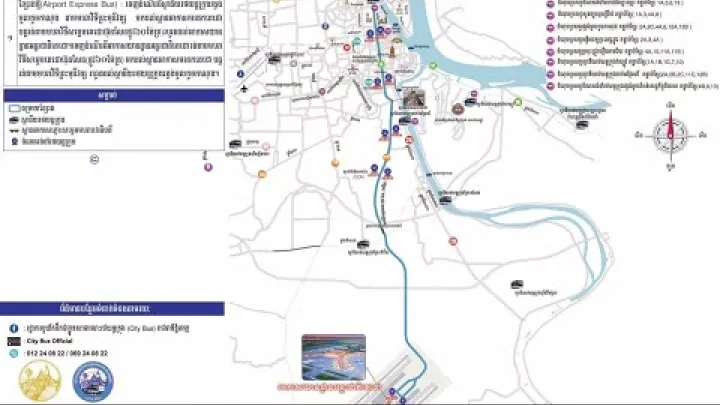
Late arrivals need a more conservative plan. Baggage collection, mobile connectivity, currency access, hotel check-in, and the availability of an appropriate road transfer all take time. If you have a long-distance bus, train, or other fixed departure soon after landing, a missed connection can be expensive and difficult to replace. Confirm the available transfer from Techo International Airport and allow extra road-transfer time when arriving late or connecting to another service.
When the connection is tight, staying overnight in Phnom Penh is usually the calmer option. It gives you a proper start for the next journey and avoids trying to navigate an unfamiliar departure point after a late flight.
Getting to Phnom Penh by Bus or Minibus
Long-distance road services are the backbone of travel within Cambodia. They connect Phnom Penh with the main tourism centers and provincial cities, but departure offices and city drop-offs are operator-specific.
Travel from Siem Reap on the main tourism corridor
Siem Reap and Phnom Penh are linked by one of Cambodia's busiest visitor corridors. Multiple coach and minibus operators commonly serve it across the day, making the route suitable for a same-day overland trip. Larger buses are generally the better choice when you have a large suitcase or want more room; premium services may offer a more structured boarding experience. Minibuses can be useful when their departure time or stop is more convenient.

Journey duration should be treated as a planning estimate, not a promised arrival time. Traffic, roadworks, meal stops, weather, and city traffic near the final stop can all change the result. A central Phnom Penh arrival may be more useful than a faster service that ends at a depot requiring a longer local transfer.
For an illustration of the range of services rather than a permanent timetable, BusOnlineTicket lists Phnom Penh–Siem Reap departures and operators. Use the live details shown when you book, including the direction of travel, since listed times and fares can change.
Travel from Sihanoukville and Kampot
Sihanoukville is the principal road gateway for travelers coming from Cambodia's coast and island ferry connections. Buses and minibuses link it with Phnom Penh, allowing many travelers to move between the coast and the capital in one day. The route is useful, but do not make a close connection from an island ferry to a bus, or from a long bus ride to a flight. Ferry timing, road conditions, and boarding arrangements can compound delays.

Kampot is another established southern route. It is often used by travelers moving between the riverside town and the capital, with coach or minibus services generally more practical than arranging a private long-distance transfer. Giant Ibis publishes a Phnom Penh–Kampot route page with its current bookable schedule and fare conditions; its stated journey duration is an operator estimate, not a guarantee.
Rail exists on the coastal corridor but generally offers fewer choices than road transport. A train may fit a traveler who wants a station-based journey and has a flexible day. For most people trying to match a hotel checkout, ferry, meeting, or airport departure, road services provide more timetable flexibility.
Travel from Battambang and other inland cities
From Battambang, road transport is usually the practical first comparison. Buses commonly provide several possible departure windows, while rail is a more constrained alternative. The best service depends on when you need to arrive, whether you have bulky luggage, and how close the Phnom Penh drop-off is to your destination.
Booking sites may show a wide range of prices and travel times for Battambang–Phnom Penh. Treat these as live market examples rather than fixed facts: the departure selection, vehicle type, and fare can change by date. A cheaper ticket may be sensible for a flexible traveler staying in Phnom Penh, but less suitable when a late arrival would disrupt an onward booking.
For other provincial cities, Phnom Penh often functions as the main interchange. Some routes are direct, while others require a change in another town or use a limited daily service. Build the itinerary around the actual route available on your travel date instead of assuming every provincial capital has an all-day direct connection.
Book buses with the exact departure and arrival point
You can book through a named operator, an established aggregator, or an official ticket office. Direct booking can make it easier to identify the operating company and its conditions. An aggregator can help compare times and prices. A local counter may be useful for a near-term trip, but you should still receive clear confirmation of the service you are buying.
Use this short checklist on your phone before departure:
- Read the operator name, route direction, date, and departure time.
- Save the precise boarding address and Phnom Penh drop-off point.
- Check the luggage allowance, change or cancellation terms, and any pickup instruction.
- Confirm whether “Phnom Penh” means a central office, a depot, or a stop near the Night Market.
- Keep the booking confirmation available without relying only on mobile data.
Major operators such as Giant Ibis advertise routes including Phnom Penh–Siem Reap, Phnom Penh–Sihanoukville, and Phnom Penh–Ho Chi Minh City. Regardless of where you book, reconfirm the bus operator, departure time, boarding point, and drop-off point shortly before travel. This matters because a company can use more than one city office or change a stop for operational reasons.
Getting to Phnom Penh by Train
Train travel offers a different pace and a fixed-station experience, but it is not a high-frequency substitute for buses. It works best when its timetable aligns well with your plans.
Check current Royal Railway service and stations
Royal Railway is associated with Cambodia's principal passenger rail corridors into Phnom Penh. Services have fewer departures than road routes, so a missed train can mean waiting until a later operating day or switching to a bus. Confirm the current timetable, operating dates, ticket process, and station details directly through current railway information before making the train the critical part of an itinerary.
In Phnom Penh, the relevant city anchor is Phnom Penh Central Railway Station. Its central location can be convenient for travelers staying in central districts or near the riverside, though the final transfer still depends on your hotel location and arrival time. Plan to arrive at the station with time to find the correct entrance and complete any ticket steps required for the service.
Do not rely on an old timetable image, a social media comment, or an undated travel article. Passenger services can be adjusted, and limited frequency makes current operating information particularly important.
Choose train or bus based on time, comfort, and flexibility
On the Sihanoukville and Battambang directions, compare the train with a road service on the exact day you wish to travel. A train can appeal if you prefer a scheduled station departure and less time on the road. It may also suit travelers who are staying close to the stations and have no fixed event immediately after arrival.
Buses generally offer more departure choices and may have a shorter scheduled journey on the routes where both modes are available. They also offer a wider choice of departure offices and drop-offs. The advantage of rail is not necessarily speed; it is the appeal of a fixed rail journey when the limited schedule matches your day.
Choose the train only if you can accept its practical limits. An early departure, a service that does not operate when you need it, or a plan change after tickets are issued can leave few recovery options. Choose a bus if timing flexibility and multiple replacement services matter more than the rail experience.
International Overland and River Routes to Phnom Penh
Regional overland travel can be rewarding, but it adds border formalities and more variables than a domestic trip. Make sure your travel documents meet the entry requirements for your nationality and itinerary before you commit to a ticket.
Travel from Vietnam by bus through the eastern corridor
The Phnom Penh–Ho Chi Minh City bus route is a common regional connection. Established companies operate this corridor, including services advertised by Giant Ibis. It can be a good value option for travelers whose trip starts or ends in southern Vietnam and who prefer an overland journey to airport procedures.
Vehicle time is only part of the trip. Immigration processing, queues, document review, stops, and traffic on either side of the border can make the total journey longer than an advertised road duration. Follow the current operator instructions for the border process, keep essential documents accessible, and retain control of money, passport, medicines, and electronics.
Compared with flying, a direct bus is often less expensive and avoids airport transfers, but it has more border complexity and less predictable arrival timing. Flying may be preferable if you have a time-sensitive commitment in Phnom Penh. Verify passport, visa, and entry requirements separately through the relevant official authorities, as transport companies cannot determine every traveler's eligibility.
Consider river travel only when the operator confirms service
A boat journey between Chau Doc in Vietnam and Phnom Penh is a niche option for travelers already exploring the Mekong Delta. Its main appeal is the river experience rather than speed or simplicity. It may involve a transfer to the departure pier, boarding procedures, border formalities, and a separate final transfer after arrival in Phnom Penh.
Compare the full route with a direct bus. The boat can offer scenery and a slower travel day, while a bus is usually the more straightforward point-to-point option. River journeys can have different luggage practices, lower schedule frequency, and exposure to sailing conditions. Do not assume that a published boat service runs daily or throughout the year; book only when the operator confirms the service for your date.
From Thailand: treat overland bus listings as unconfirmed until border checks
Some commercial platforms may display Phnom Penh–Bangkok bus itineraries even when the intended border crossing, route operation, or passenger procedures are uncertain. A listing that appears bookable is not proof that travelers will be permitted to cross that particular land border on the planned date.
This route needs more scrutiny than a standard domestic bus booking. Check current government or border-control notices and obtain direct operator confirmation before booking a Phnom Penh–Thailand bus. Ask which crossing is intended, whether the operator is actually carrying passengers across it, and what happens if the service cannot proceed.
When authoritative current information does not clearly support the land route, flying is the more dependable fallback. It removes the uncertainty of the border crossing, though it still requires normal airline and airport planning. Do not generalize a report about one crossing to every Thailand–Cambodia border point.
Compare Costs, Time, Booking Difficulty, and Arrival Risk
A useful transport decision compares the whole trip, not just the advertised fare. The cheapest option can create extra costs through a distant arrival point, a long wait, or a missed onward connection.
Build a simple mode comparison
Cost varies sharply by route, travel date, luggage, and service class, so broad bands are more useful than a single national price. Flights are normally the highest-cost choice but can be the best value where they protect a limited travel day. Buses and minibuses usually provide the lowest-cost domestic access. Rail often sits between them in convenience rather than simply price, while river trips vary with the operator and itinerary.
| Route example | Most practical choices | Booking difficulty | Arrival risk |
|---|---|---|---|
| International to Phnom Penh | Flight | Easy to moderate | Airport transfer timing |
| Siem Reap to Phnom Penh | Coach or minibus | Usually easy | Road and city traffic |
| Sihanoukville to Phnom Penh | Coach, minibus, selected rail | Easy to moderate | Ferry or road connection delays |
| Battambang to Phnom Penh | Bus, selected rail | Easy to moderate | Limited rail recovery options |
| Ho Chi Minh City to Phnom Penh | Direct bus or flight | Moderate | Border processing |
| Chau Doc to Phnom Penh | Confirmed river service | Moderate | Limited sailing and border steps |
Think about luggage handling as well. Flights involve airline baggage rules and collection. Buses may place large bags in a hold, while minibuses can have limited capacity. Rail and boats have their own boarding arrangements. If you carry fragile items, valuables, or equipment needed immediately on arrival, choose the mode and service class that gives you a manageable process.
Build buffers for late arrivals and changing conditions
Road congestion, heavy rain, flooding, river conditions, border formalities, and operator changes can affect when you actually reach Phnom Penh. Their importance depends on what follows. A late arrival at a flexible hotel is inconvenient; a late arrival for an international flight, visa appointment, wedding, or final ferry can disrupt the whole trip.
Avoid tight connections between a long-distance bus or train and an international flight. Where a route has only one or a few daily services, protect the itinerary with an overnight stay or a backup road option rather than assuming a same-day recovery will be available. Similarly, a river journey should not be the final link before an essential departure.
Check the operator's service notice and avoid tight onward connections when heavy rain, flooding, or river conditions could affect the route. This is particularly relevant during periods of severe weather, when a route's normal schedule may not reflect the practical travel day.
Use safer booking and arrival practices
Use the airline, a named transport operator, an established booking platform, or an official station counter where available. This gives you a clearer record of the service, fare, and applicable terms than an informal offer with no written details. It also makes it easier to identify the correct vehicle and seek help if a departure point changes.
At boarding, match the vehicle name and route with your confirmation rather than following a verbal direction alone. Confirm the fare before handing over cash, photograph the ticket and luggage tag, and keep your valuables, passport, medication, electronics, and essential documents in personal luggage. If a pickup or depot instruction seems unclear, contact the operator through the details on your booking.
Touts and confusing depot changes can be stressful in an unfamiliar city, especially after dark. Buy tickets through the named operator, an established booking platform, or an official counter, and keep valuables with you during transfers. A calm, documented booking and a clear destination address are more useful than relying on an unverified offer at the last minute.
Choose the Route That Matches Your Priorities
For most international visitors, flying into KTI is the simplest route to Phnom Penh. For domestic travel, buses and minibuses provide the broadest choice from Siem Reap, Sihanoukville, Kampot, Battambang, and other cities. Train travel is best when its limited schedule suits you, while Vietnam river travel is an optional scenic route rather than a main connection.
Choose a service based on the complete journey: the real arrival point, luggage needs, transfer into Phnom Penh city center, and the cost of being late. A route with a little more time or a slightly higher fare can be the better decision when it gives you a central drop-off, a clear booking record, and a comfortable buffer for what comes next.
Select area
Create a post
Posting is free and no registration is required.