Pyay Getting There: Routes by Bus, Train, Car, River, and Air
![Preview image for the video "[EngSub] 8-hour train journey from Yangon to Pyay".](/sites/default/files/styles/media_720x405/public/oembed_thumbnails/2026-08/IBC8Qu20-Wn-Y37vSl4HdNpcnhQ4otFuqSbj5LlCrBg.jpg.webp?itok=sFwCUoCD "Preview image for the video \"[EngSub] 8-hour train journey from Yangon to Pyay\".")
Getting to Pyay is easiest to plan as a Yangon-to-Pyay journey, even if you begin elsewhere in Myanmar. Road and rail provide the clearest long-distance choices, while river travel and flights require more specialized confirmation. This guide explains the main gateways, compares bus, train, private car, river, and air options, and covers the final transfer into Pyay. Because schedules, fares, operating status, and access conditions can change, use a confirmed service rather than relying on an old timetable or an unverified listing.
Plan Your Journey to Pyay Before Booking
Begin by deciding which gateway fits your starting point, arrival time, budget, and tolerance for uncertain connections. Yangon is the main route base, but travelers from Naypyidaw, Mandalay, Bagan, or Nyaung-U may need a direct service, a road connection, or a carefully planned multi-leg itinerary.
Identify Pyay's Main Gateways
Yangon is the clearest planning base for Pyay because the Yangon-Pyay corridor has the most recognizable bus, rail, and road options. Long-distance buses use Aung Mingalar Highway Bus Terminal as the Yangon departure anchor and normally refer to Pyay Highway Bus Station as the destination gateway. Trains use Yangon Central Railway Station and arrive at Pyay Railway Station. These are separate systems, so a bus ticket does not use the railway station and a train ticket does not use the highway terminal.
For road travel, the Yangon-Pyay Highway is the main road reference. It is also called Route 2 in some travel and transport contexts. A hired car or taxi should be booked for the actual Pyay destination, not only for a highway stop or a town outside the center. Ask the driver to identify the expected arrival point before departure.
The Ayeyarwady, also known as the Irrawaddy, River is a different type of gateway. Passenger-cum-cargo services and tourist cruises do not follow the same timetable or booking process as buses and trains. A river route can therefore be possible in principle without being a practical departure on a particular date.
Pyay Airport is another named gateway. It is identified by the codes PRU and VYPY, but an airport listing or flight-status page does not prove that regular scheduled passenger flights are available. Treat the airport as an option to investigate, not as a dependable default.
A named station, terminal, river port, or airport is only an arrival gateway. It does not guarantee that a direct service operates, that the service accepts foreign passengers, or that the gateway is close enough to your accommodation to walk. Build the local transfer into the plan from the beginning.
Verify Current Services and Access Conditions
Transport information for Myanmar should be treated as date-specific. A timetable published online may be useful for understanding the route, but it may not reflect a changed operating day, a temporary cancellation, a different terminal, or a service that is unavailable to a foreign passenger. A current answer from the carrier, station, terminal, or a trusted local contact is stronger than an undated schedule or an anecdotal report.
Before paying for a ticket or committing to a connection, ask the following questions:
- Does the service operate on the exact date of travel, and what is the confirmed departure time?
- What is the exact boarding point, counter, station entrance, or river jetty?
- Does the service accept foreign passengers, and which passport or identification details are required?
- What is the current fare, accepted payment method, baggage allowance, and change or cancellation policy?
- Does the route currently pass through all planned checkpoints and towns, or are there restrictions, diversions, or route permissions to consider?
- What happens if the vehicle, train, vessel, or flight is canceled, delayed, or moved to another departure point?
Ask the operator or terminal directly when possible. A hotel, licensed travel office, or trusted local contact may help interpret the answer, especially when information is given in Burmese. Do not treat a ticket page as proof that the route is open to every traveler. If the operator cannot confirm the date, route, and passenger conditions, choose a plan with fewer uncertain segments or wait for a clearer answer.
Travel from Yangon to Pyay
Yangon offers the most useful set of options for reaching Pyay: a direct bus when operating, a scheduled train, or a private car using the Yangon-Pyay Highway. The best choice depends on whether you value simplicity, a fixed rail journey, or control over stops and arrival time.
Bus from Aung Mingalar Highway Bus Terminal
A direct bus is usually the most practical choice from Yangon when a current service is confirmed. It links the main Yangon highway terminal with Pyay Highway Bus Station without requiring a change between cities. For many travelers, the bus offers a useful balance of journey speed, lower relative cost, and more departure opportunities than a fixed-schedule train.

Online listings can show the general shape of the route but should not be used as a current departure board. For example, the Myanmar Trains listing has described multiple direct Yangon-Pyay buses and included a US$7 one-way fare example. Treat those figures as indicative context only. Confirm the actual operator, departure time, fare, and destination with the carrier or terminal close to travel.
Aung Mingalar Highway Bus Terminal is separate from central Yangon and from Yangon Airport. The transfer to the terminal can become an important part of the total journey, particularly if the bus leaves early, traffic is heavy, or you arrive in Yangon shortly before departure. Allow enough time to reach the correct counter and do not choose a bus only because its advertised departure looks convenient on paper.
At the terminal, confirm that the ticket is for Pyay and ask where the vehicle boards. Some travelers use different names for destinations when speaking to local staff, so repeat the destination and check the printed ticket before leaving the counter. Have your passport or accepted identification available, and keep a written or offline record of the operator's name and contact details.
Bus comfort can vary. Check whether the fare includes the stated baggage allowance, where larger luggage will be stored, and whether hand luggage stays with you. Ask about the payment method before finalizing the purchase, especially if you are using a foreign card or another non-local payment method. Confirm whether an extra baggage charge applies rather than assuming that all luggage is included.
The bus is a strong default when the service is direct and confirmed, but it is less flexible once it has left Yangon. A private car may be better for travelers carrying unusually large luggage, making several stops, or needing to control the final arrival point. For a straightforward point-to-point trip, however, the highway bus normally requires less planning than combining separate transport legs.
Train from Yangon Central Station
The Yangon-Pyay train is the fixed-schedule alternative to the highway bus. It departs from Yangon Central Railway Station and provides a conventional rail journey for travelers who prefer trains or who want a different experience from a road trip. Its main limitation is flexibility: a train usually gives you fewer departure choices and makes the entire itinerary dependent on the operating schedule.
A published timetable from Myanmar Trains describes one direct train per day, with a scheduled journey of about nine and a half hours over a listed 288-kilometre route. This is useful as timetable context, not as a current guarantee. Confirm the operating day, departure time, fare, class, and arrival time with Myanma Railways or the station before arranging accommodation or onward travel.
Distinguish conventional Yangon-Pyay train information from references to newer or different DEMU services. A mention of a DEMU does not automatically mean that the train shown in an older Yangon-Pyay timetable has been replaced. Ask which specific train operates on your date and whether the published class and ticketing rules apply to that service.
Rail may suit travelers who prefer a slower journey with a fixed route and a station-based departure. It is less suitable when you need to arrive at a precise time, make a same-day onward connection, or leave Yangon at short notice. Journey conditions and onboard comfort can differ from expectations, so bring water, medication, and items that make a long trip manageable.
Allow time at Yangon Central Railway Station for finding the correct ticket window and platform. Carry your passport or identification, and ask how tickets are issued to foreign visitors, what payment is accepted, and whether the desired class is available. Keep the station name, train details, and Pyay accommodation address separately from the phone used for navigation.
Private Car or Taxi via the Yangon-Pyay Highway
A hired car with a driver uses the Yangon-Pyay Highway, also known as Route 2, and offers the greatest control over the road journey. It can be useful for travelers who want privacy, roadside stops, direct delivery to accommodation, or a schedule that does not fit a bus or train. It can also reduce the difficulty of moving between a Yangon hotel, a highway terminal, and the final Pyay address.
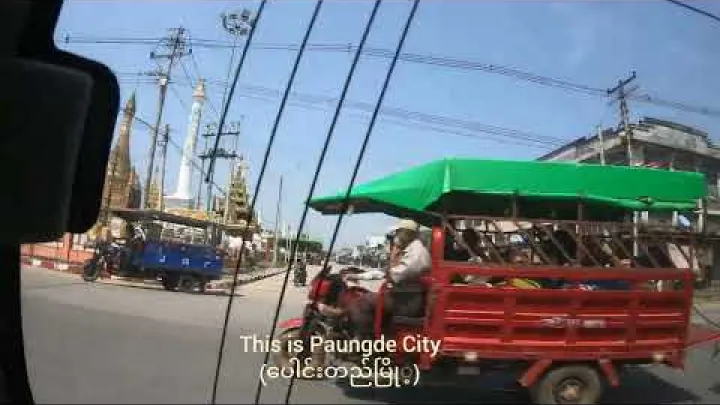
Compare the complete quote rather than looking only at the headline vehicle price. Ask whether the quote includes the driver, fuel, planned stops, waiting time, accommodation for the driver if needed, and any charges for changing the route. A car may cost more than a shared bus for one traveler, but the difference can be worthwhile when it removes several transfers or allows a group to share the vehicle.
Self-driving requires separate confirmation of licensing, permissions, vehicle insurance, fuel access, road conditions, and checkpoint procedures. Do not assume that a foreign driving licence or an international permit is enough for the route. Use a locally licensed driver unless current authorities confirm that self-driving is legally permitted for your circumstances.
Before accepting a car or taxi booking, ask the driver:
- Which road and arrival point will be used for Pyay?
- What vehicle will be provided, and how much luggage can it carry?
- What arrival time is realistic for the planned departure, stops, and current road conditions?
- Who pays for fuel, meals, waiting time, or a change caused by a road restriction?
- What is the cancellation arrangement if the journey cannot proceed?
Private road travel is the flexible option, not automatically the fastest or cheapest. A driver who knows the current route and local procedures can be more useful than an inexpensive booking with unclear terms. Record the agreed destination and price before leaving Yangon.
Reach Pyay from Other Myanmar Hubs
Connections from other major bases require more care because a direct service may be seasonal, changed, or difficult to confirm. Compare the entire itinerary, including transfers and overnight stops, rather than relying on a single journey-time result.
From Naypyidaw
Do not assume that a direct Naypyidaw-Pyay service operates simply because both cities appear in a route search. First check whether a current bus, hired car, or other direct road option is sold for your date. Confirm the exact departure point in Naypyidaw, the Pyay arrival station, and the expected arrival time.
If no workable direct service is available, a connection through Yangon may be possible, but it can add a second ticket, a long transfer, or an overnight stay. Evaluate the connection by total elapsed time rather than by the advertised time of each individual leg. A connection that arrives late may also make the final transfer into Pyay more difficult.
When comparing a direct road service with a Yangon connection, consider the number of transfers, whether the tickets are protected together, the time between arrival and departure, and what backup exists if the first leg is delayed. The route with the fewest uncertain segments is often better than the route with the lowest advertised fare.
From Mandalay
Available route information does not establish a simple, dependable direct passenger connection from Mandalay to Pyay. Check direct bus, rail, air-plus-road, and river possibilities separately instead of assuming that one booking platform covers every mode.
Yangon can serve as an intermediate planning base when the separate schedules make the connection workable. This is not automatically efficient: two tickets may create a longer wait, an overnight stay, or a difficult terminal transfer. Write out each leg, its departure point, arrival point, and time buffer before paying.
The Ayeyarwady River corridor is a specialized alternative for some Mandalay-area itineraries, but it should not be treated as a routine fast connection. It may appeal to travelers who value the journey itself and can adapt to a vessel schedule. For a time-sensitive trip, a route with fewer uncertain segments is usually easier to manage.
From Bagan or Nyaung-U
Check direct bus availability before building an itinerary around a Yangon-Bagan-Pyay sequence. A direct service may operate on some dates, while on other dates the practical choices may involve separate road legs, another Myanmar hub, or a river cruise. Do not state that a direct route never operates; treat availability as changeable until an operator confirms it.
If you are already in the Bagan or Nyaung-U area, compare the complete Pyay itinerary with the simpler travel pattern between Bagan and Yangon. A detour through Yangon may add a transfer, a separate terminal journey, and a possible overnight stay. It can still be useful when schedules line up or when Yangon is part of your wider trip, but it should be a deliberate choice rather than an assumed connection.
When checking tickets, use the place name shown by the relevant operator and confirm whether the boarding point is in Bagan, Nyaung-U, or another nearby location. Ask for each leg separately if the booking is not through-ticketed. Record the operator, departure point, arrival point, and cancellation terms for every segment before relying on the itinerary.
Consider River and Air Access
River and air travel can make sense for a particular itinerary, but neither should be the first assumption for an independent journey to Pyay. Both require stronger confirmation than a general route search.
Irrawaddy River Services and Cruises
River access is different from a normal ferry connection. Inland Water Transport describes passenger-cum-cargo transport along navigable waterways. That information supports the existence of public waterway services, but it does not establish a current direct sailing to Pyay on a particular date.
Separate public transport from a tourist cruise. An IWT vessel may be designed to carry passengers and cargo with a practical local schedule, while a cruise may sell a packaged experience with its own boarding point, cabin arrangements, meals, and itinerary. A historical route description or cruise advertisement is not proof that an independent passenger ticket is available now.
River travel to Pyay is best viewed as slow, specialized, and schedule-sensitive. River levels, vessel availability, cargo operations, weather, and boarding arrangements can affect the plan. It may suit a traveler who has time and wants the river journey itself, but it is not a good choice for a tight schedule or a same-day onward connection.
Confirm the sailing date, boarding jetty, vessel name, route, river conditions, booking channel, current price, baggage arrangements, and foreign-passenger eligibility directly with IWT or the cruise operator. Ask whether the vessel leaves from the stated jetty or from a different local landing point. Do not pay a deposit until the operator has confirmed those details for your travel date.
Pyay Airport and Flight Connections
Pyay Airport is identified by the codes PRU and VYPY. A live airport page such as Flightradar24 can help you look for recent airport activity, arrivals, departures, delays, or cancellations. However, a listing or live-status page does not by itself prove that regular scheduled passenger flights are available for booking.
Before planning to fly directly to Pyay, look for a current airline confirmation, a confirmed booking, or reliable airport information showing the service and operating date. Check the departure airport, baggage rules, and the ground connection from the airport after landing. If no direct flight is confirmed, a practical air itinerary may involve flying to a larger Myanmar gateway and continuing by road or rail.
Do not calculate the air option only from flight time. Add the transfer to the departure airport, check-in time, any connection, the trip from the larger gateway to Pyay, and the risk of arriving when local transport is limited. Air can be attractive when a real service is operating, but without that confirmation it is less dependable than a clearly sold road or rail itinerary.
Arrive in Pyay and Continue to the Center
The final local transfer deserves its own planning step. The bus station and railway station are useful arrival anchors, but the exact drop-off point and the distance to your accommodation can vary by operator and booking.
Bus and Rail Arrival Points
For a highway journey, use Pyay Highway Bus Station as the main arrival reference. For rail, use Pyay Railway Station. Confirm the exact station or terminal address, entrance, and operator-specific drop-off point before departure. A ticket may name the city but not explain which side of a terminal or station the vehicle will use.
Send the accommodation the expected arrival point and ask for clear directions to the property. Request the address in Burmese as well as English, or save a screenshot that can be shown to a local driver. This is more reliable than relying only on a map pin or a verbal description after a long journey.
Some travelers may be able to walk from an arrival point, but do not assume that every guesthouse, hotel, or attraction is within easy walking distance. Decide between walking and locally arranged transport using the current location, luggage, daylight, and road conditions. If the final transfer is unclear, arrange it with the accommodation rather than improvising immediately after arrival.
Late Arrivals and Practical Transport Precautions
Contact the accommodation before leaving for Pyay if the bus, train, car, or flight may arrive after dark or later than the original estimate. Give the property your operator, expected arrival point, and approximate arrival window. Ask whether it can arrange a known driver or explain the clearest local transport option.
Before using local transport, agree on the destination and fare. Show the saved address and confirm that the driver is taking you to the accommodation rather than to an unrequested alternative. Prefer an accommodation-arranged transfer, a known driver, or a clearly identified local service. If someone offers an unsolicited rerouting or transfer, pause and verify it with the accommodation before accepting, especially after dark.
Keep your phone charged and store the accommodation address, operator contact, and a backup contact offline. Keep luggage with you until the destination is clear, and avoid handing over a phone or passport unnecessarily. This is practical caution, not a judgment about every local driver. A clear destination and an agreed fare reduce confusion when you are tired or arriving late.
Compare Options and Prepare for Travel Day
The best way to get to Pyay depends on the whole journey, not only the vehicle used for the longest segment. Use the following comparison as a planning guide, then replace general descriptions with the confirmed details for your date.
Compare Time, Cost, Comfort, and Booking Difficulty
| Mode | Best use | Time profile | Cost profile | Comfort and flexibility | Booking difficulty |
|---|---|---|---|---|---|
| Bus | Direct Yangon trip | Often the most straightforward overland choice when confirmed | Usually low to moderate; confirm the fare | Shared travel with limited flexibility after departure | Moderate; check terminal and operator details |
| Train | Fixed rail journey | Longer and schedule-dependent in published listings | Usually low to moderate; confirm class and fare | Rail experience with fewer departure choices | Moderate; allow time for station procedures |
| Hired car | Stops, privacy, and direct arrival | Flexible; depends on road conditions and stops | Often higher for one traveler; compare the full quote | Most flexible and private | Moderate; check driver and legal conditions |
| River | Experience-led itinerary with time available | Slow and highly schedule-sensitive | Varies by vessel or cruise; confirm directly | Distinctive but least flexible | High; check vessel, jetty, and eligibility |
| Air | Confirmed flight or gateway connection | Potentially quick for the flight segment; total time may be uncertain | Often higher after adding transfers | Comfortable flight segment but connection-dependent | High unless a scheduled service is clearly confirmed |
From Yangon, choose the bus when a direct departure is confirmed and the terminal transfer is manageable. Choose the train when its operating day and ticketing procedure suit your schedule and you value the rail journey. Choose a hired car when privacy, stops, luggage, or a precise Pyay drop-off matter more than the lowest price. River travel and air travel are specialist choices that need their own operator or airline confirmation.
From Naypyidaw, Mandalay, Bagan, or Nyaung-U, compare the number of uncertain segments first. A route with a slightly higher fare may be better if it removes an unprotected transfer, an overnight wait, or a late arrival with no local transport. Conversely, a low-cost route may be reasonable when every leg is confirmed and you have enough time for delays. The useful question is not only which option is cheapest, but which plan is most likely to complete the whole journey without a difficult gap.
Use a Travel-Day Preparation Checklist
Prepare a small set of information and supplies that works even when mobile data or online booking pages are unavailable:
- Passport or accepted identification, plus any ticket details required by the operator.
- A charged phone, a charging cable, and an offline copy of the accommodation address.
- The departure terminal, station, jetty, or airport written separately from the navigation app.
- The arrival point, operator name, booking contact, and accommodation phone number.
- Payment options for the ticket, local transport, food, and an unexpected change of plan.
- Water, medication, and luggage that can be carried safely through a terminal or station.
- A time buffer for the transfer to the Yangon departure point and for delays on the route.
- A fallback contact and a possible alternative route, without continuing when local conditions advise against travel.
Do not build a tight onward connection around an unconfirmed bus, train, vessel, or flight. Save the important details as screenshots or on paper, and tell your accommodation when you expect to arrive. If a service is canceled, ask the operator or accommodation for a confirmed alternative instead of accepting an improvised route from an unknown intermediary.
Choose the Best Way to Get to Pyay
For most Yangon-based plans, a confirmed direct bus is the simplest starting point, while the train is a fixed-schedule alternative and a hired car offers the most flexibility. Travelers from Naypyidaw, Mandalay, Bagan, or Nyaung-U should compare complete itineraries and avoid assuming that a direct connection operates. River services and Pyay Airport can be worthwhile when a specific operator or flight is confirmed, but they should not be treated as automatic options.
Whichever route you choose, record the departure gateway, arrival point, operator contact, fare, and accommodation address before travel day. A well-confirmed ordinary route is usually more useful than an attractive itinerary built on uncertain schedules or an unverified connection.
Select area
Create a post
Posting is free and no registration is required.