Singaraja Getting There: Airport, Bus, Ferry and Car Routes

Singaraja getting there planning is different from planning a trip to South Bali. Singaraja is in Buleleng Regency on Bali's north coast, while most international visitors arrive at Ngurah Rai International Airport (DPS) in the south. That means the final part of the journey is usually a cross-island road trip, even if you start by plane, ferry, or long-distance bus. This guide explains the main routes to Singaraja, how Lovina fits into transport planning, which terminals matter, and what to confirm before you travel.
Quick Answer: Best Ways to Get to Singaraja
For most travelers, the best way to get to Singaraja depends on arrival time, luggage, budget, and comfort with transfers. A direct road transfer is the simplest option, while bus and ferry routes can work well if you have time and can verify the next connection.
Fastest Option: Pre-Booked Car or Taxi
The easiest route for most international visitors is to fly into Ngurah Rai International Airport (DPS) and continue by road to Singaraja. The distance can look manageable on a map, but the trip crosses Bali from the busy south to the quieter north. Denpasar traffic, resort-area congestion, mountain roads, rain, and the time of day can all affect the journey.
A pre-booked private driver or fixed-price transfer is usually the most practical choice for travelers with luggage, families, older passengers, late arrivals, or limited time. It avoids the need to negotiate after a long flight and gives you one vehicle from the airport or hotel to your final address in Singaraja.
Before confirming, ask for the total price, pickup point, vehicle size, luggage capacity, waiting policy, and whether any parking or toll charges are included. Quoted prices vary by season, vehicle, pickup area, and provider, so treat any fare you see online as guidance rather than a universal rate.
Best Budget Option: Bus Routes via Denpasar or Lovina
Bus travel can reduce the cost of getting to Singaraja, but it usually adds time, transfers, and uncertainty. Some visitors use tourist buses toward Lovina, while others look for local or intercity buses through Denpasar, Terminal Ubung, or Singaraja-area terminals.
Lovina is close to Singaraja and is better known among foreign visitors, so many tourist transport services advertise Lovina rather than Singaraja city. If your accommodation is in central Singaraja, check whether the bus stops in Lovina, at a Singaraja terminal, at an operator office, or at a hotel zone. You may still need a local taxi, angkutan, or pre-arranged driver for the final leg.
This budget approach is feasible for flexible daytime travelers with light luggage. It is less convenient for first-time visitors arriving at night or anyone with a tight schedule. Same-day public transport details can be limited online, so confirm current departures locally with your accommodation, a terminal office, or the transport operator.
Best Option for Late Arrivals
Late flights into Bali reduce the usefulness of bus connections to North Bali. Tourist buses may already have departed, local transport may be limited, and it can be harder to compare options calmly at the airport.
If you arrive in the evening or at night, pre-arrange a driver and exchange contact details before departure. Confirm where the driver will wait, how long they will wait if your flight is delayed, and whether the price is still valid for a late pickup.
Be cautious with unofficial offers at busy airport areas. Not every unsolicited offer is unsafe, but unclear pricing and rushed negotiation can lead to problems. For a night drive across the island, choose a driver you trust, avoid overloaded vehicles, and do not start the trip if the driver appears too tired to continue safely.
Understand the Route Before You Book
The main transport challenge is geography. Singaraja is not hard to reach, but it requires more planning than destinations near the airport, Kuta, Sanur, or Denpasar.
Singaraja Is on Bali's North Coast
Singaraja is the main city of Buleleng Regency in North Bali. Most international arrivals land in South Bali at Ngurah Rai International Airport, so reaching Singaraja normally means crossing the island by road.
This explains why the route can feel longer than the map distance suggests. The journey may pass through urban traffic, central highland roads, and smaller local roads near the north coast. When comparing travel options, look beyond distance and ask how many transfers, waiting periods, and late-day delays are likely.
Lovina and Singaraja Are Closely Linked but Not the Same Stop
Lovina and Singaraja are often discussed together because both are on Bali's north coast. Lovina is a well-known visitor base, while Singaraja is the regional city and administrative center. Many shuttle services, tours, and hotel transfers use Lovina as the destination name because more tourists recognize it.
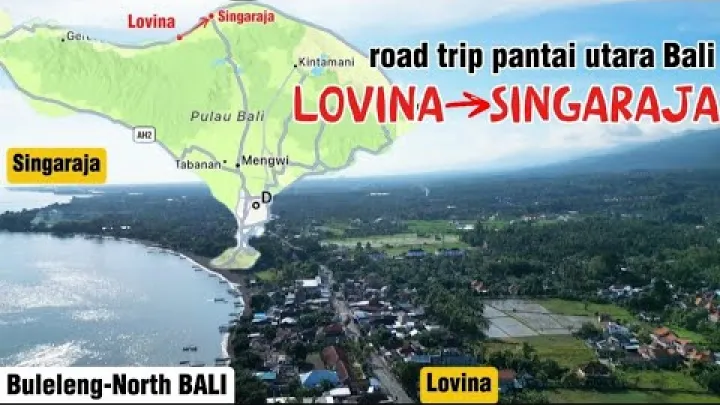
If you are staying in Singaraja city, do not assume that a Lovina ticket includes drop-off in Singaraja. Ask for the exact stop in writing if possible. Useful questions include: Is the drop-off in Lovina, central Singaraja, Banyuasri Terminal, Penarukan Terminal, Sukasada Terminal, or at my hotel?
The final Lovina-to-Singaraja leg is short compared with the cross-island journey, but it still matters if you arrive after dark, carry large bags, or do not have mobile data. Save your accommodation address and phone number offline before you leave South Bali.
There Is No Train or Commercial Airport in Singaraja
Singaraja does not have a commercial airport for regular passenger arrivals, and Bali does not have an operating passenger rail network for this route. All practical routes to Singaraja eventually depend on road transport.
This is true even if your first leg is an international flight to Bali, a domestic flight to another airport, a ferry from Java, a ferry from Lombok, or a long-distance bus. Travelers coming by rail through Java still need to reach the ferry at Ketapang, cross to Gilimanuk, and continue by road on the Bali side.
Knowing this early helps avoid wasted time searching for a nonexistent train to Singaraja or a local airport transfer. Focus instead on choosing the best road leg for your arrival point.
From Ngurah Rai International Airport to Singaraja
Ngurah Rai International Airport (DPS) is the main gateway for most visitors. From there, the practical choices are private transfer, taxi, ride-hailing where available, or a multi-step bus route through South Bali or Central Bali.

Private Transfers and Airport Taxis
For airport pickups, check the current meeting procedure from your driver or accommodation. Airport pickup zones can change, and some drivers may ask you to meet at a specific door, parking area, or nearby landmark.
Ride-Hailing Apps and Metered Taxis
Ride-hailing apps and metered taxis can be useful tools, but they are not always the simplest answer for a long trip to North Bali. Availability can vary by pickup zone, time of day, driver willingness, and local transport rules.
A driver may accept a short city trip but decline a long journey to Singaraja, especially late in the day. App estimates can also change with demand, route, and waiting time. If you use an app, compare the estimate with a private transfer quote and a hotel-arranged driver quote before deciding.
For metered taxis, make sure the driver understands that the destination is Singaraja in Buleleng Regency, not a local address in Denpasar. For fixed-price taxis, agree the full amount before entering the vehicle.
Public or Tourist Bus Connections from the Airport Area
Available route evidence does not show a simple direct public airport bus from Ngurah Rai International Airport to Singaraja. Route aggregators may show combinations involving walking or local movement to a South Bali departure point, then a bus toward Ubud, Lovina, or North Bali. For example, Rome2rio presents airport-to-Singaraja travel as a combination rather than a single direct airport bus.
The usual pattern is to reach a departure area such as Kuta, Sanur, or Ubud, take a tourist or intercity service toward Lovina or North Bali, and then complete the final leg to Singaraja. This can work for flexible travelers with daytime arrivals and light luggage.
Do not treat an online route combination as a guaranteed same-day schedule. Waiting time between legs can make the total journey much longer than the road travel time. If you land late, have checked luggage, or need to arrive the same evening, a pre-booked driver is usually safer and simpler.
From Denpasar and South Bali to Singaraja
If you are already staying in South Bali, you have more options than someone arriving at the airport at night. Still, the best departure point depends on where you are staying and whether you want a direct transfer or a cheaper shared route.
Routes from Kuta, Seminyak, Canggu, and Sanur
From Kuta, Seminyak, Canggu, and Sanur, the main choices are private driver, taxi, or tourist bus toward Lovina. Kuta and Sanur are more common organized transport departure areas than some beach neighborhoods, so you may need to travel to a pickup point before the northbound journey begins.
If you are in Canggu or Seminyak, factor in local traffic when comparing a bus with a private car. A cheaper bus may look attractive, but the time and cost of reaching the actual departure point can reduce the saving.
For travelers with a relaxed schedule, a tourist bus can be a reasonable middle option. For travelers moving with large bags, children, or work equipment, a direct car from your accommodation to Singaraja is usually easier.
Routes from Ubud and Central Bali
Ubud can be a convenient staging point for a northbound route to Lovina or Singaraja. It is already closer to the central highlands than the southern beach areas, and many drivers are familiar with routes toward North Bali.
A private driver is the simplest option if you want to include stops in highland or waterfall areas on the way. Agree the stops, waiting time, and final arrival target before departure. A transfer with sightseeing stops should not be priced or timed like a direct transfer.
Bus combinations via Ubud may also work, but they require more flexibility. Confirm the current departure point and whether the service ends in Lovina, central Singaraja, or another location.
Why the Mountain Road Can Take Longer Than the Map Suggests
Many routes between South Bali and Singaraja cross the central highlands around the Bedugul corridor. These roads can be scenic, but they are not the same as a flat urban express route.

Common time factors include traffic leaving the south, slower driving on bends and gradients, rain, poor visibility, ceremonies, local congestion, and short stops requested by passengers. Conditions vary, so a map estimate should be treated as a starting point rather than a promise.
Build buffer time into your day, especially if you have an onward ferry, long-distance bus, check-in deadline, or evening appointment in Singaraja. If you are prone to motion sickness, prepare before the mountain section.
Bus Travel and Terminals in Singaraja
Singaraja has more than one transport node. This is important because a ticket or driver may say “Singaraja” without specifying the exact drop-off point.
Banyuasri Terminal for Long-Distance and Gilimanuk Routes
Banyuasri Terminal is an important west-side Singaraja bus node for regional and longer-distance movement, including routes that connect toward Gilimanuk and onward Java-linked travel. If you are arriving by bus, ask whether the bus stops at Banyuasri Terminal, another terminal, an operator office, or a roadside point.
Online platforms can help you see possible intercity links to and from Singaraja. For example, redBus lists Singaraja bus ticket options and long-distance route context, including Java-side connections. Use these listings as planning aids, not as the final authority on same-day operating details.
Before booking a long-distance bus, check the operator name, departure point, arrival point, baggage policy, and whether the route involves a ferry crossing. If you are being met in Singaraja, send the exact drop-off name to the person collecting you.
Penarukan and Sukasada Terminals for Regional Routes
Singaraja's local transport system can be fragmented. Regional routes may use Penarukan or Sukasada rather than Banyuasri, depending on direction and service type.
Local transport documents from Dishub Buleleng identify Penarukan-related public passenger vehicle flows and route anchors such as Penarukan, Banyuasri, Sukasada, and surrounding village directions. This supports the practical point that Singaraja transport is not limited to one simple “bus station.”
If you plan to use local buses, angkutan, or village transport, confirm the correct terminal before departure. Ask your accommodation, the driver, or a local agent which terminal serves your direction. Do not rely only on the word “Singaraja” when a route may start or end at a different terminal.
Tourist Buses to Lovina and the Final Leg to Singaraja
Tourist buses are often easier for foreign visitors than local buses because they use clearer booking channels and familiar pickup areas. However, many terminate in Lovina rather than Singaraja city.
Before buying a ticket, confirm the exact drop-off, departure time, luggage rules, and whether onward transport to Singaraja is included. If the operator says “Lovina/Singaraja,” ask what that means in practice.
Tourist buses are a middle option. They are easier than navigating local terminals, but they are slower and less flexible than a private car. They work best when you travel in daylight, have a flexible arrival plan, and can arrange the final local transfer in advance.
Ferry and Overland Routes from Java, Lombok, and East Bali
Ferry routes are useful for travelers already moving overland through Indonesia. They are less direct for most international visitors than flying into Bali, but they can make sense if you are coming from East Java, Lombok, or East Bali.
From Java via Ketapang and Gilimanuk
The common overland pattern from Java is to reach Ketapang near Banyuwangi, cross by ferry to Gilimanuk in western Bali, and then continue by road to Singaraja. This route suits travelers coming from Banyuwangi, East Java, or Blimbingsari Airport (BWX).
General ferry information from Lombok Network describes the Ketapang to Gilimanuk crossing as a regular public ferry link between Java and Bali. Current frequency, boarding time, weather delays, and port procedures can change, so check conditions close to travel time.
The Gilimanuk-to-Singaraja road leg still needs planning. If you arrive late, carry significant luggage, or do not want to negotiate at the port, arrange onward transport in advance or confirm bus options before crossing.
From Lombok via Lembar and Padang Bai
Travelers coming from Lombok by public ferry commonly use the Lembar to Padang Bai route. After arriving at Padang Bai in East Bali, you still need to travel by road to Singaraja.
Padang Bai is not close to Singaraja in practical transport terms. The route may be feasible in one day, but only if ferry timing, arrival conditions, and onward road transport line up well. Weather, port queues, and late arrivals can affect the plan.
Before committing to a same-day Lombok-to-Singaraja itinerary, check ferry departure times, expected arrival time, and the availability of a driver or bus from East Bali. If you arrive after dark, a pre-arranged road transfer is usually more comfortable.
From East Bali and Padang Bai Along the Coast
If you are already in Padang Bai, Candidasa, Amed, or nearby East Bali areas, Singaraja is reachable by a coastal or northeast Bali road route. This can be a good option for travelers following a multi-island or slow-travel itinerary.
A private car is usually simpler than piecing together local buses or bemos with luggage. Regional public transport may exist on some segments, but it is less visible online and may require local confirmation at terminals, markets, or operator offices.
When planning from East Bali, ask whether the route goes directly to Singaraja or requires a change near Amlapura, Tejakula, Penarukan, or another local point. The exact answer may depend on the day, vehicle, and operator.
How to Choose the Right Transport
The right option is not always the cheapest or fastest on paper. For Singaraja, the best choice is the one that matches your arrival time, tolerance for uncertainty, luggage, and need for a direct drop-off.
Compare Time, Cost, Comfort, and Booking Difficulty
Use the table below as a practical comparison. Times and costs are deliberately described in broad terms because fares, schedules, and travel conditions can change.
| Transport option | Typical time pattern | Cost level | Best for | Main drawback |
|---|---|---|---|---|
| Pre-booked private transfer | Direct road trip; depends on traffic and mountain conditions | Higher | Families, late arrivals, luggage, first-time visitors | Costs more than shared transport |
| Airport taxi or fixed-price taxi | Direct if a driver accepts the long trip | Medium to higher | Travelers who want same-day convenience | Price must be clear before departure |
| Ride-hailing app where available | Direct if accepted by a driver | Variable | Comparing quotes and checking availability | Long trips may be declined |
| Tourist bus to Lovina | Slower than a private car; may need final transfer | Medium to lower | Flexible travelers with light luggage | May not stop in Singaraja city |
| Local or intercity bus | Often longest due to transfers and waiting | Lower | Budget travelers with time | Schedules and terminals can be unclear |
| Self-drive car or scooter | Flexible but demanding | Variable | Experienced, licensed drivers | Traffic, mountain roads, insurance, fatigue |
| Ferry plus road route | Depends on port timing and onward transport | Variable | Travelers from Java, Lombok, or East Bali | Multiple connections can fail if delayed |
The cheapest route is not always the best route. A low fare can become poor value if it creates missed connections, late-night negotiation, extra taxi costs, or multiple terminal changes with luggage.
Plan for Touts, Price Negotiation, and Pickup Restrictions
At busy gateways such as airports, ports, and bus terminals, you may be approached by people offering transport. Some offers may be legitimate, but rushed decisions can lead to unclear prices or destinations.
Before entering a vehicle, agree on the total fare, destination, currency, luggage, waiting time, and any stops. If you are going to Singaraja, say the full destination clearly: Singaraja, Buleleng, North Bali. If possible, show the address on your phone.
App pickup rules and local transport restrictions can change by place. Follow current signs and official pickup instructions, and do not assume that an app car can stop anywhere you choose.
Avoid Risky Self-Drive Decisions
Self-driving gives flexibility, but it may not be the safest or easiest choice for visitors unfamiliar with Bali traffic, local road behavior, and mountain routes. A long first-day drive from the airport to Singaraja can be tiring after an international flight.
If you rent a car or scooter, make sure you have the correct license, understand your insurance coverage, and use proper safety equipment. Scooter riders and passengers should wear helmets. Avoid riding or driving at night if you are tired, inexperienced, or carrying heavy luggage.
Scooters can be useful for local movement around North Bali once you are settled. They are less suitable for a first-time cross-island arrival with suitcases, poor weather, or limited experience on Indonesian roads.
Final Arrival Checklist for Singaraja
Before you travel, reduce uncertainty by confirming the details that matter most. A few messages before departure can prevent confusion at the airport, port, bus stop, or terminal.
Confirm the Exact Drop-Off Point
Confirm whether you are being dropped at central Singaraja, Lovina, Banyuasri Terminal, Penarukan Terminal, Sukasada Terminal, a hotel, a guesthouse, or an operator office. These are not interchangeable for a traveler arriving with luggage.
The drop-off point matters because it affects your final local transfer. A bus that ends at Lovina may be convenient for a beach hotel but not for a city address. A terminal stop may require a taxi or local pickup.
Save your accommodation address, map location, phone number, and booking confirmation offline. If your Indonesian pronunciation is limited, showing the written address is often clearer than repeating the name verbally.
What to Verify Before You Travel
Verify the current bus departure time, ferry status, driver pickup location, quoted fare, travel time buffer, and late-night transport availability. If your route has several legs, confirm each leg separately.
Useful confirmation points include your accommodation, the transport operator, a local travel agent, terminal staff, or official port information where available. Online route data can be helpful for planning, but it may lag behind local operating conditions.
If a connection is essential, such as a ferry arrival followed by a long road trip, avoid planning with no buffer. Leave room for waiting time, weather, traffic, and changes in pickup location.
Final Recommendation
The best default choice for most visitors is to fly into Ngurah Rai International Airport and use a pre-booked road transfer to Singaraja if convenience matters. This is the clearest option for late arrivals, families, heavy luggage, and first-time visitors.
The best budget choice is to use bus routes through South Bali, Denpasar, Ubud, or Lovina only if you have time and flexibility. Confirm the departure point, final stop, and onward local transfer before you buy the ticket.
The best overland choice depends on your direction of travel. Use Gilimanuk for Java routes via Ketapang and Banyuwangi, and use Padang Bai for Lombok or East Bali routes, then arrange the road leg to Singaraja carefully. Singaraja is very reachable, but it rewards travelers who plan the final transport details before arrival.
Select area
Create a post
Posting is free and no registration is required.